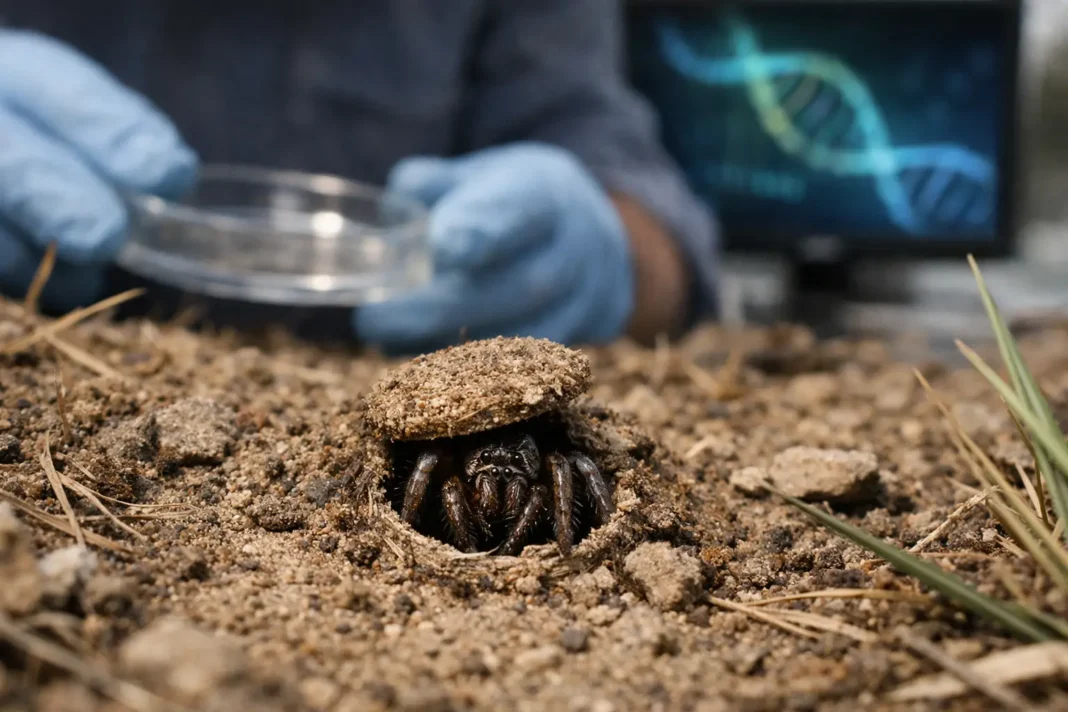

A spider small enough to fit comfortably on a coin has produced an outsized finding for genetics. A California trapdoor spider named after Stephen Colbert has been found to carry a genome roughly 50% larger than that of a human, despite its modest body size. The spider, about the size of a quarter, contains 4.6 billion DNA base pairs and 52 chromosomes, giving researchers an unusually large genetic blueprint to examine within a compact arachnid.
The discovery adds a striking example to a core principle of genetics: genome size does not scale neatly with body size or outward complexity. Humans have long served as a familiar reference point in public discussions of DNA, but the Colbert-named spider shows how evolutionary history can expand or reshape an organism’s genetic material in ways that are not visible from anatomy alone. The finding also highlights how much remains to be learned about spiders, a group with extraordinary ecological diversity and specialized traits such as silk production, venom systems and underground hunting strategies.
Trapdoor spiders are known for a lifestyle built around concealed burrows rather than roaming webs. In California, these spiders belong to lineages whose evolutionary paths can be shaped by geography, habitat and limited movement. A genome of 4.6 billion base pairs gives scientists a broad archive for investigating how such lineages diverged and adapted over time. The presence of 52 chromosomes is also significant because chromosome number and structure can offer clues about how genomes are reorganized across generations.
The case is a reminder that genome sequencing is not only a tool for studying humans or model organisms. By extending sequencing work to lesser-known species, researchers can compare patterns across the tree of life and better understand how evolution operates at the molecular level. The National Human Genome Research Institute defines a genome as the complete set of DNA instructions in an organism, and this spider’s instruction set is notably expansive for an animal so small.
For the public, the celebrity-derived name gives the discovery an accessible entry point. For science, the importance lies in the data: billions of DNA base pairs that may help clarify the evolutionary history of spiders and the genomic changes that accompany their diversification. The finding places a tiny trapdoor spider in a much larger conversation about biodiversity, evolution and the hidden scale of genetic information.