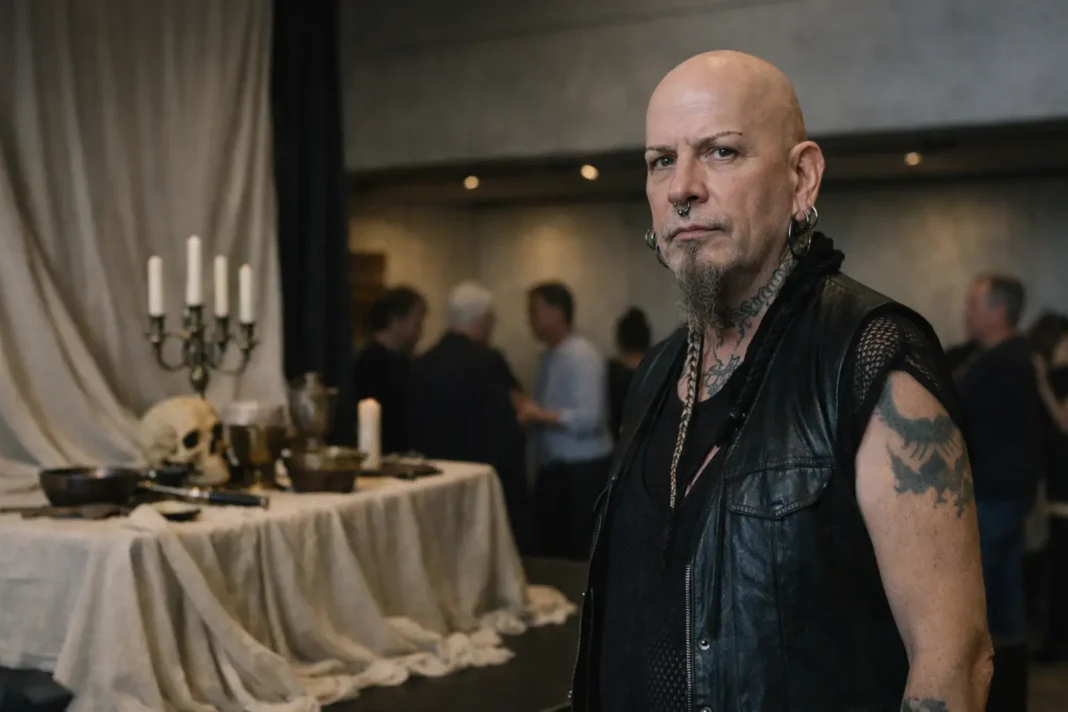

Ron Athey’s art has long placed the human body at the centre of confrontation. The American performance artist, now arriving in the United Kingdom, has built a career through works involving piercing, suspension, blood, stretching and ritualised endurance. His name is closely associated with the most demanding edges of performance art, where the body is not simply represented but used as an instrument, archive and site of risk.
In a recent interview with The Guardian, Ron Athey described his work as an attempt to create something close to a miracle, while also acknowledging his knowledge of bodily extremity. The contrast is central to his public image: soft-spoken away from the stage, yet responsible for performances that have unsettled audiences, critics and institutions. His practice has even drawn condemnation in the United States Senate, an indication of how far his art has travelled beyond galleries and experimental venues.
Among the works most often cited is Self-Obliteration, in which Athey appears naked with a long blonde wig fixed to his head by blunt needles, then brushes it violently before tearing it away, causing blood to run across his face and body. In Solar Anus, hooks inserted into his face pull the skin around his cheeks and eyes into a mask-like tension. In St Sebastian, he is suspended by chains while assistants pierce his flesh with arrows and needles. These actions are not presented as decorative shock; they belong to a language of endurance, iconography and ritual.
Athey has also linked his artistic vocabulary to a childhood he has described as shaped by a “cult”, making religious imagery and bodily suffering recurring points of reference in his work. That background helps frame the intensity of his performances without reducing them to autobiography. They draw on martyrdom, punishment, transformation and spectacle, placing them inside the history of contemporary art rather than outside it as mere provocation.
His arrival in the UK renews a long-running debate about what live art can ask of performers and audiences. Athey’s work challenges the idea that nudity alone carries transgressive force; instead, it turns exposure into a more complex question of control, consent and meaning. For institutions presenting such work, the challenge is not only practical but cultural: how to make space for practices that remain difficult, disturbing and significant without simplifying them into controversy.