

Medical device companies are constantly integrating new AI models into their products, and doing so often requires the help of development partners like hospitals and health systems.
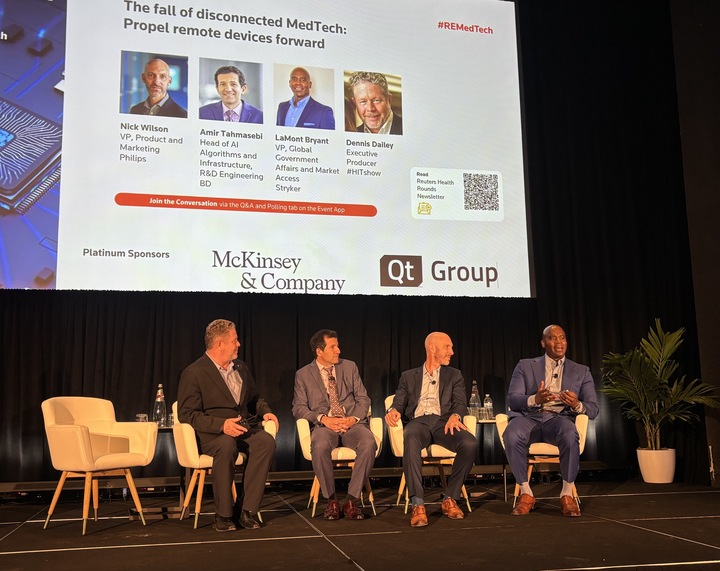
During Reuters’ MedTech conference in Boston, a panel of three medical device executives discussed how they’re working with these clinical partners to develop and refine their technologies. Drawing from these collaborations, they also highlighted three common misconceptions they believe hospital leaders often have about AI.
AI is going to take over the process
Some health system leaders seem to be wary that algorithms could become a more important part of the care delivery process than human judgment and expertise, noted LaMont Bryant, vice president of global government affairs and market access at Stryker.
But he emphasized that this isn’t the case.
“AI is not here to take over the process, but it’s another tool that can help allow [clinicians] to make a decision based on better data and better information,” Bryant stated.
Medical device companies understand that physicians and nurses know what’s best for their patients, he noted, saying that Stryker sells tools to enhance their clinical decision-making — never replace it. These tools promise to help clinicians practice at the top of their license, as well as experience less burnout tied to administrative tasks and manual processes.
Tech companies just want your data
It’s common for hospital leaders to assume that tech companies and AI startups simply want to buy their data, said Nick Wilson, vice president of product and marketing at Philips.
“Every C-suite discussion I go into inevitably has some form of, ‘We have a huge database. What can we do — how can we sell it to you?’ basically, which I think can be useful in very certain circumstances. But monetizing data is not good enough unless we’re able to pull it forward to insights and then pull that forward to actual change and action — which is where the real hard work comes from, not sourcing the raw data,” he explained.
Tech developers typically don’t want to just buy hospital data and then work with it by themselves — they’re seeking partners that can help them figure out how to translate that data into useful insights that can lead to better clinical decisions and outcomes, Wilson declared.
Clinical workflows are being automated fully
AI is not fully automating clinical tasks — and most healthcare technology developers have no intention of building tools to do that anytime soon, pointed out Amir Tahmasebi, head of AI algorithms and infrastructure at Becton Dickinson.
“AI is to augment, not automate everything,” he remarked.
AI can also make care safer, Tahmasebi added. For instance, digital twins — virtual replicas of patients — let care teams track a device’s performance and detect patterns that signal trouble. This allows for proactive interventions that prevent patients from having to visit the emergency room, he explained.
In short, medical device makers want the message to be clear that AI isn’t here to replace doctors or nurses — it’s here to help them make better decisions, prevent adverse events and improve patient care.



