
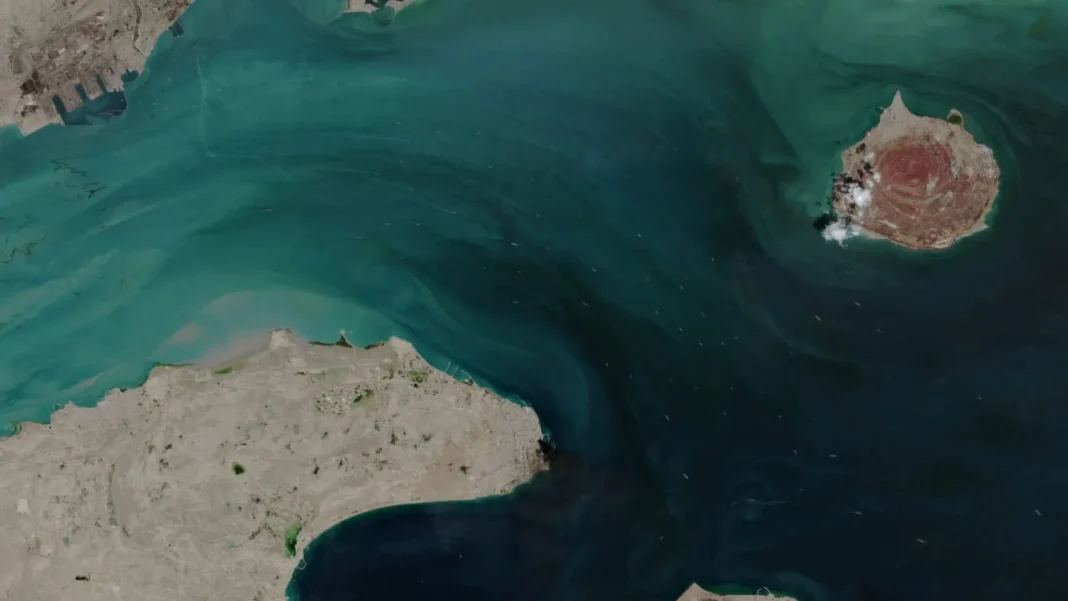

Iran’s semi official Tasnim News Agency, linked to its Islamic Revolutionary Guard Corps warned Wednesday about the vulnerability of undersea internet cables in the Strait of Hormuz. The thinly veiled warning, though not official, targeted a critical though often overlooked part of global infrastructure: the fibre‑optic lines that carry much of the world’s data.
“The concentration of many internet cables in a single narrow passage has made the Strait of Hormuz a vulnerable point for the region’s digital economy – a place where cables, after passing through the Strait, connect to coastal landing stations and major regional data centers,” the report by Tasnim read. It added that “simultaneous damage to several major cables – whether through accidents or deliberate action – could trigger severe outages across the Persian Gulf.”
The report was accompanied by a graphic showing a detailed map of undersea internet cables running through the Strait of Hormuz.
It noted that multiple systems, including at least seven major communication cables, serve the Gulf States and that more than 97 percent of global internet traffic runs through the fiber-optics networks on the seabed of the narrow waterway. Tasnim specifically pointed out the Falcon, AAE-1, TGN-Gulf and SEA-ME-WE cables that connect a large port of the region’s data centers in the Middle East, Europe, and Asia.
Tensions have soared over the Strait of Hormuz – a vital oil transit route; and the IRGC’s statements have raised concerns that digital infrastructure could become a significant front in the simmering conflict.
Heavily reliant on cables
The report also discussed the cloud and data-center infrastructure in countries such as the United Arab Emirates and Bahrain. During the war, Iranian drones struck data centers in Bahrain and the UAE and warned of other retaliation against American tech giants across the region calling them “enemy technology infrastructure.”
A report by Iran International suggested that the Tasnim report hinted that “undersea cables and regional data hubs now sit alongside ports, shipping lanes, and energy facilities in the conflict’s widening map of pressure points.”
The Gulf states are heavily reliant on the cables connecting them to global networks and supporting financial systems, cloud computing, and artificial intelligence infrastructure across the region. The Gulf has been heavily investing in AI and the cables under the Hormuz allow their data centers to communicate as far away as Europe, Asia, and Africa.
Subsea cables are the fastest way to transmit internet data. Even limited damage to a few major cables could slow or disrupt internet connectivity across the Middle East, South Asia, and even parts of Europe. Past incidents show that repairs can take weeks or months, especially in contested waters where access is restricted.
The warnings come amid heightened regional tensions and follow earlier disruptions in the Red Sea, where cable cuts caused significant outages. Last year, a ship was struck by the Houthis and its anchor dragged across the seabed, damaging a cable.
According to a Bloomberg report, work on a massive cable for Meta was disrupted by Operation Roaring Lion/Epic Fury – six months after Meta acknowledged that another section of 2Africa, a planned 45,000-kilometer (28,000-mile) underwater cable system, was delayed following attacks by the Houthis in Yemen.
The cable, one of the world’s largest subsea cable projects, was part of an effort to expand internet services by looping around Africa.
Protecting the cables
According to CBS News, while Iran’s conventional navy was pretty much destroyed during the war, roughly 60 percent of the IRGC’s naval arm that was built for asymmetric warfare is still operational, including fast-attack speed boats. Those small vessels could take part in a sabotage operation targeting the cables.
While no attack has yet taken place, Iran’s warnings have also raised questions about broader implications for data protection and communications. If damaged, the process of repairing underwater cables could take months and cost millions of dollars. Traffic would also have to be rerouted through alternative pathways.
The Stimson Center discussed in a recent report how Saudi Arabia, the UAE, and Qatar have come together for an international consortium that would build cables not only at sea but on land – diversifying cable routes and reducing reliance on chokepoints, such as Hormuz. But, it added, building fibre-optic cables on land involves a myriad of legal and regulatory requirements because of the data moving across multiple borders.
It also brings into question the issue of national security access requirements and various privacy and digital sovereignty laws, as well as differing security standards.
Source:
www.jpost.com




