
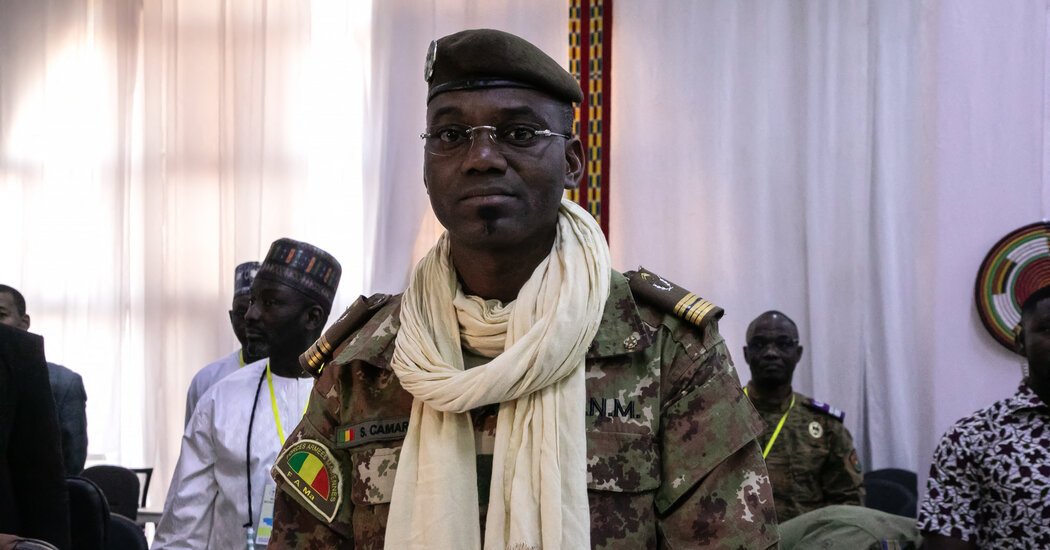

Mali’s defense minister, Gen. Sadio Camara, was among those killed in coordinated attacks by Al Qaeda-linked militants across the country over the weekend, a government spokesman said on state television late on Sunday, in a big blow for the Malian Army that shows the growing strength of the terrorist group in the country.
The spokesman, Issa Ousmane Coulibaly, said a vehicle “laden with explosives and driven by a suicide attacker” had targeted General Camara’s residence, in the country’s military headquarters just outside the capital, Bamako. General Camara, he added, had engaged in a gunfight with the attackers before being fatally wounded.
In response to his death, Mali declared a two-day period of national mourning.
General Camara was a key figure in the 2020 coup that toppled the government of then-President Ibrahim Boubacar Keita, amid discontent over the government’s failure to address corruption and growing violence of Islamist insurgents. He was Mali’s main point of contact with Russia, which provided security services for the junta first through the Wagner paramilitary group and then Africa Corps.
Mali has seen a major escalation of violence in recent years involving jihadist groups, the most powerful of which has lately become JNIM, the group that claimed credit for the weekend attacks alongside an ethnic minority separatist group.
JNIM, or Jama’at Nusrat al-Islam wal-Muslimin, meaning “Group for the Support of Islam and Muslims” was established in 2017. Affiliated with al-Qaeda, it has sought to deepen its influence in West African countries like Mali and Burkina Faso, where it has instituted Islamic law in the areas under its control.
Despite its beginnings as a rural insurgency, JNIM has in recent years increasingly directed its attacks on urban centers, a sign of its growing political ambitions.
In the latest, highly-coordinated attacks, which took place simultaneously in multiple cities, the group used car bombs and armed drones.
In a statement issued during the offensive, JNIM said it had captured Kidal and the central city of Mopti, as well as military bases in nearby Sevaré and in Gao. It named the Azawad Liberation Front, an armed separatist movement of the Tuareg ethnic minority, as its partner in the attacks.
Russian mercenaries who had been holed up in a camp in the northern city of Kidal announced their departure on Sunday, together with Malian troops. Several Russian bloggers connected to the mercenaries published videos over the weekend showing trucks carrying Africa Corps equipment including heavy artillery leaving Kidal, with fighters cheering nearby.
French news outlets reported that Africa Corps forces had reached a deal with the Azawad Liberation Front allowing them to leave Kidal. In its statement, JNIM offered not to target the Russians and to “build a balanced and effective future relationship” with them if they withdrew from the Mali conflict.
Russia’s Kremlin-affiliated Wagner mercenary group was once a formidable force in six nations across Africa with promises to quell Islamist rebellions in return for access to some of the continent’s vast natural resources, but it significantly scaled down its operation after the Russian invasion of Ukraine in 2022 and was formally disbanded in 2023.
The core of Wagner’s Africa personnel stayed on, but the Russian force has at times struggled, including suffering a major defeat in 2024 in northern Mali, in which The New York Times confirmed the deaths of at least 46 Russian mercenaries and 24 Malian soldiers, and there appear to have been few large-scale economic gains for Russia.
In an interview with the state broadcaster ORTM on Sunday, Maj. Gen. Oumar Diarra, the Malian military’s chief of general staff, said that more than 200 terrorists had been “neutralized” during the latest counteroffensives against the insurgents, who he said were trying to disguise themselves by wearing military uniforms.
“Search and sweep operations are continuing in practically all areas and we are searching for them, pursuing them, and destroying them wherever they are found,” he said.
Ruth Maclean and Nataliya Vasilyeva contributed reporting.
Source:
www.nytimes.com




