
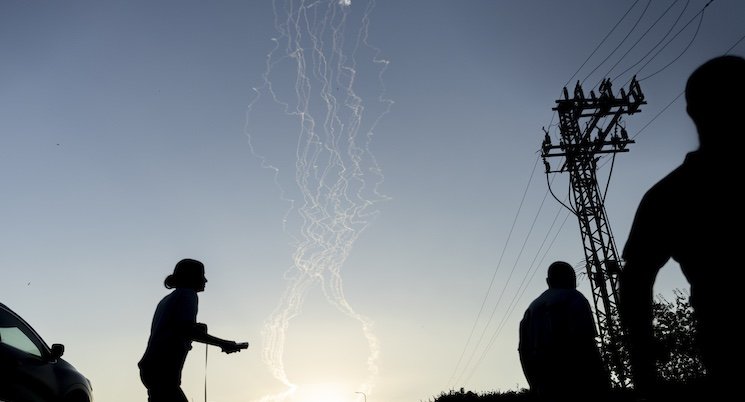

The debate over the Iron Dome is a near-perfect encapsulation of the weakness of the Israel discourse in America. Opponents of the purely defensive program try to work their way back from their partisan conclusion to a coherent rationalization for it. They then demand we dignify their ignorant declarations with a response.
Here’s the latest version of this routine. Democrats looking for an excuse to vote against Iron Dome have reverse engineered the following talking point: Iron Dome, they say, isn’t actually defensive, because the fact that it protects Israelis from rockets makes Israel more likely to attack its enemies.
This seems to be the reasoning that a fair number of Democrats have settled on. As Semafor’s Dave Weigel noted, this argument allows them to claim to support only “purely defensive” weapons while still voting against Iron Dome.
Anyone who has participated in the social media discourse on Iron Dome has had this theory tossed at them. Usually it’s “Nathan Thrall says so!” Thrall’s argument is as follows: “Iron Dome facilitates greater Israeli offensive measures, because it lowers the perceived cost to Israel of escalating or extending or initiating attacks.”
Now, making this particular argument requires one to be unfamiliar with basic political-military decisions—why an army would procure certain weapons systems instead of others, what its broader strategic and tactical aims are, its perceived threats, etc. A fair amount of this is usually in public documents.
But in the case of the Iron Dome the debate is even more frustrating because we don’t need to theorize. We already have the answer. The data tell us what common sense would suggest: Iron Dome makes Israel less likely to escalate military conflicts because it can absorb a significant level of rocket attacks from Gaza with minimal casualties.
Israel left Gaza entirely in Palestinian hands in 2005. Hamas won a civil war against Fatah and, upon taking full control of the strip, rained down rockets on Israel. In 2008, Palestinians in Gaza fired over 2,000 rockets at Israel, far more than double the number of the prior year.
Israel eventually responded with Operation Cast Lead, which combined air and ground campaigns, to restore order.
The key fact here: Iron Dome didn’t yet exist. It was field tested in 2009 and deployed in 2011, then periodically updated and improved from there. Ironically, the idea for Iron Dome was divisive in some quarters of the IDF precisely because it was a strictly defensive weapon.
In any event, without Iron Dome, Israel’s air campaign was deemed insufficient to stop the threat, and a ground incursion commenced.
That timeline is important because the level of rockets from Gaza dropped precipitously after Cast Lead—until 2012. That year, Hamas tried to draw Israel back into an escalation. Israel, however, was content to keep to airstrikes to suppress the rockets, because Iron Dome was up and running and intercepting most of the rockets, which bought time for cease-fire negotiations.
Iron Dome changed the equation for Hamas as well. While it made Israel more patient, Hamas responded by becoming more violent and expanding its range of warfare against Israel to include attack tunnels and primitive naval raids. In other words, finding ways to initiate a ground war on its own by invading Israel.
This discovery, along with Hamas’s brutal murder of three Israeli teenagers in the West Bank and the brewing threat of a two-front war, led to Israel’s next ground incursion into Gaza in 2014. That counteroffensive began with an air campaign as usual, but because Hamas was using Palestinian civilians as human shields, Israel found it more difficult to take out a sufficient number of targets. Hamas forces then infiltrated Israel through a cross-border tunnel, and Israel responded with a ground incursion of its own.
In 2014, as in 2012, rockets were not enough to push Israel into full-scale war. The Iron Dome was saving lives on both sides of the conflict and preventing escalation. Hamas thus found other ways to provoke a ground war.
That model continued to hold. After 2014, the next time rocket fire reached similar levels was 2021. Yet Israel only threatened a ground incursion as a tactical trick; the IDF stuck to airstrikes for the entire campaign.
The next conflict began on October 7, 2023. To state the obvious, it was not about rockets.
So, to be clear: We do not wonder whether Iron Dome saves Palestinian lives just as it saves Israeli lives. It does. We do not wonder whether Iron Dome makes Israel more or less willing to escalate the conflict; it makes Israel less willing to escalate.
There is no debate, in the traditional sense. There is the reality, and then there are the Israel-haters yelling at reality.
This is, again, one of the more frustrating aspects of the Israel discourse. We have established facts, and when low-information partisans try to deny those facts, they get insulted if we don’t give them our full attention. And so we must explain, for the thousandth time, why they are wrong. In the process, it can appear to outsiders that the effects of, say, the Iron Dome on the conflict are up for legitimate debate. They aren’t.
Source:
www.commentary.org




