

Depending on which news sources you consume, President Trump is either giving Iran all the time in the world to respond to U.S. negotiators because he’s in no hurry to resume strikes, or he’s giving them a limited window of a few days before he’s out of patience.
Either way, the president seems to be in no particular rush.
Perhaps that’s a feint by the president designed to retain the element of surprise. Or, and this might be wishful thinking, it’s because he isn’t thinking about Iran as much as he’s thinking about China at the moment.
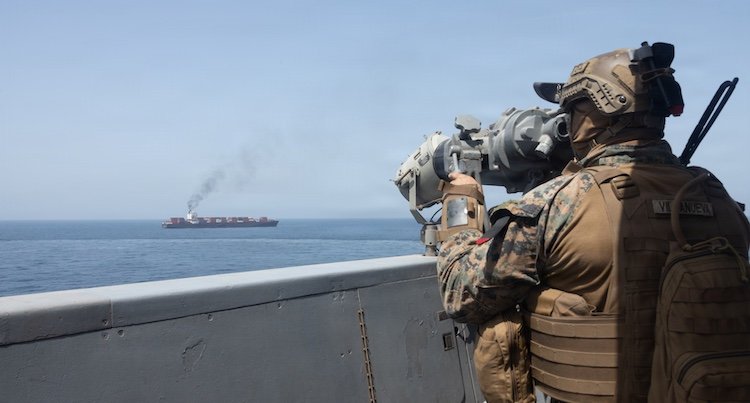
On Tuesday, the U.S. interdicted the “stateless” Tifani, a ship with a reputation for helping Iran evade sanctions. A comment by a shipping expert to the Wall Street Journal stands out: “It’s like you’ve been driving the same road every day and you see one person in the HOV lane over and over and over, and finally you see one that gets pulled over,” said Stanford University’s Raymond Powell.
The Tifani, the Journal reports, is one of over 500 ships in a so-called shadow fleet critical to China’s ability to import Iranian oil—an economic lifeline for Tehran but nearly as important to Beijing, since the energy-guzzling Chinese economy gets Iranian oil at a discount.
The important point about the Tifani, however, is that it was in the Indian Ocean, far from the Hormuz choke point and the area to which the U.S. has applied its blockade. “If the U.S. continues to target this floating supply,” the Journal says, “it could cut into an important source of income for the Iranian regime. Without that financial cushion, Tehran would find it much harder to sustain the war and drag out talks to end it.”
That would explain why Trump might think time is on his side. Iran believes it can wait out the U.S., leveraging the relentless Western media campaign against the war and the low public approval of the president. If all the regime in Tehran needs to do is survive, it has an advantage over the U.S., which obviously wants more out of this than to merely survive. Iran thinks lowering its expectations will raise the stakes on Trump, and it very well might. If Trump is committed to targeting the shadow fleet, however, the stakes are raised for Iran as well.
And for China. The country is Iran’s top oil customer, so a U.S. blockade of Hormuz also hurts Beijing. But there’s a weakness to this strategy: Iran already has 140 million barrels of oil sitting on ships outside the blockaded zone. As long as all that oil can be delivered, Iran and China have less urgency to end the Hormuz blockade.
And if China wants Iran to end the war, it will. China is the most important source of cash and missile-supply replenishments for Iran. Putting pressure on China by definition puts pressure on Iran.
There’s another reason going after the shadow fleet could prove effective. A Hormuz-only blockade is only a temporary threat to China. Breaking up the shadow fleet would be a much more permanent wound to the CCP and to Iran. The U.S. is telling China that if global shipping continues to suffer, Beijing will not avoid that suffering. Instead, it’ll face the dismantling of its carefully crafted system of sanctions evasion, the replacing of which would be time consuming and very expensive.
Is this the Trump administration’s actual strategy? If not, perhaps it should be under consideration. But there’s more evidence that the U.S. is thinking along these lines: The Washington Post reports that the U.S. intercepted and redirected a couple of ships that had left Iranian ports before the blockade began.
One of those was the Dorena: “Satellite imagery obtained by The Washington Post showed the Dorena was in the Arabian Sea on April 18, about 300 miles west of India’s southern coast. It was among a group of vessels that satellite photographs had shown in the port of Chabahar before the blockade took effect.”
The war in Iran may be far less localized than it initially appeared. The physical targets are still Iranian, but the broader target is—or should be—China’s patience.
Source:
www.commentary.org



