HomeOpinionThree Clear Ways AI Is Reshaping Work, Health and Security

Three Clear Ways AI Is Reshaping Work, Health and Security

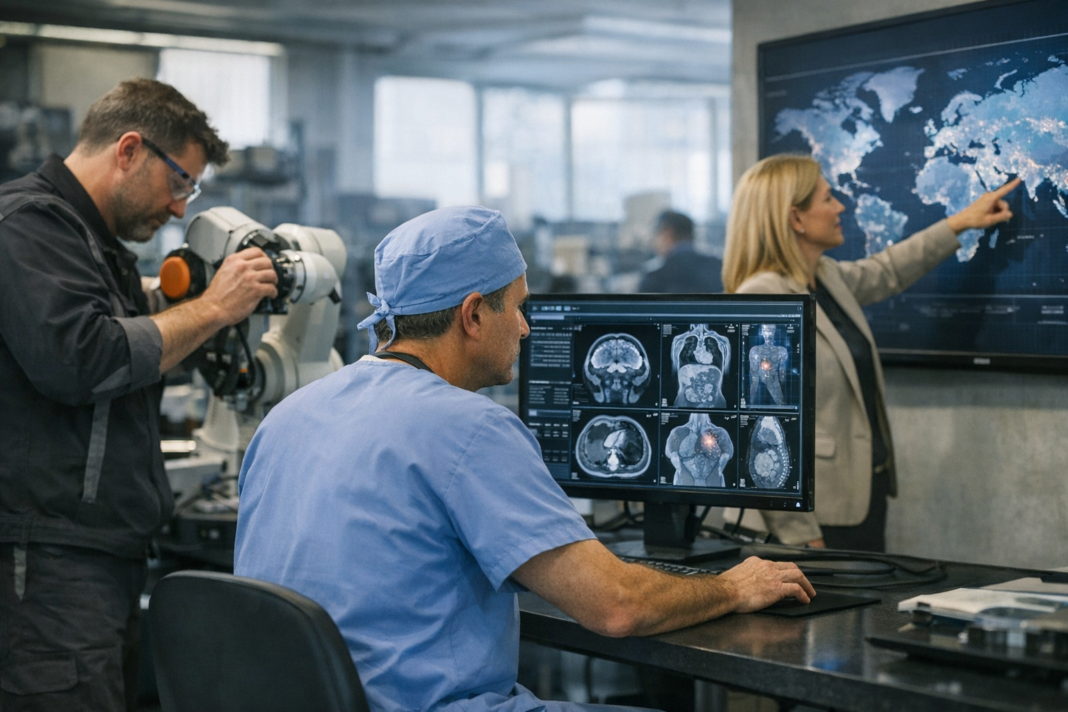
Artificial intelligence is altering core dimensions of contemporary life, with measurable effects on labor markets, medical practice and international security. As technologies such as large-scale machine learning and generative models move from research labs into everyday use, businesses, regulators and public institutions are adapting to concrete challenges and opportunities. The conversation now centers on practical consequences—how jobs are organised, how care is delivered and how states manage risk—rather than abstract promises.

In economic life, automation and cognitive augmentation are changing how work is performed. Sectors that rely on routine data processing have already incorporated algorithmic tools to speed decision-making and reduce repetitive tasks, while other industries deploy AI to optimise supply chains and customer service. These shifts are prompting firms and public authorities to invest in workforce training, labour-market transitions and new forms of social protection. Policy debates focus on balancing productivity gains with measures to support displaced workers and to ensure equitable access to the benefits of innovation.

In medicine and the life sciences, algorithmic systems are increasingly used for image interpretation, clinical decision support and early-stage drug discovery. Clinical sites and research institutions are testing models that assist clinicians and accelerate experimental cycles, while health regulators and organisations consider standards for safety, transparency and data governance. The World Health Organization and national agencies have published guidance and assessments addressing deployment risks and validation needs, reflecting the sector’s emphasis on evidence, oversight and patient protection. See broader coverage at healthcare.

On the geopolitical front, states and alliances are assessing the implications of AI for cybersecurity, information environments and military systems. Security institutions and diplomatic bodies are engaging in technical and normative work to manage dual-use technologies and to discourage destabilising applications. Regulatory initiatives in Europe and engagement by organisations such as the European Commission and NATO illustrate efforts to combine legal frameworks, standards and international dialogue. The resulting landscape will determine how risks are mitigated and how benefits are distributed across societies. For broader context on the technology itself, consult artificial intelligence and geopolitics.


Advertisementspot_imgspot_img

Hot this week

From Factory Floor to Political Faultline: How Luton’s Former Car Workers Are Rewriting Trust

Former car workers in Luton, abandoned by employers and institutions, are shifting their political allegiance, with wider implications for parties and unions.

Rise in Emergency Visits by Young Children Signals Strain on Mental Health Services

Emergency departments report more children, some as young as six, presenting with self-harm, eating disorders and acute emotional distress.

Planet-sized detector: Earth’s field tightens dark matter constraints and flags strange signals

Researchers used Earth's magnetic field and atmosphere as a detector, setting new limits on ultralight axions and finding unexplained dark photon signals.

Why snake embryos coil to the right: new study reveals a mechanical cause

CT scans of 900+ embryos show faster body growth than gut creates a tether that forces right-handed spirals inside snake eggs.

Healey to frame UK recovery while addressing debt and regional disparities

Chancellor John Healey will present plans to spread growth across the UK ahead of his first Budget, while addressing debt concerns.

An Astronaut’s View: The 9/11 Smoke Plume Seen from Space

An astronaut aboard the ISS photographed the smoke over New York on 9/11, producing one of the most enduring orbital images of the attacks.

Emergency department failings behind rising clinical negligence claims, families say

A BBC analysis links cases like Oli's to a wider rise in clinical negligence claims in England and highlights pressure on services and families.

Stage-style hiring: when recruitment turns into a live audition

Employers stage live pitch events for candidates. The approach offers visibility and risks bias, privacy and fairness challenges.

Canada’s $20bn Counter-Tariffs Take Effect, Straining North American Trade Ties

Canada's counter-tariffs on $20bn of U.S. goods take effect, testing the resilience of the world's largest bilateral trading relationship.

Holborn and St Pancras byelection becomes a gauge of Labour’s southern appeal

A Holborn and St Pancras byelection tests Labour momentum and offers the Greens a high-stakes opportunity in a traditionally safe seat.

Newcastle frames Howe departure as a managed transition, says sporting director

Newcastle sporting director Ross Wilson says the club planned for Eddie Howe's exit and that the summer never felt chaotic.

How Colin From Accounts Found a Quiet, Satisfying Finale

The modest rom-com concluded with a measured finale that rewarded character work and restraint, confirming its place in contemporary TV.

Wellness Apps and the New Economics of Women’s Health

Health apps for women raise concerns over privacy, clinical oversight and commercialization, prompting calls for clearer standards and protections.
Advertisementspot_img

Related Articles
