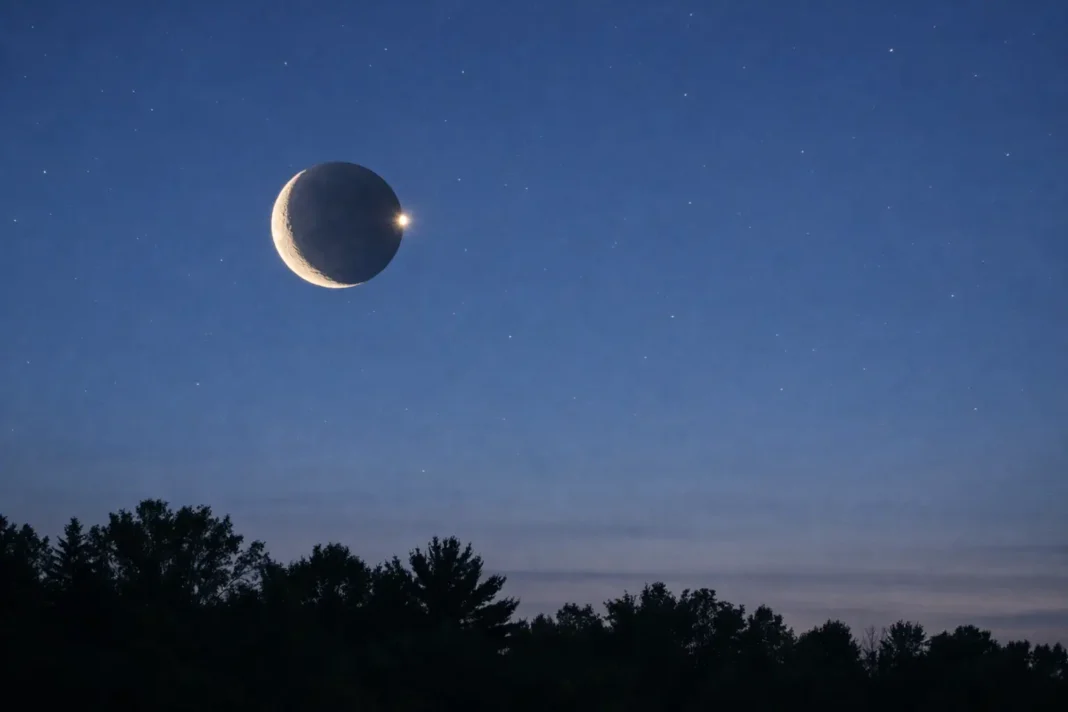

Rare predawn occultation will put the planet Jupiter briefly out of view for observers across parts of North America and the Caribbean on the morning of Oct. 6. The event is a lunar occultation: the slim, waning crescent moon slides directly in front of Jupiter, making the planet vanish from sight for observers along the path. Portions of western and central Africa will also see the alignment, though for many of those locations it will occur in daylight.
The moon will present only about 20% illumination, a slender crescent moving eastward against the star field. As the two bodies rise in the east before dawn they will appear to draw closer until the lunar limb covers Jupiter. Observers on the centerline of the occultation path can expect the planet to remain hidden for up to approximately one hour, after which Jupiter will re-emerge. No optical aid is strictly required to witness the disappearance and reappearance, but binoculars or a small telescope will make the passage more striking.
Through a modest telescope, Jupiter will resolve as a tiny disk rather than a point, and its disappearance behind the lunar edge typically takes on the order of a minute as the disk is covered. Detailed visibility maps and timings for the event are available from In-The-Sky.org, while specific start and end times for many cities are published by the International Occultation Timing Association. Those resources list local predictions for urban centers across the eastern and central United States, Canada and the Caribbean.
Outside the narrow occultation corridor the crescent moon will still appear to skim close to Jupiter, offering attractive photographic opportunities as the two objects sit in close proximity. Amateur and casual skywatchers can capture strong images with binoculars, a stable camera mount or a smart-telescope setup. The alignment of a moon occulting Jupiter of this geometry will not repeat on North American skies until Nov. 27, 2037, a gap noted by observers tracking long-term occultation cycles (When The Curves Line Up), making the upcoming event a relatively rare viewing opportunity.