HomeScienceVoyager 1 Reaches a Distance Where Its Signal Takes a Full Day...

Voyager 1 Reaches a Distance Where Its Signal Takes a Full Day to Arrive

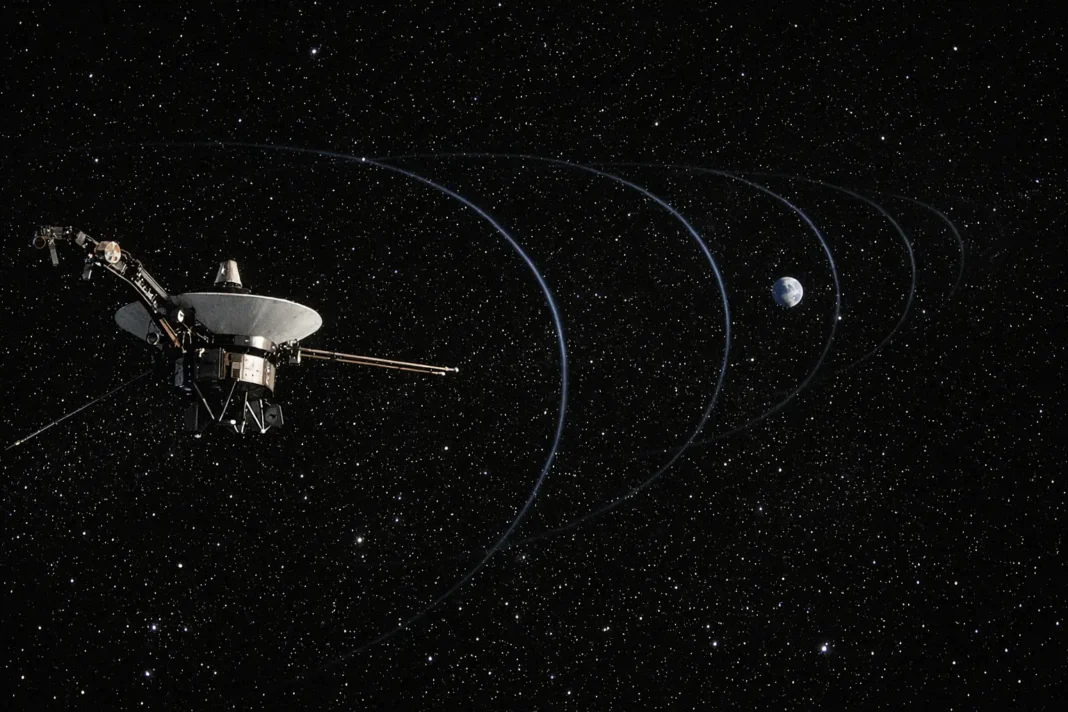
Voyager 1 has crossed a threshold that turns distance into a new measure of time. The spacecraft is now 16.1 billion miles from Earth, far enough that light and radio signals need roughly 24 hours to travel between the probe and mission teams. Nearly five decades after launch, NASA is still receiving data from the most distant spacecraft ever built by humans.

The milestone highlights the scale of space exploration beyond the planets. A command sent from Earth cannot reach Voyager 1 until the next day, and any response takes another full day to return. That delay is not caused by weak communications equipment, but by the speed limit of nature itself: even light needs time to cross the vast gap between Earth and the spacecraft. At this distance, mission operations depend on patience, precision and systems designed in another technological era.

Voyager 1 was launched in 1977 and later moved beyond the region dominated by the Sun’s immediate influence, entering interstellar space. Its journey has become one of the longest-running scientific efforts in modern history. The probe continues to travel outward while carrying instruments and hardware that have exceeded their original expectations by decades. Each successful transmission now carries unusual scientific and symbolic weight, because it links Earth with a machine that has left the planetary neighborhood behind.

The achievement also underlines the fragility of the mission. Power aboard the spacecraft is steadily declining, and engineers have had to manage technical problems while preserving the ability to communicate across billions of miles. The farther Voyager 1 travels, the more demanding that connection becomes. Yet the spacecraft’s continued operation provides rare measurements from a region no other probe had reached before it, extending humanity’s direct presence into a part of space that remains largely unexplored.

For NASA, the 24-hour signal time is more than a numerical record. It shows how a mission designed in the 20th century still shapes scientific understanding in the 21st. Voyager 1 is no longer simply a spacecraft moving away from Earth; it is a reference point for the outer limits of human engineering, communication and curiosity. Its faint signal, arriving after a full day in transit, remains one of the clearest reminders of how far exploration can reach.


Advertisementspot_imgspot_img

Hot this week

Artemis II’s Fiery Return Shows the High Stakes of Going Back to the Moon

Jeremy Hansen’s account of Artemis II’s re-entry highlights the risks of Orion’s return after a historic lunar mission.

Pochettino at Manchester United: Discipline, Fitness and a Demanding Reset

Mauricio Pochettino’s methods, shaped at Spurs and described by Toby Alderweireld, point to a demanding Manchester United era.

Entertainment’s Quiet Reckoning Is Years in the Making

Brand, Walliams and MAFS controversies reflect a longer shift in entertainment, accountability and duty of care.

Sponge Test May Broaden Access to Cancer Checks for Persistent Indigestion

A capsule sponge test could allow more people with severe indigestion to be assessed in GP surgeries without hospital endoscopy.

Pochettino’s Manchester United Task Starts With Culture, Defence and Fernandes

Mauricio Pochettino takes charge at Manchester United with culture, defensive structure and Bruno Fernandes central to his agenda.

Verstappen Inherits Las Vegas Pole After Antonelli Penalty

Kimi Antonelli topped Las Vegas qualifying, but a five-place penalty moves Max Verstappen to pole ahead of George Russell.

How Australian Television Turned Local Voices Into Global Hits

Australian shows from Bluey to Colin from Accounts are reaching global viewers, helped by distinctive voices, local humour and streaming habits.

News Publishers Look to Their Own AI Tools to Avoid Becoming Big Tech’s Raw Material

Publishers are turning archives and expertise into AI tools to avoid becoming raw material for Big Tech platforms.

Readers Choose Dogs and Cats as Science Edges Toward Animal Communication

A reader poll highlights public interest in speaking with pets as AI helps scientists decode animal vocal signals.

Daily Daraxonrasib Pill Raises Cautious Hope in Pancreatic Cancer

A daily daraxonrasib pill has shown tumour shrinkage and possible disappearance in some pancreatic cancer patients in a clinical trial.

Anthropic’s Market Debut Gives Pure AI Its First Public Test

Anthropic’s stock market debut makes it the first pure AI company to list publicly, testing investor confidence in the sector.

UK and EU Move Toward Youth Mobility Deal at Friday Summit

The UK and EU are expected to approve a youth mobility scheme, with food trade and carbon emissions deals also under discussion.

Pochettino’s Manchester United Task Starts With Culture, Defence and Fernandes

Mauricio Pochettino takes charge at Manchester United with culture, defensive structure and Bruno Fernandes central to his agenda.
Advertisementspot_img

Related Articles
