
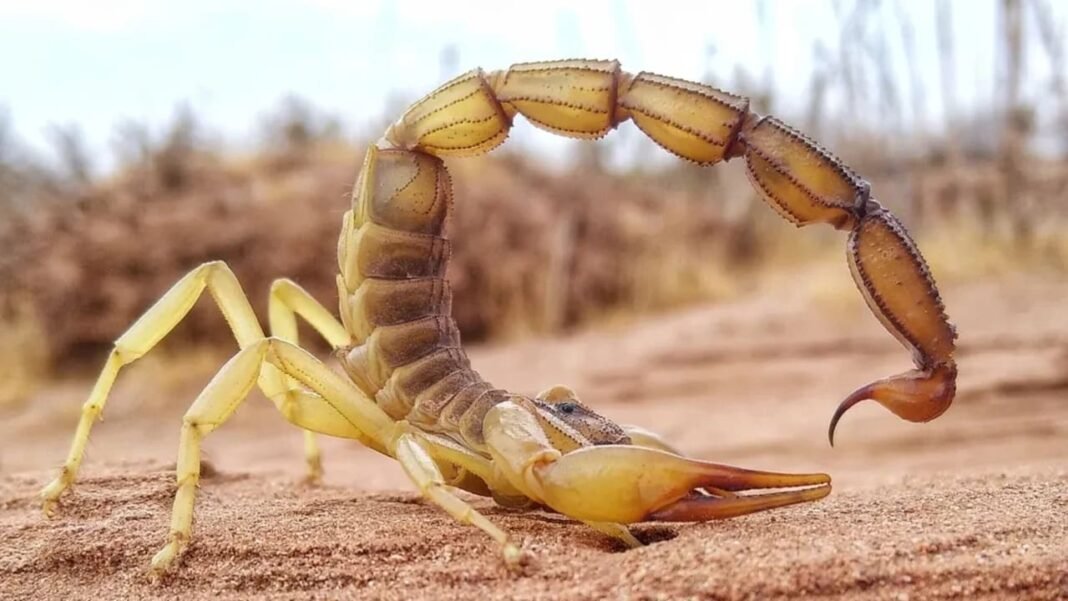

Scorpions’ stingers and pincers are reinforced with trace metals arranged in precise patterns that boost durability and cutting power, according to a new study. Researchers surveyed specimens from 18 species and used high-resolution electron microscopy and X-ray analysis. The analysis, published in the Journal of The Royal Society Interface, is the first to statistically examine metal uptake across scorpions while accounting for phylogenetic relationships. It reveals metal “recipes” that track with how each species hunts and defends itself.
Zinc, manganese, and sometimes iron are concentrated where these tools face the most stress. Zinc peaks at the tip of the venom-delivering stinger and along the cutting edges of the pincers. Manganese forms a band just below the stinger’s tip to create a flexible yet sturdy transition.
The team examined a large museum collection and found that scorpion weapons are selectively reinforced at wear-intensive zones. At the stinger, the highest zinc content sits at the point, followed by a layer of manganese that strengthens without making the structure brittle. In the pincers, metals accumulate on the cutting and gripping edges—often in toothlike structures—while the remaining framework retains other mechanical properties. A similar localized pattern appears on the pincers’ movable outer segment, where zinc or a zinc–iron mix lines the edge that endures the greatest forces during prey capture. X-ray imaging confirmed that the pincers and stingers contain iron, zinc, and manganese, a combination that underpins their resilience, according to Marca.
Species with large crushing claws and smaller stingers show different metal patterns than those with delicate pincers and more muscular stingers. The study found that the more zinc a scorpion accumulates in its stinger, the less is available to fortify the cutting edge of the pincers, and vice versa. Species with powerful, robust crushing pincers tended to show less zinc in those claws than species with long, slender pincers. Species with very thin and fragile pincers often carried higher zinc concentrations in the claw edges, apparently preventing fractures by allowing the claws to bend and grasp without snapping.
In these cases, zinc is tied to hardness and to resistance against crack formation and propagation under repeated loads. Iron followed a complementary pattern: it was not found in scorpion species with stronger pincers but was more common in species with long, less robust structures. Its role appears to be improving resistance to wear as prey struggles to escape. Altogether, the distribution of trace metals maps closely to how species prioritize crushing versus stinging, reinforcing the idea that scorpions optimize their tools like engineers by tuning materials at microscopic scales to match mechanical demands.
“This points to a role for zinc beyond hardness, perhaps playing a bigger role in durability,” said Sam Campbell, an environmental scientist at Australia’s University of Queensland, according to Popular Science.
The analysis integrates evolutionary relationships to show that metal enrichment is widespread across the group. Researchers estimate that almost all of the roughly 3,000 known scorpion species share this integration of heavy metals into their anatomy. That prevalence helps explain the durability of scorpion weapons through deep time and supports the notion that metallic impregnation of chitin is a fundamental survival strategy among arthropods. The authors suggest that spiders and wasps likely apply comparable metallic engineering to their venom-delivery and cutting structures.
Source:
www.jpost.com



