
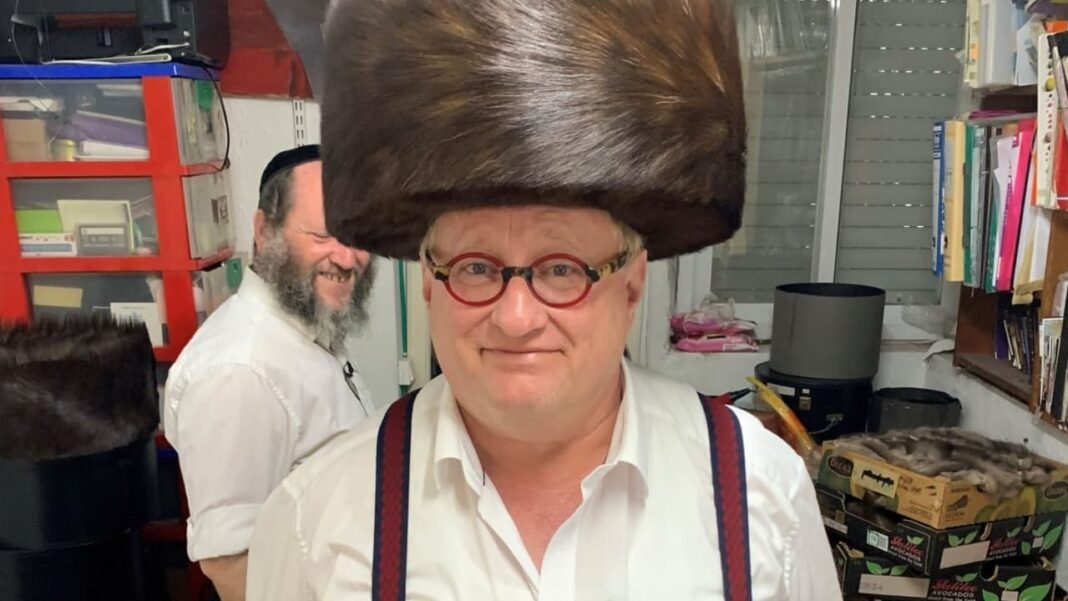

There is a particular kind of documentary that pretends to explain a world, and another that recognizes how little can truly be explained from the outside. God Speaks Yiddish, directed by author Tuvia Tenenbom, based on one of his his best-selling books, belongs firmly to the latter. It does not decode the ultra-Orthodox universe it enters. It lingers within it, attentive, patient, and deliberately unresolved.
To many outsiders, the ultra-Orthodox community of Mea Shearim remains a mystery. It is a closed world that often sparks wild fantasies and associations, partly due to its theological rejection of the Israeli state, which has made it a frequent projection screen for antisemitism. Tenenbom’s film neither confirms nor corrects these projections. It replaces assumption with presence.
The film accompanies the bestselling book Careful Beauties Ahead, published by Gefen. At the same time, the project achieved wide international resonance through its German edition, Gott spricht Jiddisch (“God Speaks Yiddish”), published by Suhrkamp Verlag and recognized as a Der Spiegel bestseller, as well as through its Hebrew edition, Haredi vetovlo, a bestseller in Israel; and in Romanian under the title Haredi by Integral publishing. This multilingual trajectory underscores the work’s unusual reach.
Immersion and anecdotes
Shot over an extended period while researching the book, the documentary becomes a parallel act of immersion. It is informative, anecdote-rich, and quietly analytical, not through commentary, but through accumulation. Conversations unfold. Gestures repeat. Silences linger. Meaning emerges slowly, and never completely.
Set largely within the narrow streets and interiors of Mea Shearim, the film moves with a restrained, almost cautious camera. The cinematography by Florian Krauss and Isi Tenenbom is central to the film’s effect. Their approach avoids spectacle in favor of proximity. The camera stays grounded, often at eye level, attentive to faces, textures, and small movements. This visual modesty becomes immersive. The viewer begins to feel the density of the environment, the weight of routine, the invisible codes governing everyday life.
God Speaks Yiddish won Best Documentary 2024 at the Indie Film Festival Berlin.
The film is enriched by a series of striking appearances that expand its range without breaking its tone.
Motty Steinmetz offers a rare glimpse into the spiritual power of music, where voice becomes devotion. Dan Schueftan introduces a contrasting, analytical perspective, often blunt and controversial, creating tension between lived experience and external interpretation. And Israel Meir Hirsh, a vivid figure within Neturei Karta, embodies a deeply rooted ideological world, continuing the legacy of Moishe Hirsh.
Personal dimension
Born into an ultra-Orthodox rabbinical family of Polish-Romanian descent, Tenenbom left that world at 17, served in the Israeli army as a tank driver, and later built a life in New York across literature and theater. This film marks a return. Over two years, he re-visits the community he once left behind. The camera carries that tension, between familiarity and estrangement, belonging and distance.
Visually, the film remains grounded, negotiating its place within the world it records. It is both guest and intruder, and that duality becomes central to the experience. The pacing is deliberate. Scenes unfold slowly, mirroring a life structured by repetition and continuity.
Prayer, conversation, movement all follow rhythms that gradually reshape the viewer’s sense of time. Moments of tension surface quietly, in glances, hesitations, and small disruptions.
In the end, God Speaks Yiddish is not about solving the mystery of Mea Shearim. It is about remaining inside it. It asks the viewer to accept the limits of understanding, and to sit, for a while, within that uncertainty.
That is where the film finds its quiet power.
Tenenboim is the author of several humorous books; he also went undercover in new York City at a pro-Palestine event.
Available worldwide, its reach extends beyond festivals. It can be streamed directly at https://www.GodSpeaksYiddish.com.
To register for the free viewing in Tel Aviv on April 29, go to: https://www.eventbrite.com/e/inside-mea-shearim-documentary-screening-with-filmmaker-tickets-1988038155640?aff=oddtdtcreator
Source:
www.jpost.com



