
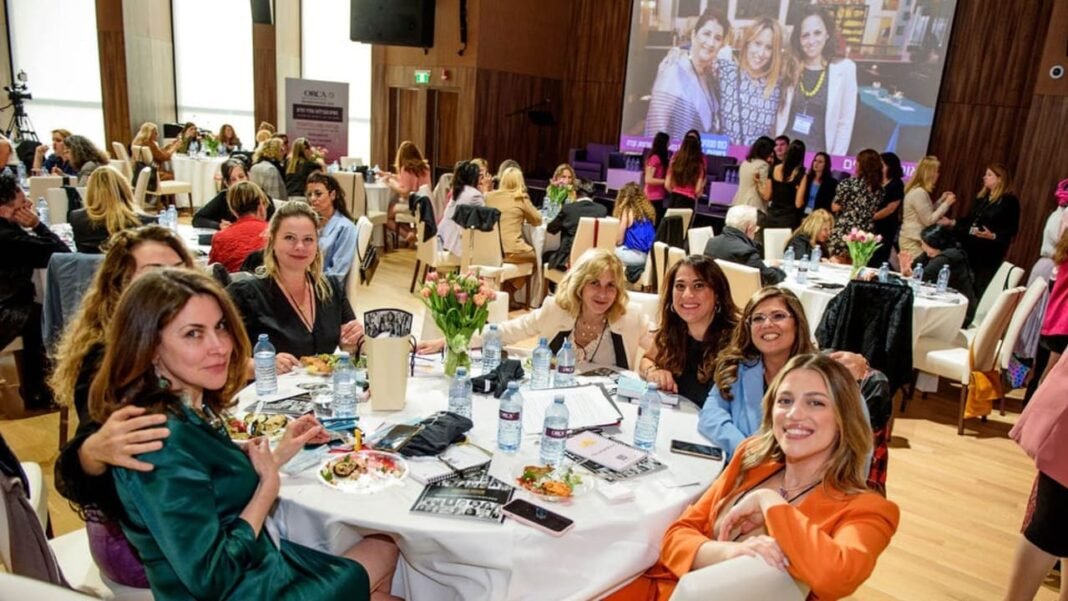

The word “networking” has become somewhat of a cliché in recent years. So it comes as no surprise that Orly Carmon, lawyer, entrepreneur, and founder of the women’s business community ORCA Global Leadership, isn’t fond of it. She uses it almost impatiently, as if it belongs to a world she has long outgrown – one of polite exchanges, business cards, and conversations that evaporate the moment they are no longer useful.
“Networking is shallow,” she says. “It’s transactional in the smallest sense. That’s not what we’re building.”
What Carmon has built through ORCA is harder to categorize: a transnational network of women from over 55 countries who do business with one another, invest in one another, and, just as deliberately, take responsibility for something beyond themselves. It’s designed around movement: of capital, knowledge, and influence.
The idea did not emerge fully formed. Like much of Carmon’s trajectory, it took shape through observation and a refusal to accept what she saw. A decade ago, in Toronto, she was already organizing what appeared to be a successful professional community.
Israeli men and women gathered, exchanged ideas, and built connections. But something was missing. “I realized that the real deals weren’t happening in the room,” she says. “They were happening outside of it.”
The moment which clarified it came almost incidentally. A major deal had been closed between two men who had met not through the formal network but in Carmon’s own business community, which led them to a friendly conversation on the sidelines of a children’s hockey game, where the deal was struck. “I asked him [one of the men], ‘Why did you give the deal to him?’” Carmon recalls. “And he said that it wasn’t intentional. They spent time together, became friends, and it just happened.”
For Carmon, that answer revealed the mechanism she had been missing. Trust, not access, was the real currency, and it was being built elsewhere. “Women weren’t there,” she says. “They weren’t part of those informal spaces; and when you’re not there, you’re not part of the flow.”
She responded immediately. “I’m not taking care of men anymore,” she recalled thinking, and started building something for women, where the relationships are strong enough that business naturally moves within the network. What emerged from that decision was ORCA: not a networking group but an infrastructure designed to replicate and redirect the dynamics through which power circulates.

CARMON, WHO grew up in an ultra-Orthodox home in Jerusalem, and gradually left that world, has a unique instinct to build systems rather than critique them. “I don’t like change,” she remarks with a smile. “I like development. Development is something you grow into.” That distinction, between abrupt change and cumulative growth, runs through her work.
As a teenager, she studied at an international Jewish school in Switzerland, founded after World War II to create relationships between future leaders of Jewish communities. “The idea was that if something ever happened again, there would already be a network. There would be trust.”
Years later, that same logic reappeared in ORCA – responding to structural imbalance rather than an existential threat. When she relocated to Canada, Carmon had already established a successful career in Israel’s corporate sector, but she soon realized that in Toronto, she had to start anew, building community from the ground up. “There was no Facebook, no infrastructure. So I built one.”
What started as informal gatherings evolved into more organized initiatives, and by 2014 she was on a plane to a global leadership conference in London, where she would serve as the representative for UJA after the organization reached out to her. On the return flight, she decided to expand. “I said, we’re going to create three things: a business club, women’s circles, and community events,” she remembers. “People told me it would take years. It didn’t.”
Contribution as currency
ORCA’s internal structure is organized around five pillars: connection, collaboration, co-learning, creation, and contribution, which Carmon resists treating as slogans. “Connection means depth,” she says. “A real relationship. Collaboration means we actually do business together. Co-learning means we keep developing – financial intelligence, communication, leadership. Creation is about bringing your voice. And contribution – this is non-negotiable.”
She pauses before clarifying what that means. “A woman who reaches a position of influence and doesn’t give back, does not belong here,” she asserts.
ORCA is intentionally selective. It is built for women who are already leading in their fields, who are accustomed to influence but often lack a true peer group. “I’m not here to teach someone how to write a CV,” Carmon says. “I work with women who walk into a room and are used to being the smartest person there. But even they don’t have a space where they are challenged by equals.”
Contribution is embedded in the network’s structure, shaping not only what members achieve but also how they think about responsibility. “Community is part of the identity, it’s not something you do on the side,” she says. When asked to give an example that captures the essence of ORCA, Carmon turns not to metrics or milestones but to a figure from the organization’s book, The Wisdom of Women’s Leadership.
“Rina Idan is, in my eyes, one of the most prominent figures in the book – not because of her title but because of her life path,” she says. “It embodies leadership in the deepest sense: the ability to face an impossible reality, choose responsibility, and turn personal pain into a force that creates wide-scale change.”
Idan was formerly a reserve lieutenant colonel who headed the IDF’s casualty branch, spending years accompanying families in their most difficult moments. Her breaking point came around 2000, following the kidnapping by Hezbollah of three Israeli soldiers from Har Dov, whom they abducted to Lebanon, says Carmon. “It shook her deeply, and it led her to leave the army, not because her sense of mission ended but because it changed form.
Idan is now the CEO of the nonprofit Kav Lachayim, which provides support for children with complex disabilities and rare syndromes. “But her transition to civilian life was anything but smooth. She joined Kav Lachayim when it was on the verge of collapse. [The organization] was millions in debt, a system that was falling apart. Idan could have chosen personal security, but she chose to stay.”
That decision, Carmon says, became a turning point. “With extraordinary determination and leadership, she led an almost impossible recovery, mobilizing public support, bringing creditors on board, rebuilding trust, and transforming the organization from a collapsing body into a social empire with tens of millions of shekels in activity each year.”
For Carmon, the significance of Idan’s story goes beyond organizational success. “It’s about the essence of leadership as we see it in ORCA,” she says. “She led through belief, values, and the ability to truly see people, even when the system had already given up on them.”
That, Carmon suggests, is precisely what ORCA seeks to cultivate. “Women who don’t wait for opportunities but create them. Women who lead through responsibility. Women who can take a complex reality and turn it into a space of hope and real impact.”
In recent years, that ethos has taken on broader urgency, and ORCA’s next phase reflects that shift. The network is expanding beyond Hebrew-speaking Israelis to include English-speaking women engaged with questions of Jewish identity and global belonging. “I want to work with women who understand that Israel is central to the future of the Jewish people,” she says. “Because if Israel is strong, Jews everywhere feel stronger.”
The organization’s growth has followed no single blueprint. Some developments were planned; others emerged in real time. “I was speaking at a conference in Budapest, and I said, without planning it, ‘The next one will be international.’ And then it was,” Carmon recounts.
Today, ORCA connects women across many countries, industries, and regions. The results are tangible – business growth and new partnerships – but Carmon prefers not to reduce it to mere metrics. “Ultimately, it’s about impact,” she emphasizes. “Not just within the network but beyond it.” Under Carmon’s leadership, the organization had orchestrated dozens of conferences, seminars, and several all-women expeditions to India, Morocco, and Costa Rica, among other destinations.
“I want to leverage the power we’ve built to create meaningful change,” Carmon states when asked about her future plans. The core idea is straightforward: Influence, when shared purposefully, amplifies. “Individually, you can achieve a lot,” Carmon notes. “But together, you can go much further.”
She then adds after a moment: “And if you’re in a position of leadership, giving back isn’t optional. That’s the whole purpose.”
This article was written in cooperation with ORCA.
Source:
www.jpost.com




