

Thousands of students from 31 countries took part in My Family Story this year, the international heritage program run by ANU – Museum of the Jewish People in Tel Aviv, whose 2026 winners were recently announced in a global online ceremony broadcast from Israel to six continents.
The Manuel Hirsch Grosskopf International Competition is now in its 31st year.
The closing event, held on Zoom from the museum, included students, teachers, and family members from around the world, with the ceremony conducted in English and accompanied by live translation into Hebrew, Russian, French, and Spanish. Arkia sponsored the event and donated airline tickets for the winners and their families.
My Family Story is the flagship program of the Koret International School for Jewish Peoplehood Studies, ANU’s educational division. The project was created and is led by Martha Mazo, who has headed Spanish-language educational programs at ANU for 31 years.
The program highlights diverse Jewish family histories
The program invites young people in Israel and abroad to research their family histories, document their heritage, and transform their roots projects into creative, museum-style exhibits. In addition to schools, the program includes Jewish museums worldwide, summer camps, informal education frameworks, and families.
This year, hundreds of students submitted works exploring family stories, identity, memory, migration, heritage, and community. The entries were judged by an international panel led by ANU.
Oded Revivi, CEO of ANU – Museum of the Jewish People, said the program gives young people a rare opportunity to connect personal memory with Jewish history.
“In a rapidly changing world, the ability to pause for a moment, listen to the stories that shaped us and connect past, present, and future is an extraordinary educational and moral gift,” he said.
“My Family Story gives young people the opportunity to discover the roots from which they grew and to understand how their personal story fits into the broad mosaic of the Jewish people. The fact that hundreds of students from 31 different countries take part in the project every year illustrates the power of the family story to connect people, communities, and cultures.”
Naama Keller, director of the Koret International School at ANU, said, “In the My Family Story program, children discover that they are not only heirs to the past, but also creators of the future. Through their family stories, they become the next link in the continuing chain of the story of the Jewish people.”
The winning projects will be displayed in the competition’s international digital archive and in the interactive installation devoted to the project at ANU – Museum of the Jewish People, becoming part of a growing collection of thousands of family stories gathered from across the Jewish world.
Meet the first-place winners
The first-place winner in Hebrew is Alex Alush of A.D. Gordon School in Givatayim for “The Album That Never Was.” The project tells the story of Alush’s great-grandmother, Gita, born in Belarus in 1933, who, at the age of 10, was forced to flee the ghetto alone and hide in the forest, leaving behind her family and every trace of her past. Because of the war, the first photograph of her was taken when she was 13, in an orphanage.
Using artificial intelligence (AI), Alush recreated lost moments from Gita’s childhood, from her warm family home to her dramatic escape, turning stories passed down through the generations into tangible images. The project sought to give Gita back the childhood memories that had been stolen from her.
Sarah Sitton Massri of Or HaHayim School in Mexico City won first place in Spanish for “SHOCK/SHUK,” a sensory project about her Syrian Jewish family’s heritage as merchants. The work combines smells, textures, colors, and tastes to reflect the “flavor” of her family and cultural identity. Two lamps bearing family names symbolize the light she has received from past generations and the light she passes on to the future.
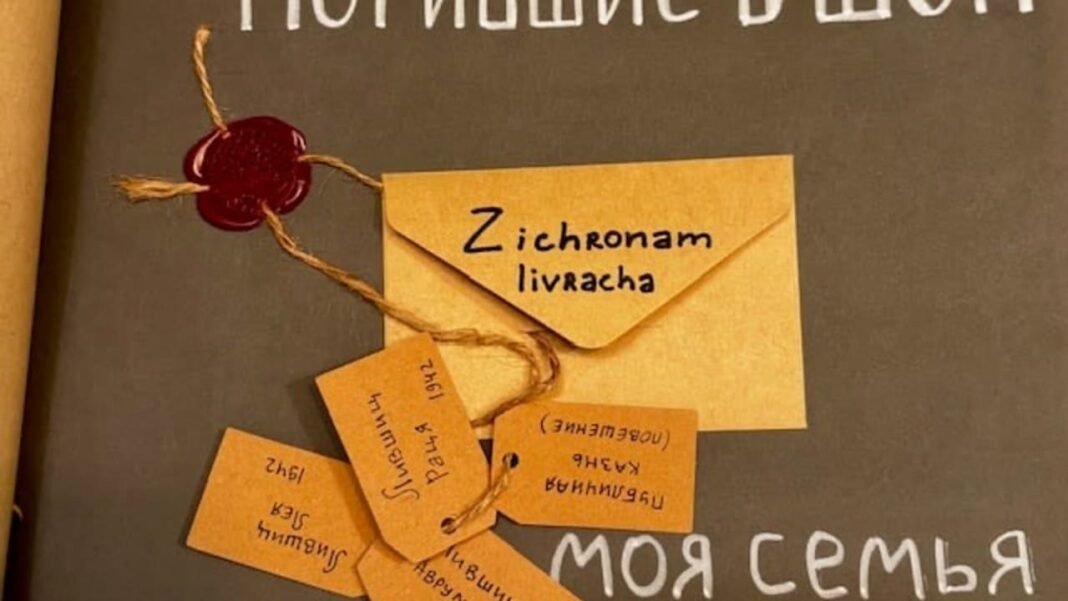
Daniel Voloshchuk of the Shalom Education Center in Rockville, Maryland, won in Russian for a handmade project utilizing the visual language of family albums and memory books. His research explored the gaps, silences, and omissions that often exist in Jewish family archives, especially in the wake of the tragedies of the 20th century. The judges praised the project’s warmth, authenticity, and use of handmade elements, including aged paper and handwritten Russian.
Aaron Lévy of École Marianne Picard in Neuilly-sur-Seine, France, won first place in French for a board game called “Our Roots Journey.” Born in France and living in Paris, Lévy comes from a family with roots in Tunisia on his mother’s side and Morocco on his father’s side. He interviewed his parents and all four grandparents, creating a game in which players move through family history by answering questions, following clues, and completing challenges. The game is housed in an old suitcase, symbolizing the journeys and displacements his family experienced over the years.
Zoe Sharf of Mount Scopus Memorial College in Melbourne, Australia, won first place in English and in the general international category. Her project explores how a legacy of giving passes from generation to generation and shapes personal identity.
At the center of her work is a unique tzedakah box made of transparent acrylic and engraved copper coins. Each coin includes faces, documents, and family values, representing lives of meaning and contribution. Sharf was inspired by her great-grandmother, who survived a labor camp in Siberia during World War II and cared for her younger brother, as well as by later generations of relatives who continued the family tradition of giving, including doctors and volunteers.
Sharf said the creative process taught her that, just as a tzedakah box fills gradually, identity is built step-by-step, coin-by-coin, and value-by-value, as part of a long chain of compassion, courage, and mutual responsibility linking her family story to the larger story of the Jewish people.
Source:
www.jpost.com



