
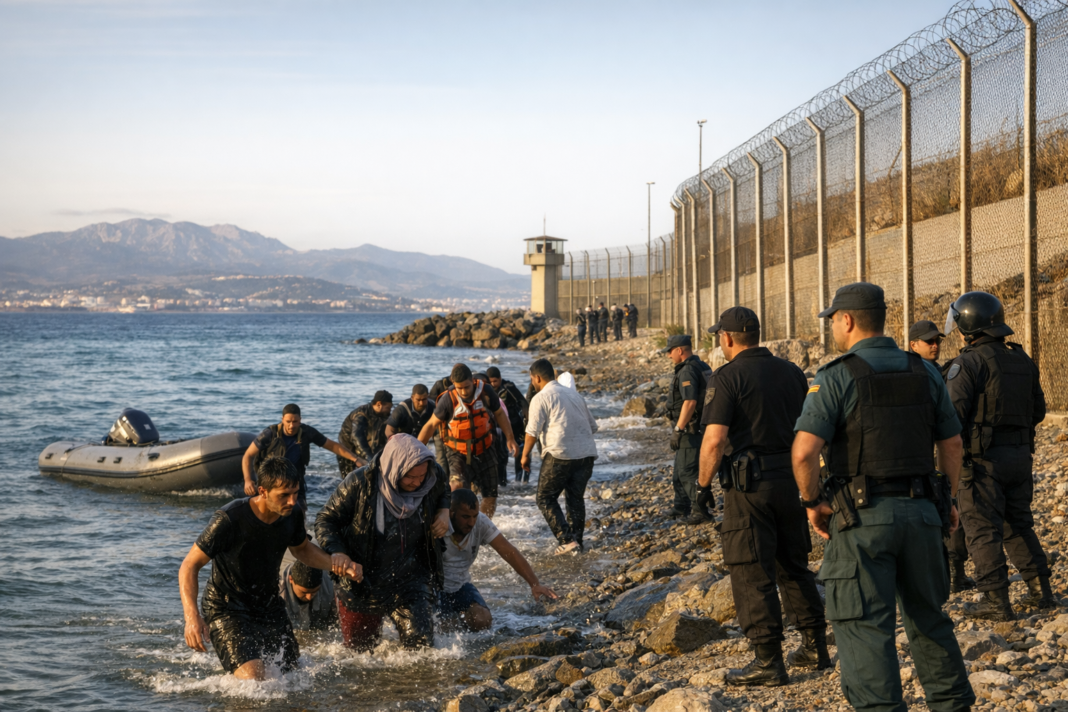

Pedro Sánchez faces pressure after footage of thousands of migrants entering Ceuta last week prompted a swift political reaction across Europe. The images were widely circulated online and were cited by several European governments as evidence that Spain’s recent migration measures require closer scrutiny.
Italy and Denmark organised a letter, eventually signed by 22 EU heads of government, that linked the influx to Spain’s programme to regularise undocumented migrants. The Spanish initiative has attracted more than one million applications, a figure referenced by critics who urged colleagues in Brussels to consider the extent to which national policies may act as pull factors.
EU leaders and commentators framed the episode as a test of collective migration management, and the response included calls to examine policies across the bloc. The messaging found resonance with the political right in several countries, where social media and party channels amplified the images and framed them as a consequence of liberalised entry and regularisation measures. Critics within Spain also pointed to domestic political implications, noting increased pressure on the government from opposition parties and right-leaning movements.
Far-right reaction online and the coordinated letter underline a divergence of views among EU capitals about how to balance border security, legal regularisation and humanitarian obligations. The exchange between Madrid and other European leaders highlights the limits of unilateral approaches to migration in a union where member states face differing domestic pressures and legal frameworks. Madrid has defended its measures as part of a regulated process to integrate long-term residents, while other governments have emphasised immediate border management.
Spain now confronts a dual challenge: managing a complex regularisation scheme that has drawn substantial applications, and engaging EU partners to develop common responses that address both short-term border incidents and longer-term migration dynamics. The episode is likely to shape discussions in Brussels about coordination, information-sharing and the interplay between national reforms and regional policy responses.





