
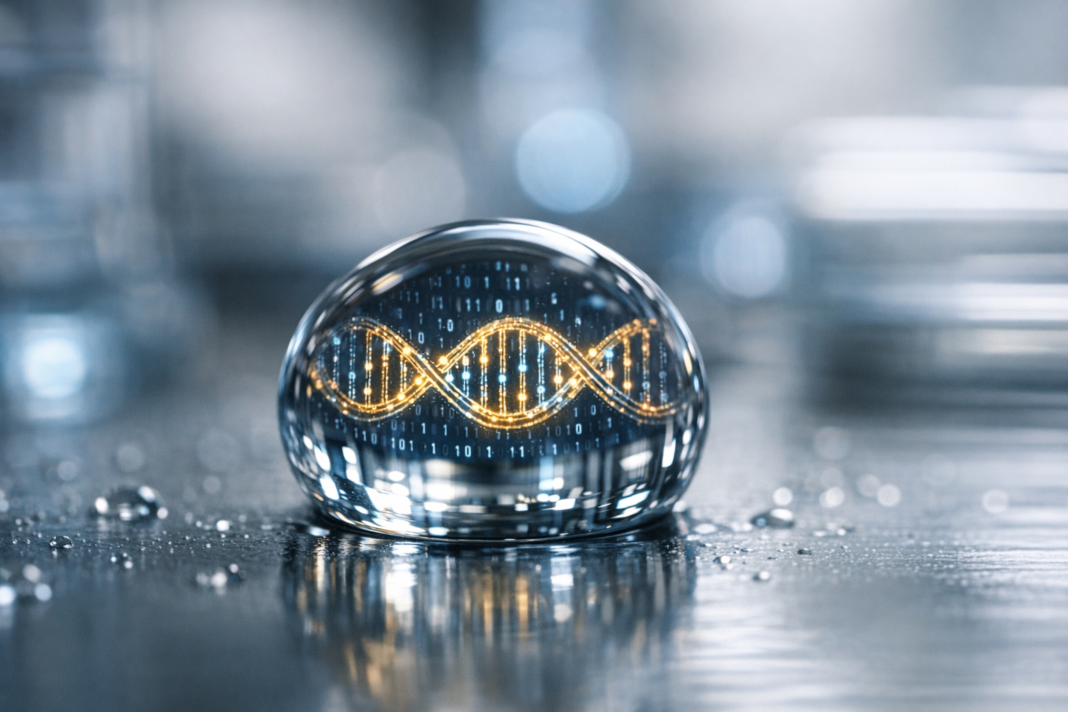

DNA-powered computer demonstrated a new route to molecular computation by performing programmable calculations inside a minute droplet of salt water. The system, described in a study published Sept. 16 in Nature, uses short strands of DNA that bind to positions on a longer scaffold so that the most energetically favourable arrangement encodes the correct result. Researchers call their device the Scaffolded DNA Computer (SDC); its operation relies on thermodynamics rather than stepwise electronic processing.
The SDC is assembled by mixing designed DNA strands in a small volume, then heating and cooling the solution so the components can interact and settle into stable configurations. In this setup the binding is competitive: many strands vie for scaffold sites and the network of interactions steers the ensemble toward the configuration that represents the answer. Co-authors Damien Woods and Abeer Eshra, both affiliated with Maynooth University, emphasise that billions of molecules participate in each computation, so the collective behaviour of the mixture carries out the calculation.
In laboratory tests the team programmed and ran ten different programs, including 100-bit computations and common arithmetic tasks. Simple sums such as 10 + 3 were resolved in roughly 30 seconds, while substantially larger problems required hours. Across experiments the researchers performed more than 700 computations and demonstrated reusability: several programs were repeated up to 24 times and one experiment was rerun after 18 months by rehydrating dried components. The authors note the SDC is slower than silicon processors but fast compared with previous molecular systems and offers an unusual combination of programmability and reuse.
Potential applications remain exploratory but include specialised roles where conventional electronics are impractical: molecular-scale data storage, computation in biological settings, and integration with smart materials. The study highlights further challenges—improving scaffold design, enhancing read-out methods and developing theoretical tools—before such devices move beyond laboratory demonstrations. Researchers describe the work as a step toward energy-efficient molecular computing and novel approaches to data storage at the molecular level.





