
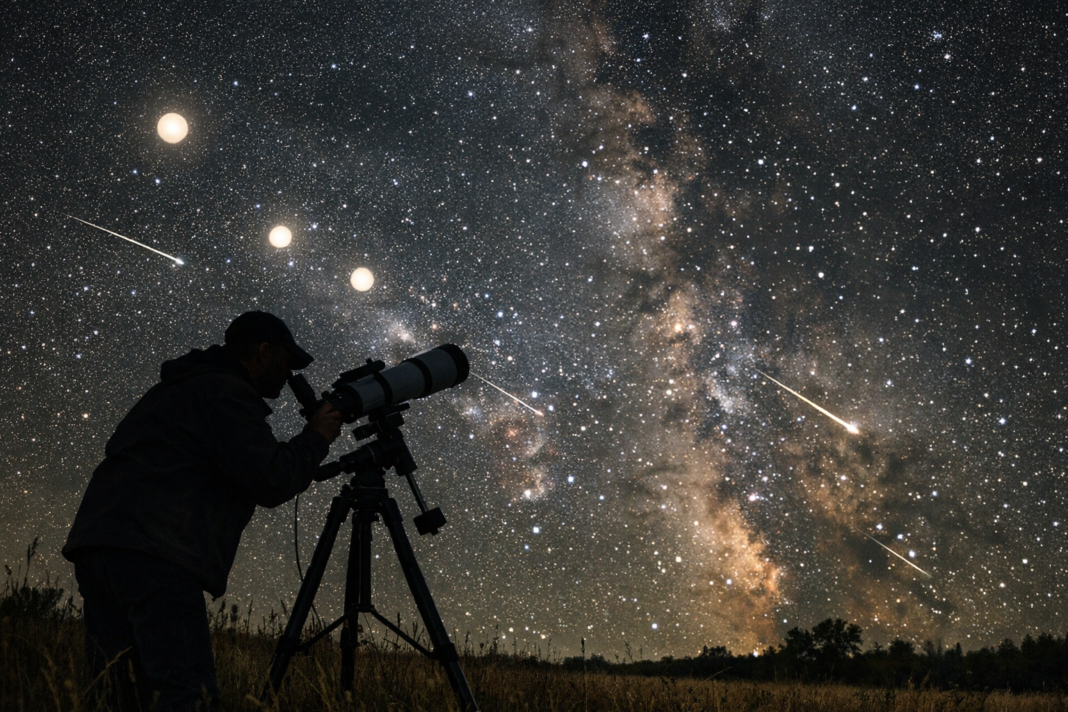

Autumn night skies bring a concentrated calendar of visible planets, meteor showers and deep-sky objects across September, October and November. Observers in both hemispheres will find several outer-planet oppositions, a November supermoon and the season’s principal meteor displays, together with classic targets such as the Pleiades and the Andromeda galaxy. For background on our changing view of neighboring galaxies, see NASA. Practical session planning benefits from checking moon phases and local twilight times via dedicated stargazing resources.
Three planetary oppositions fall this autumn: Neptune reaches opposition on September 26, Saturn on October 4 and Uranus on November 25. Neptune and Uranus remain telescopic targets that generally require 6–8 inch apertures to appear as small colored discs; Saturn will be visible to the unaided eye and will show its rings through modest amateur scopes. The brightest full moon of the period, a November supermoon on November 24, will affect faint-object viewing and astrophotography during that night and adjacent evenings.
The season’s meteor activity offers varied opportunities. The Draconids (active October 6–10, peak October 8–9) favor earlier evening hours and can produce a modest rate under dark skies. The Orionids (October 2–November 7, peak October 21–22) and the Leonids (November 6–30, peak November 17–18) provide reliable displays in the late-night to pre-dawn window, with expected rates quoted in source material. The Taurids, split into Southern and Northern components with peaks around November 4–5 and November 12 respectively, yield lower counts but are noted for occasional bright fireballs; moon phase will determine the best viewing windows for each shower.
Autumn also presents rich deep-sky and constellation targets. The Pleiades and Hyades re-emerge into evening skies from October onward; the Andromeda galaxy (M31) climbs to favourable positions in October and November for both visual observation and imaging. Southern objects such as the Helix Nebula are best sought in September before they sink lower, while the Triangulum galaxy remains a late-evening target into December. In the north, Cassiopeia rises higher through the season and hosts open clusters like the Owl Cluster and NGC 7789, known as Caroline’s Rose after Caroline Herschel. For imaging faint nebulosity, integration times cited in technical guides range from a few hours to upwards of 10 hours depending on target and equipment; select moonless nights and minimal local light pollution for best results.






