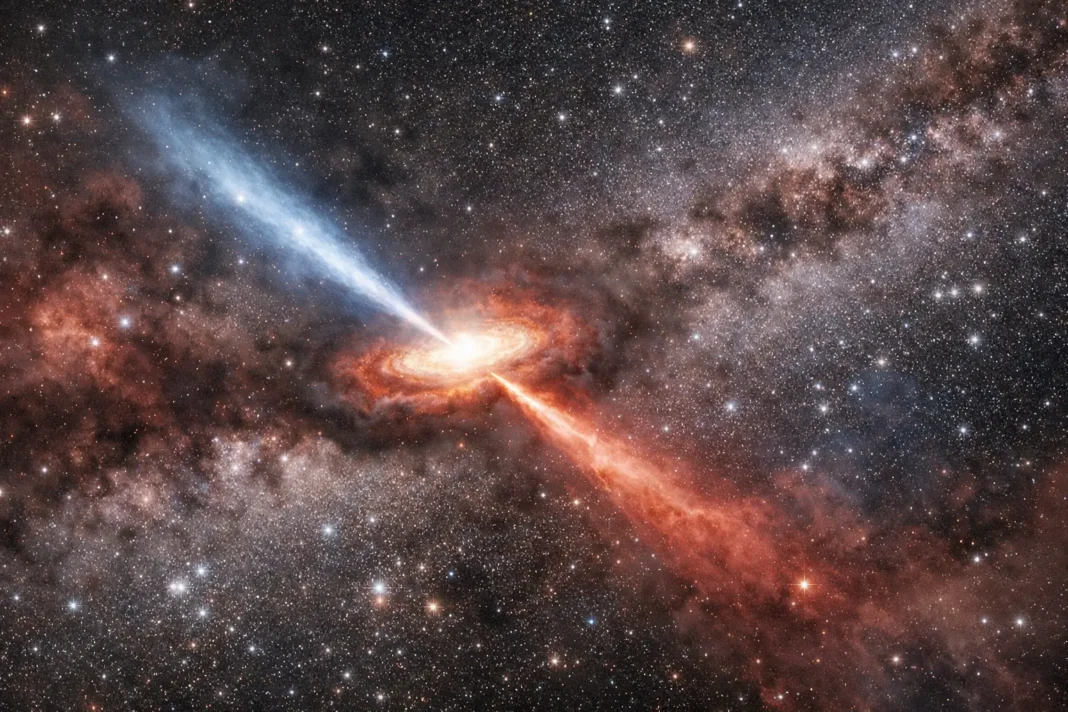

New candidate microblazar identified inside the Milky Way: IRAS 18293-0941 emerges as the most convincing example yet of a long-predicted compact blazar analogue. An international team led by Josep Martí of the University of Jaén and collaborators in the Netherlands and Argentina has documented the object in a study accepted for publication in Astronomy and Astrophysics.
The source lies roughly 12,000 light-years from Earth and is obscured by interstellar dust. Observers characterise the system as a binary pairing of a stellar-mass black hole and a massive hot companion star with an orbital period of about 11 days; material transferred from the star appears to feed bipolar relativistic jets, one of which is oriented toward Earth. The team combined fresh observations from ground facilities with archival radio data, using instruments including the Calar Alto observatory, the European VLBI Network and the MeerKAT array, as well as archival Very Large Array records.
Analyses show that the object matches many theoretical signatures of a microblazar: broad spectral output across wavelengths, evidence of strong jet interaction with the surrounding medium and a putative hotspot opposite the jet aimed at Earth. A key expected signature — rapid brightness variability produced by Doppler boosting when a jet points close to the line of sight — has not been clearly detected. Investigators, including co-author Pedro Luque-Escamilla, note that the dense local gas and dust could smooth out short-term fluctuations, while follow-up work is focused on confirming the nature of the downstream hotspot and the mechanism of jet–ambient interaction.
The publication frames this candidate as a potential laboratory for studying how compact jets accelerate particles to very high energies and how they impact their environments. External researchers not involved in the study have described the findings as a robust and important step toward recognising microblazars as distinct sources. If confirmed, the object will refine models of jet physics around stellar black holes and contribute to the broader effort to map sources of ultra-high-energy particles in our galaxy. See the study citation and data for further technical detail in Astronomy and Astrophysics. Black holes and jets remain central to the ensuing observational programme.