
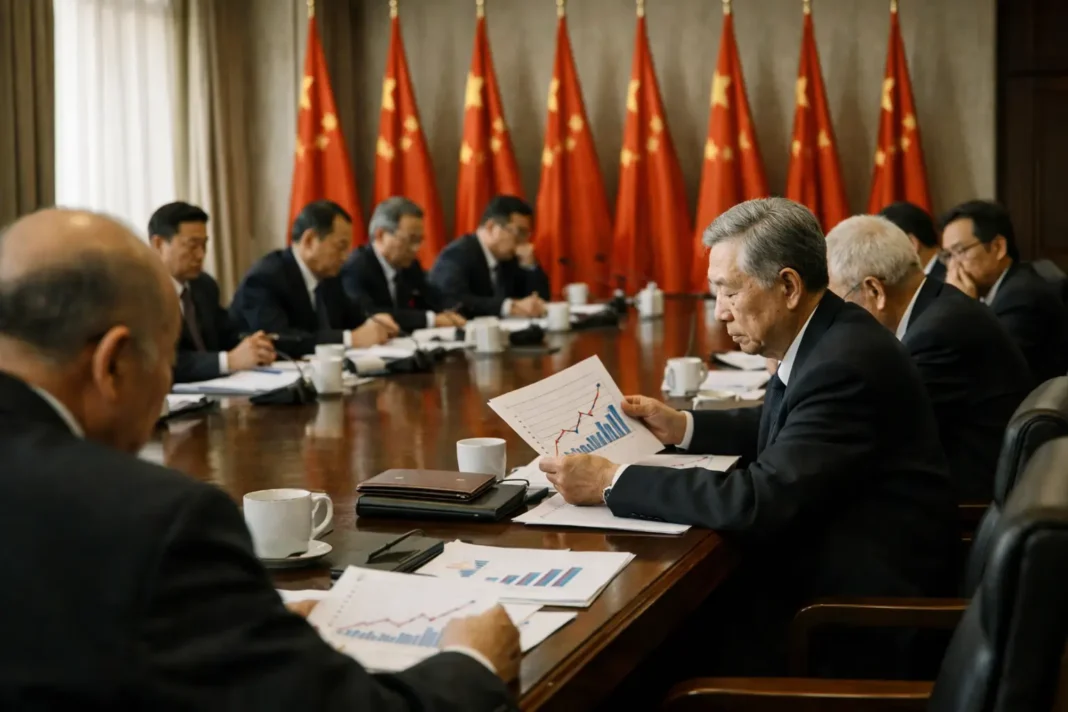

China’s long-term stability is drawing renewed scrutiny as political, economic and demographic pressures increasingly overlap. The central question is not whether an abrupt collapse is inevitable, but how the Chinese state would manage a convergence of challenges affecting leadership continuity, domestic control and its capacity to project influence abroad. For governments, investors and international institutions, the trajectory of China remains central to global trade, security and financial stability.
The political dimension is closely tied to the concentration of authority around Xi Jinping and the reduced visibility of succession planning within the Chinese Communist Party. China’s governance system has historically placed a premium on continuity, yet the absence of a clearly signalled transition path can become a source of uncertainty in any highly centralised political structure. In such systems, succession is not only a personnel issue; it affects policy direction, elite cohesion and the credibility of decision-making at moments of stress.
Economic conditions add another layer of strain. The world’s second-largest economy is dealing with a weaker property sector, pressure on local government finances, cautious consumer demand and a more difficult external environment. Official releases from the National Bureau of Statistics of China have shown a shift away from the high-growth dynamics that defined previous decades. The International Monetary Fund has also identified long-term challenges linked to productivity, debt and demographics. These issues matter beyond national borders because Chinese demand influences commodity markets, manufacturing networks and the earnings of multinational companies exposed to economic cycles.
Demography is another structural constraint. China is ageing, its workforce is under pressure, and the country has entered a phase in which population trends no longer automatically support expansion. That shift complicates efforts to sustain growth while financing social needs and maintaining employment for younger generations. At the same time, a slower economy can limit the resources available for internal security, industrial policy and overseas strategic initiatives, including the diplomatic and infrastructure networks that have expanded China’s global footprint over the past decade.
The international consequences of a weaker or more inwardly focused China would be significant. A state facing simultaneous pressure at home may become more cautious in some areas and more assertive in others, making its choices harder to read for partners and rivals. For geopolitics, the key issue is resilience: whether Beijing can adapt its economic model, preserve political cohesion and manage demographic decline without exporting instability through markets, supply chains or security tensions. The answer will shape global policy debates for years.





