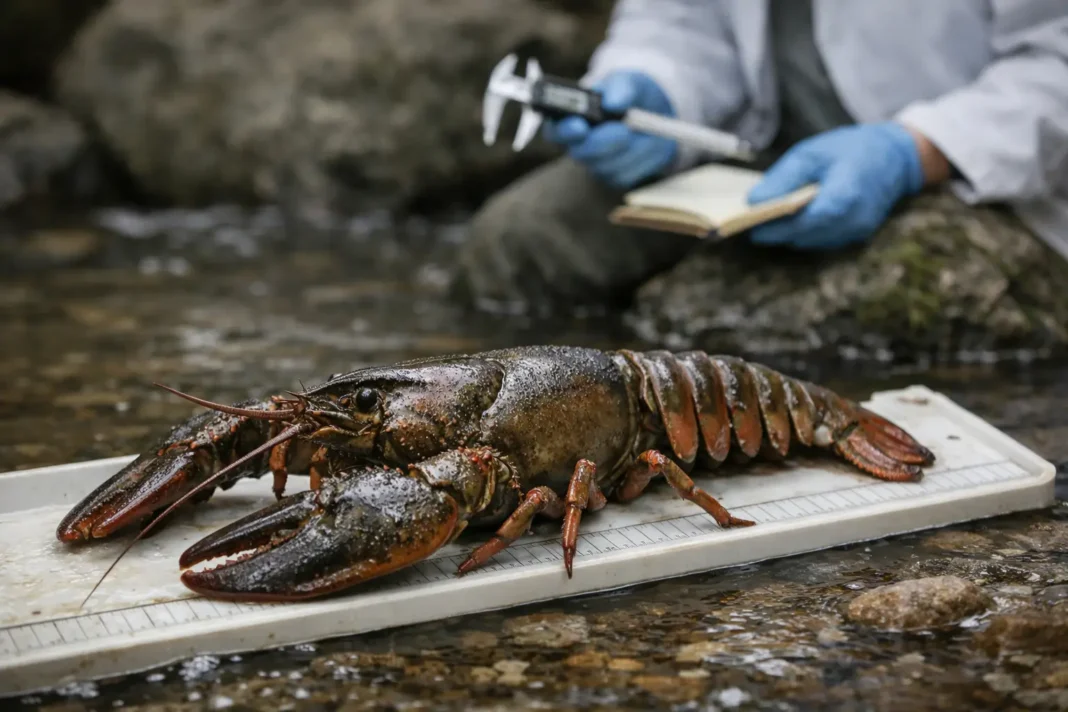

Researchers announced the discovery of a fresh record-holder among freshwater crayfish after a coordinated, nationwide search identified a specimen in Tennessee larger than the famously large “Crawzilla“. The find ends the run of the previously celebrated individual as the largest documented in recent field surveys and provides new material for scientists studying size evolution in decapod crustaceans.
The research team compared measurements from the new specimen with data gathered across multiple states and species, concluding that North American crayfish appear to approach a consistent upper size threshold. Scientists attribute this apparent limit not to environmental scarcity alone, but to biological constraints related to how muscle mass and the protective exoskeleton scale as an animal grows, factors that can restrict further increases in overall body size.
The finding carries significance beyond record books. Knowing that many crayfish species converge on a similar maximum size helps biologists refine models of growth, energy allocation and predator–prey dynamics in freshwater ecosystems. It also aids agencies and conservationists in interpreting population data: exceptionally large individuals are rarer than previously thought, and their presence, or absence, can influence assessments of habitat quality and species health.
Researchers stress that the discovery raises targeted questions about the anatomical and physiological mechanisms behind the size ceiling, and they call for continued sampling and laboratory work to test hypotheses about muscle performance, exoskeletal strength and other limiting factors. Ongoing monitoring of crayfish populations will clarify how common such oversized individuals are across different rivers and lakes and how environmental change may affect the occurrence of unusually large specimens.