
Local councils’ decisions are emerging as a decisive arena in the contest over climate action, shifting attention from national party labels to borough chambers and committee rooms. Recent electoral moments have kept the spotlight on party competition, but events in places such as King’s Lynn and West Norfolk suggest that the fate of formal environmental commitments can be determined at the municipal level. That dynamic has implications for how policy is implemented on flooding, planning and public health, and for how environmental movements organise across the political spectrum. The debate touches on both the language used to justify policy and the administrative levers that sustain it.
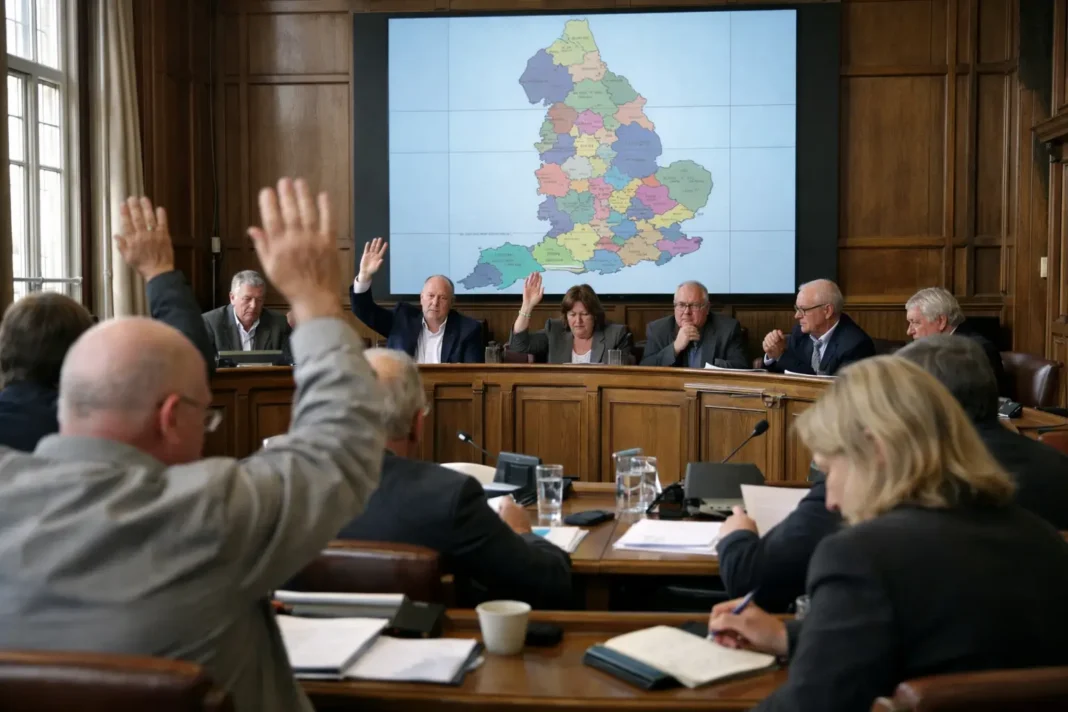
Around the end of June a council meeting in King’s Lynn and West Norfolk had to be postponed because of extreme heat before reconvening the following week. At the subsequent session a motion to remove the council’s 2021 climate emergency declaration was advanced by Austen Moore and was defeated by a vote of 33 to 7. The sequence — postponement for heat, then a rapid reversal attempt — underlined the practical stakes of local votes: declarations can shape planning priorities and signal access to resources for adaptation projects.
Similar motions have appeared in other councils led by Reform UK, where debates have at times centred on sceptical or historically framed arguments about warming. In one council in Kent a member questioned the urgency of contemporary warming by invoking past climatic episodes and emphasising carbon dioxide’s role as a naturally occurring gas. A local scientist and a member of Extinction Rebellion liveblogged the King’s Lynn debate and shared maps illustrating flood exposure across the county, reinforcing the link between council decisions and tangible local risks.
The pattern emerging from these council chambers suggests that environmental policy durability will depend less on party brands and more on municipal governance, evidence presented to councillors, and the capacity of civil society to engage day-to-day. Reversals of declarations erase formal commitments that can guide procurement, planning and resilience spending, while contested council debates reshape public understanding of climate priorities. For advocates and officials alike, the immediate task is to translate scientific and technical evidence into municipal-level policies that survive electoral and organisational churn and strengthen local resilience to extreme weather and flooding. Climate and environment issues are increasingly settled or unsettled at town halls rather than in party manifestos.