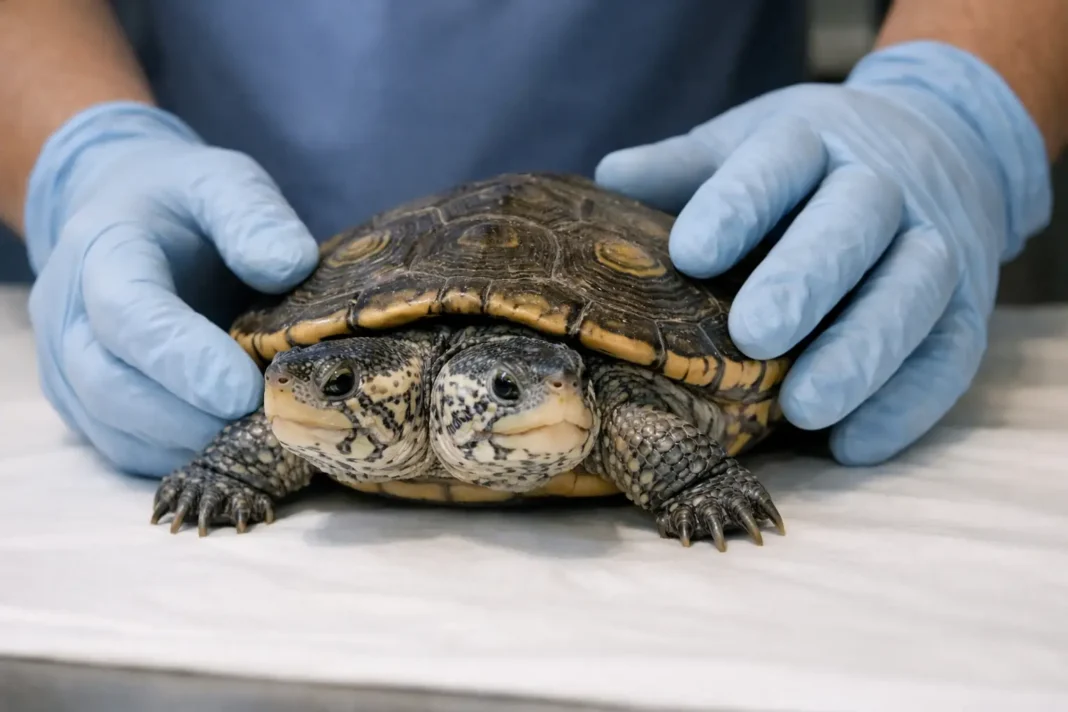

Two-headed terrapin hatchling discovered on Cape Cod has drawn attention from wildlife rescuers and researchers. The tiny diamondback terrapin, weighing about 5.2 grams, was located at a protected nesting site in Wellfleet by staff from Mass Audubon and transported on Sept. 17 to the Cape Wildlife Center in Barnstable for veterinary care. The animal, a hatchling of diamondback terrapin, arrived under the supervision of local rehabilitators and remains under close observation.
The condition, known as bicephaly, results when a single embryo begins to split but does not fully separate, producing two heads on a single body. Zak Mertz, chief executive of the New England Wildlife Centers, described the phenomenon as uncommon in terrapins and said both genetic and epigenetic influences are thought to contribute. Mertz and the center’s team noted that factors such as long lifespans, site fidelity to nesting beaches, limited genetic diversity, and incubation conditions like temperature and moisture may all play roles in the development of such anomalies.
While rare, bicephaly in wild animals is not unprecedented. The center identified this terrapin as the third two-headed hatchling reported in the region over the past five years, offering additional material for study. Research published in 2021 on two-headed sea turtle embryos and hatchlings reported craniofacial and spinal malformations and reduced body size compared with typical hatchlings, and concluded that such deformities can hinder feeding, movement and other functions essential for survival. Continued documentation of these cases helps scientists assess potential links between developmental anomalies and broader environmental or population health issues.
Diamondback terrapins inhabit brackish marshes along Atlantic and Gulf coasts and are considered vulnerable in parts of their range. In Massachusetts the species is listed as threatened under the state endangered-species framework; its federal status remains under review by the U.S. Fish and Wildlife Service (federal species page). Veterinarians at the Cape Wildlife Center are monitoring the hatchling closely and reporting observations to inform care and future study. The case underscores how individual rescue events can provide insight into conservation challenges facing coastal reptiles and their habitats.