
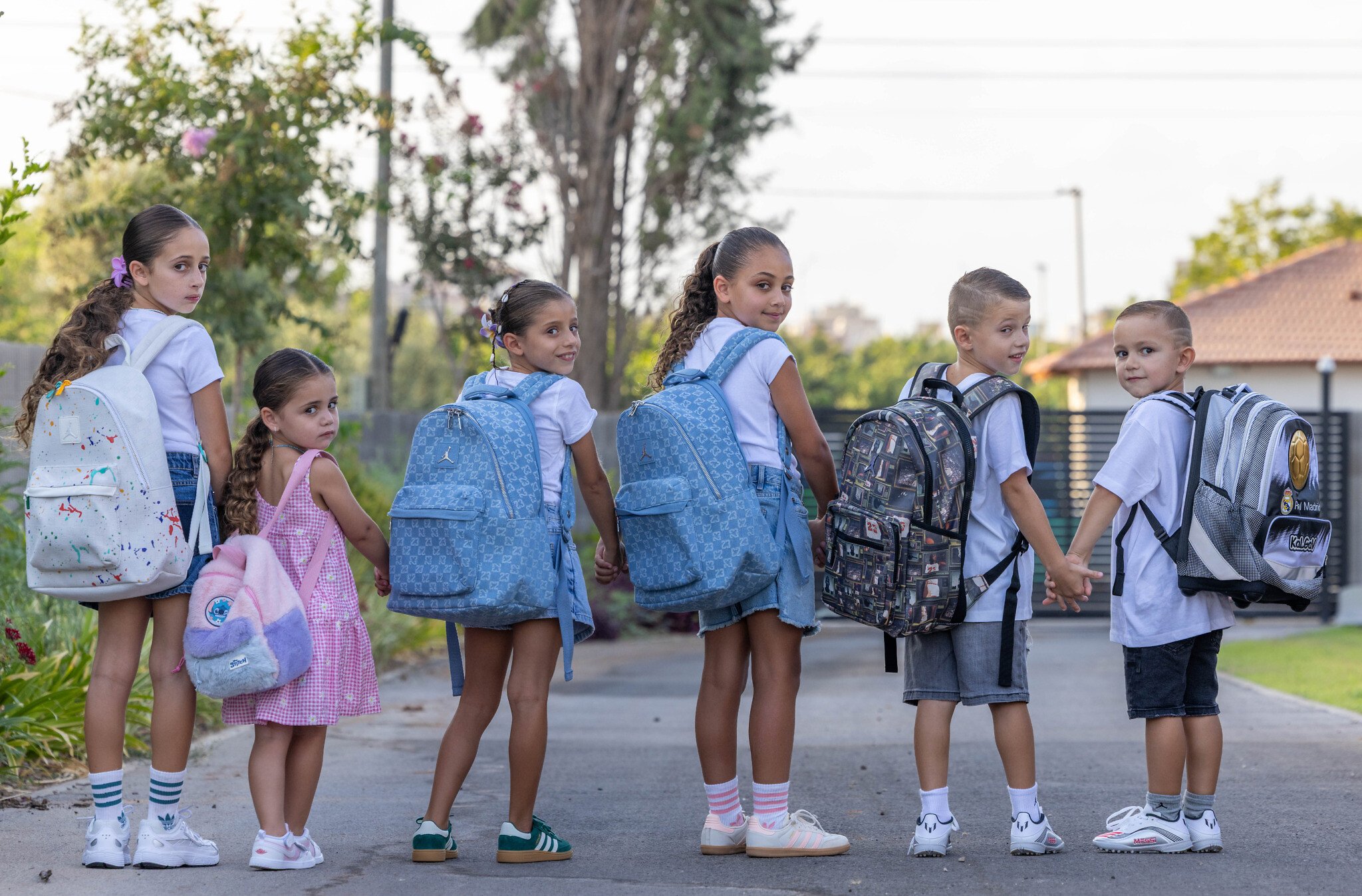

For the first time in Israel’s history, this year thousands more children will begin first grade in religious Jewish schools than in secular ones, according to data the Education Ministry provided to The Times of Israel, in a change that experts say could be a harbinger of a large-scale shift in society.
Additionally, the data shows that the number of first-graders in secular schools has declined for the second consecutive year, with 5,000 fewer incoming elementary school students than in September 2023, also marking an unprecedented occurrence.
Experts who spoke with The Times of Israel cautioned that data from individual years should be viewed with caution, as unique factors can influence them. Still, they acknowledged that these developments mark a dramatic shift compared to the traditional social makeup of the country.
And they highlighted concerns that that some streams of religious education are not adequately preparing their students for the modern world or to integrate and contribute to mainstream society — a shift that could fracture Israel’s tech-dependent economy and military.
“We are witnessing a change in the country’s structure,” said demographer Sergio DellaPergola, professor emeritus and former chairman of the Hebrew University’s Harman Institute of Contemporary Jewry.
Almost 180,000 children are set to start elementary school on Monday. Of them, 66,185 students will attend regular public schools (mamlachti); 29,470 national religious public schools (mamlachti–dati); and 42,751 ultra-Orthodox schools. In addition, 11,418 six-year-olds will attend Bedouin schools, 2,702 Druze schools, and 26,975 Arab schools (the data also includes 63 first graders registered at Circassian schools).
The total of children enrolled in Orthodox schools, therefore, stands at 72,221, or around 6,000 more than in secular Jewish schools.
Young ultra-Orthodox students in their school in the ultra-Orthodox Mea Shearim neighborhood in Jerusalem, on August 25, 2025. (Chaim Goldberg/Flash90)
The shift has been building for decades.
In 2000 — the earliest year for which data was provided to The Times of Israel — the balance was still decisively in favor of secular education: 51,680 first graders entered secular schools, compared to 16,639 in national religious institutions and 16,525 in Haredi ones.
In 2015, secular schools enrolled 66,059 first graders, while 23,083 entered national religious schools and 29,967 joined Haredi schools.
“I think the Education Ministry’s numbers tell us some interesting things,” DellaPergola told The Times of Israel in a phone interview.
“First of all, over the past 25 years, the overall share of Jewish and Arab first graders has remained relatively stable, with Arab students only slightly decreasing,” DellaPergola said.
In 2000, Arab children made up 26% of first graders, compared to 24% in 2015 and 23% in 2025.
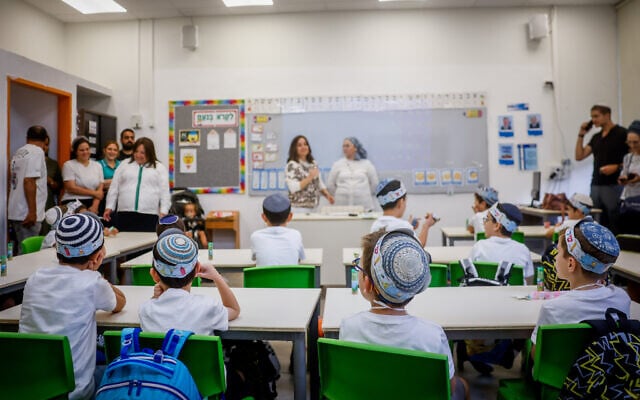
Israeli children on their first day of school in Jerusalem, on September 1, 2024. (Chaim Goldberg/Flash90)
“In contrast, the shift within the Jewish sector has been dramatic,” he said. In 2000, 61% of Jewish first graders were enrolled in secular public schools, 20% in national religious schools, and 20% in Haredi schools.
“Today, secular students account for 48%, national religious for 21%, and Haredi for 31%,” DellaPergola said.
The figures show that after years of relative stability — with between 70,000 and 72,000 secular first graders annually — the numbers began to decline in 2024 and again in 2025.
Asked whether the sharp drop in secular first graders might be linked to the unprecedented wave of emigration Israel has seen over the past two years, DellaPergola said such a connection was plausible.
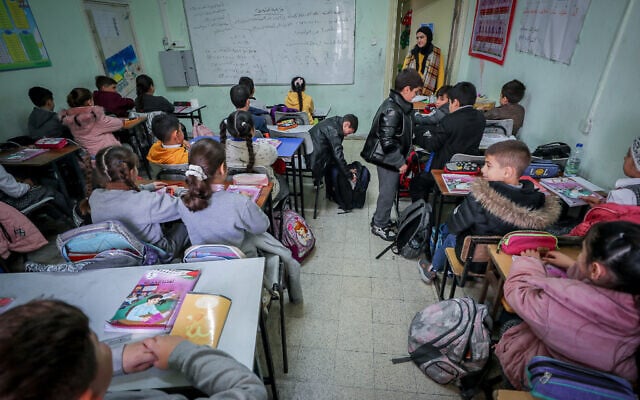
Arab students at the Noreen school, in the Jerusalem Arab neighborhood of Beit Hanina, on January 17, 2023. (Jamal Awad/Flash90)
Between 2023 and 2024, a record number of Israelis left the country. Some 82,000 who departed in 2023 had not returned by the end of 2024, while only 24,000 Israelis moved back during that period. Around 30,000 new immigrants also arrived.
The trend began alongside the government’s push for a controversial judicial overhaul in early 2023 that critics said was undermining democracy, and deepened after the Hamas-led attacks of October 7, 2023, and the ensuing war.
“It is reasonable to hypothesize that the decline in secular first graders is tied to emigration, since those leaving the country are more likely to be secular than religious or Haredi,” DellaPergola said. “But at this stage, we cannot say with certainty that this is the case.”
The demographer noted that data from the Central Bureau of Statistics show some 29,000 of those who left Israel were Israelis not recognized as Jewish by the Chief Rabbinate. While the Rabbinate recognizes only children of Jewish mothers as Jews, under the Law of Return anyone with a Jewish grandparent — along with their immediate family — is eligible to immigrate to Israel.
This population, numbering more than half a million in total, overwhelmingly enrolls its children in secular schools.
Hebrew University demographer Sergio DellaPergola. (courtesy/Sergio DellaPergola)
The demographer also pointed out that the overall number of first graders has dipped slightly in recent years. After peaking at an all-time high of 180,356, the figure dropped to 178,526 in 2024 before rising again to 179,564 in 2025. This follows a steady upward trend since 2000, when just 114,000 children entered first grade.
While birthrates among secular Israelis remain lower than those of their religious and Haredi counterparts — where families may average up to six children — they still exceed two children per woman, a level considered sufficient to maintain population size.
“More children are born in Tel Aviv, a largely secular city, than in any European country,” DellaPergola said.
A refusal to work and to serve in the army
DellaPergola also highlighted that the increase in the number of Haredi students presents important challenges for Israeli society.
“On the one hand, the state needs to provide resources [to the Haredi community] in light of their children’s right to receive an education; on the other, if in exchange for these resources we see a refusal to work and to serve in the army, we have a big problem,” he said.
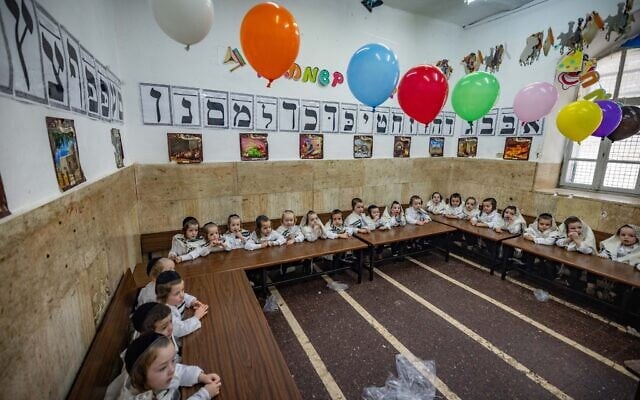
Ultra-Orthodox kids dressed up in costumes at their school, in Mea Shearim, Jerusalem, ahead of the Jewish holiday of Purim, on March 12, 2025. (Chaim Goldberg/Flash90)
The Haredi school system includes several types of schools, ranging from public schools that teach the full curriculum of core subjects required in Israel, to semi-private or completely private institutions that teach part or almost no core subjects at all, and are only partially funded by the state.
For years, the rapid growth of the Haredi community has fueled concern about its integration into broader Israeli society — particularly when it comes to sharing civic and economic responsibilities. Only 54% of Haredi men are employed, a large share of families live below the poverty line, and community leaders have consistently resisted efforts to draft young men into the army, despite the High Court of Justice ruling that decades of blanket exemptions were illegal as they violated the principle of equality.
Below the entire developed world in math, science, and reading
According to Prof. Dan Ben-David, head of the Shoresh Institution for Socioeconomic Research and a senior faculty member in the Department of Public Policy at Tel Aviv University, the Haredi community is just one of the challenges facing the Israeli education system.
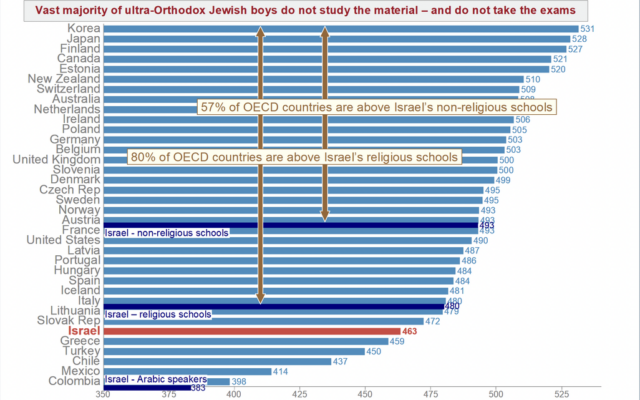
Data from the Shoresh Institution for Socioeconomic Research show Israeli students overall place 31st out of 36 countries in the OECD’s Programme for International Student Assessment (PISA) for the years 2006-2022. (Courtesy Dan Ben-David/Shoresh Institution for Socioeconomic Research)
“Israel is basically below the entire developed world in math, science, and reading,” Ben-David said in a phone interview.
He cited Israel’s performance over many years in the OECD’s Programme for International Student Assessment (PISA), which assesses the general level of students in member countries.
“Secular schools in Israel perform the best in the country, yet their students still rank below most OECD peers,” Ben-David said. “National religious schools score lower than 80% of other countries, while Arab students rank below many developing nations. As for Haredi schools, they are not even part of the equation, since their students generally do not take these exams.”
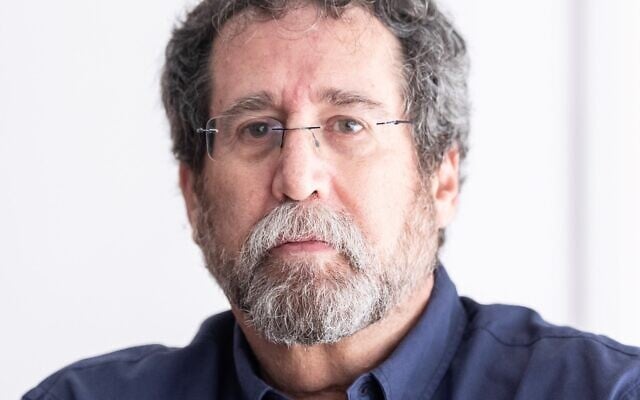
Professor and Ben-David (Courtesy)
Shoresh data show Israeli students overall placed 31st out of 36 countries, with South Korea, Japan, and Finland leading the list. If only secular schools were considered, Israel would rise to 22nd place, just above France and the United States. National religious schools alone would rank 29th, between Latvia and Italy, while Arab students would fall to the very bottom of the ranking.
“This is how we are preparing our children to compete with students from other countries, in a global economy,” Ben-David warned.
Given the poor level of instruction in core subjects within the Haredi sector, he added, “roughly half of Israeli children are receiving what is essentially a third-world education.”
“If today they are half of the children, tomorrow they are going to be half of the adults, and more,” Ben-David said. “The share of the Haredi community in the general population is simply doubling every 25 years.”
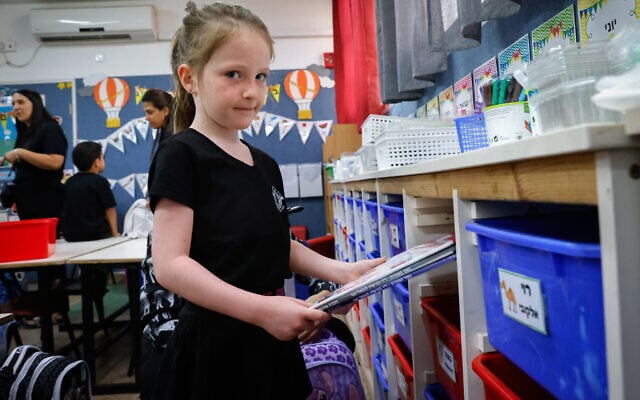
An Israeli girl who is about to start first grade meets with her new teacher at the Tali school in Jerusalem on August 28, 2025. (Yossi Zamir/Flash90)
In the city of Jerusalem, for example, the largest in Israel, Haredi first graders are almost double the first graders from the Jewish religious and secular populations combined (8,652 compared to 4,643), according to numbers provided to The Times of Israel by the city’s municipality. Additionally, the number of Arab children who are starting elementary school stands at 7,780.
Ben-David stressed that urgent action is needed to reform Israel’s education system. He pointed out that, despite Israeli students spending more days in school and more hours in the classroom than almost all OECD peers, their educational outcomes remain far below international standards.
“A majority of adults who received a third-world education cannot sustain a first-world economy, nor a first-world army,” he said. “We are facing a national security emergency.”



