
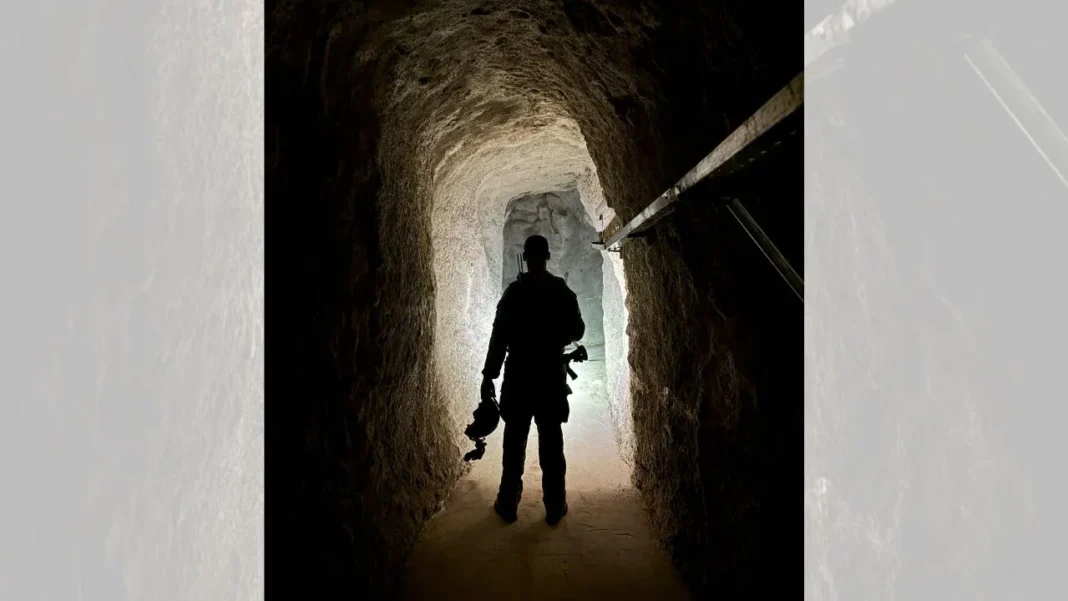

The IDF on Tuesday announced it has destroyed the largest Hezbollah tunnel city in all of southern Lebanon, a network built with significant aid from Iran.
According to the IDF, this network could house and provide weapons, communications, and other operational infrastructure for thousands of Radwan special forces fighters in the area.
During the 2024 invasion of Lebanon, the IDF previously found three tunnel city-type networks, but this one, near Kantara, is the largest.
Kantara is around 11 kilometers into southern Lebanon, roughly situated parallel to the midpoint of where Margaliyot and Dovev are located on the Israeli side of the border.
Next, the IDF said that the tunnel runs two kilometers in length and 10 kilometers in width, with photos showing that it spreads out in several different directions, covering numerous other villages in the area.
IDF destroys the largest Hezbollah tunnel city in Southern Lebanon, built with aid from Iran. April 28, 2026.
Tunnel network even larger than described
In fact, the tunnel network is even larger than described, as this description only includes the large western portion of the network.
There is an almost parallel eastern tunnel network, which Hezbollah probably intended to connect to the western network at some point, but never got around to doing so.
That eastern network is also quite large and is also being destroyed.
Division 36, including Brigade 7, the Golani Brigade, commandos, and the Yahalom special forces until were all involved in extended fighting moving from east to west in Lebanon from Rav Talatin to a-Taibah and eventually to Kantara.
According to the IDF, Division 36 is the last IDF division that has still been penetrating into new areas, with other IDF divisions already having shifted in the last week or so to cleaning out Hezbollah weapons and lookout posts.
Now, Division 36 will also likely shift to the cleaning-out mission.
The IDF said that Kantara has complex topography in that it is connected both to portions of southern Lebanon closer to the Israeli border, but also connects to Hezbollah forces east of the Wadi Saluki.
Further, the IDF said that in this area, it faced a complex mix of short-range close-quarters fighting, along with long-range attacks by Hezbollah from positions that are further North in Lebanon.
Long-range attacks have included rockets, anti-tank missiles, and drones, including First Person View (FPV) drones, which use technology and manual operators that make them harder to jam and much more deadly.
A number of recent incidents in which IDF soldiers were killed or wounded came from such FPV attacks.
The IDF admitted that it does not yet have a full answer for FPV attacks, though in general, it has improved in anti-drone defenses since 2023.
Another tactic it has tried is using Israeli intelligence to more widely target all aspects of the FPV drone ecosystem, from materials used to make the drones, to operations centers, to tracking and killing operators, even when they are not using the drones at a specific moment.
This Kantara area has been one of Hezbollah’s main fallback positions for storing enough infrastructure for an invasion of northern Israel after it lost its first line of defense of southern Lebanese villages to Israel in fall 2024.
Regarding evidence of Iranian involvement in building the Kantara tunnel network, the IDF said that it has evidence of Iranian funding and planning, including certain modes of building and operating the tunnel which are uniquely Iranian in terms of being a higher level of professionalism as compared to other Hezbollah tunnels.
Iranian weapons discovered in tunnel network
In addition, the IDF found trademark Iranian weapons in the tunnel network.
Although the IDF knew about the tunnel’s general existence in 2024, the military said the conditions were not yet ripe for such a deep penetration into southern Lebanon, with most of the IDF at that time not penetrating deeper than three to five kilometers.
However, even knowing that the tunnel network existed in the Kantara area, the IDF said that the special forces Yahalom tunnel location unit needed over a week to find all of the various entrances of the network to fully map it out.
Hezbollah had spent more energy than usual, cleverly hiding the network under a variety of civilian structures.
The IDF used hundreds of tons of explosives to destroy the tunnel, which at points reaches 25 meters or more deep.
The IDF said that Division 36 has not seen many Lebanese civilians yet returning to its area of control.
According to the IDF, this could be because the area Division 36 is operating in has had continued fighting even this week.
In contrast, areas where civilians have returned have gotten quieter, and the IDF said it is possible that with fighting concluding in the Kantara area, more civilians might start trying to return.
Source:
www.jpost.com




