

When talking about dental health, most of us immediately think of sweets: Candies, toffee, caramel, chocolate, cookies, snacks, sugary drinks. But in terms of the teeth, not every sweet behaves the same way. There is a big difference between food that washes out of the mouth quickly and food that sticks to the teeth and stays there for a long time; there is a huge difference between regular sugar that feeds cavity–causing bacteria and a sweetener that the bacteria can barely break down; and there is also a difference between regular milk chocolate and dark chocolate, especially sugar–free varieties.
So, if you are already snacking, and assuming that sugar–free gum is not really a “candy,” the choice that is least damaging to the teeth is sugar–free dark chocolate. Not because it is a health food that should be eaten without limitation, but because compared to candies, toffee, caramel, gummies, pretzels, or Bamba, it has several real advantages.
Why is sticking to the teeth so important?
Cavities do not form just because we ate sugar once. They are related to the amount of sugar, the frequency of eating, the duration of time that the carbohydrates remain in the mouth, the composition of the saliva, brushing, and fluoride. One of the important factors is the duration of exposure: The longer sweet or starchy food remains between the teeth, the more time oral bacteria have to break it down and produce acids that damage the enamel.
Studies in the field of dentistry show that free sugars are a major factor in the development of cavities, but the form of the food, the texture, the duration of time spent in the mouth, and the frequency of eating also affect the risk.
A review article published in the American Journal of Clinical Nutrition emphasized that it is not only the amount of sugar that determines the risk, but also the form of the food and the duration of its exposure to the teeth. Sticky foods or those that break down slowly in the mouth can prolong the duration of the drop in pH within the plaque, meaning the time during which the tooth environment is more acidic and less friendly to the enamel. This is why gummy candies, toffee, and caramel are particularly problematic: They not only contain sugar, but they also adhere to the teeth. Lozenges are problematic because they remain in the mouth for a long time.
In another category – halva, for example, can stick because of its texture. Salty snacks like pretzels and Bamba are also not completely innocent in terms of the teeth: They break down in the mouth into starches, get stuck in the crevices and gaps, and the saliva breaks down the starch into simpler sugars. For the bacteria, this can still be a celebration.
Why does chocolate behave differently in the mouth?
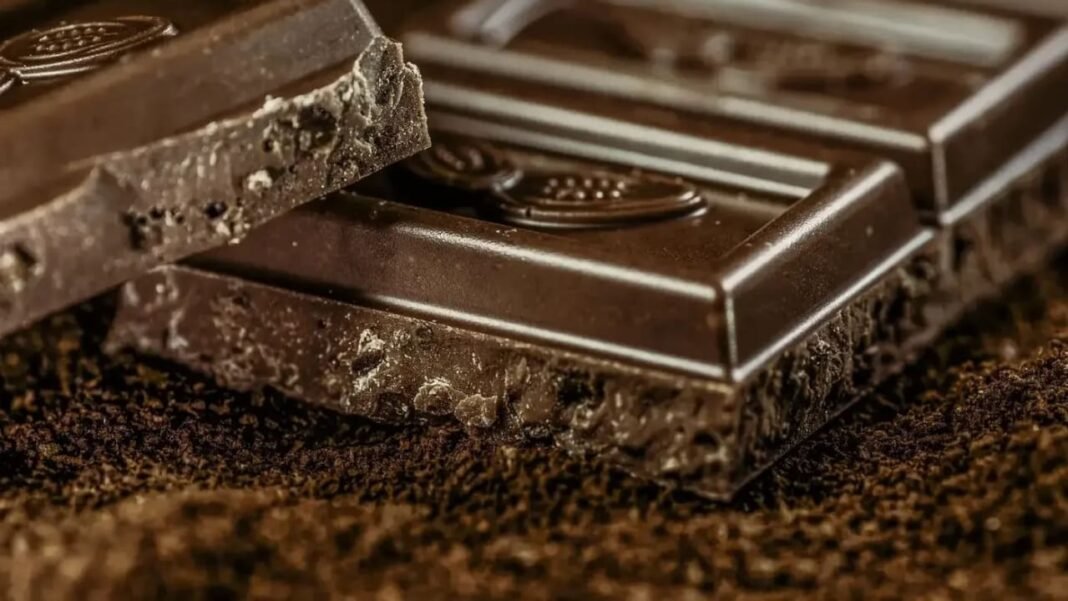
Chocolate, especially dark chocolate, melts relatively quickly and does not stick to the teeth like toffee, gummies, or starchy snacks.The fat in chocolate causes it to melt and disappear from the mouth faster compared to sticky foods. This does not mean it magically “protects” the teeth, but in terms of residence time and sticking, it is generally less problematic.
When it comes to sugar–free dark chocolate, there is an additional advantage: It contains no regular sugar that feeds cavity–causing bacteria in the same way.
Most sugar–free chocolates contain sugar alcohols, such as maltitol, and sometimes also erythritol or other combinations. These sweeteners are not broken down in the mouth as efficiently as sucrose, and are therefore considered less cariogenic, meaning less likely to promote cavities.
Reviews in the field of dentistry note that sugar–free products based on polyols, such as xylitol, erythritol, sorbitol, and maltitol, reduce the risk of cavities compared to products containing regular sugar, provided they replace sugar and are not added to it.
What is in cocoa that interests dental researchers?
Here comes the more surprising part. We already know that cocoa beans are not just a “chocolate flavor” but contribute quite a bit to our health. They are rich in polyphenols, tannins, flavonoids, and it turns out, they contain additional substances that have been studied in the context of oral bacteria, plaque, and inflammation.
Laboratory studies have found that some of the polyphenols in plants, including cocoa, can inhibit the growth and adherence of bacteria associated with cavities, such as Streptococcus mutans, and affect plaque formation. A review published in the journal Molecules concluded that plant polyphenols have potential anti–cariogenic activity, among other things, through their effect on bacteria, their adherence to teeth, and their acid production.

It is important to be precise: Most of the evidence regarding cocoa and teeth comes from laboratory studies, small studies, or studies on isolated cocoa components.
You cannot take away from this a message of “chocolate prevents cavities.” It is possible to say that cocoa itself contains interesting components in terms of oral health, and that sugar–free dark chocolate rich in cocoa is a better choice than sweet milk chocolate, sticky candies, or snacks that stick to the teeth.
Sugar–free chocolate for children
Sugar–free chocolate is not dangerous for children in small amounts once in a while, but it should not become a major daily habit. In children, maltitol and other polyols can cause stomach discomfort more quickly if eaten in large quantities. In addition, one should be careful with the message: “Sugar–free” does not mean “limitless.” It is better for children to get used to small portions of sweets, rather than the thought that a sugar–free product is an unrestricted snack.
If you are already giving a sweet, it is preferable to choose something that finishes quickly in the mouth and does not stick to the teeth. A small square of chocolate is preferable in terms of the teeth to a lozenge that stays in the mouth for a quarter of an hour, or to a toffee that adheres to the crevices. And still, after eating a sweet, it is important to drink water, not to snack on sweets repeatedly throughout the day, and to maintain regular brushing.
A small square with coffee
In a balanced menu, a small square of chocolate with coffee can certainly be a snack. You can vary this, of course, with yogurt, fruit, almonds, nuts, or a small sandwich, but chocolate in a defined amount of one square is not a “slip–up.” It simply needs to be planned rather than continuous eating from the wrapper.
In my opinion, even on a diet, the best choice would be sugar–free dark chocolate, or dark chocolate with 70% cocoa or more, in the amount of one square. For those who have diabetes or pre–diabetes, it is advisable to check the ingredients list, pay attention to the type of sweetener and the total amount of carbohydrates, and not settle for the “sugar–free” label on the packaging.
The bottom line: If you are already having a sweet, sugar–free dark chocolate is one of the choices least damaging to the teeth, and is usually also preferable in terms of blood sugar fluctuation compared to regular sweets. It melts quickly, sticks less, does not provide cavity–causing bacteria with regular sugar, and cocoa itself contains components that have been studied in the context of oral health.
But as always in nutrition, here too the quantity makes the difference: A small square with coffee, yes. A whole bar because “it’s sugar–free,” absolutely not.
Source:
www.jpost.com



