
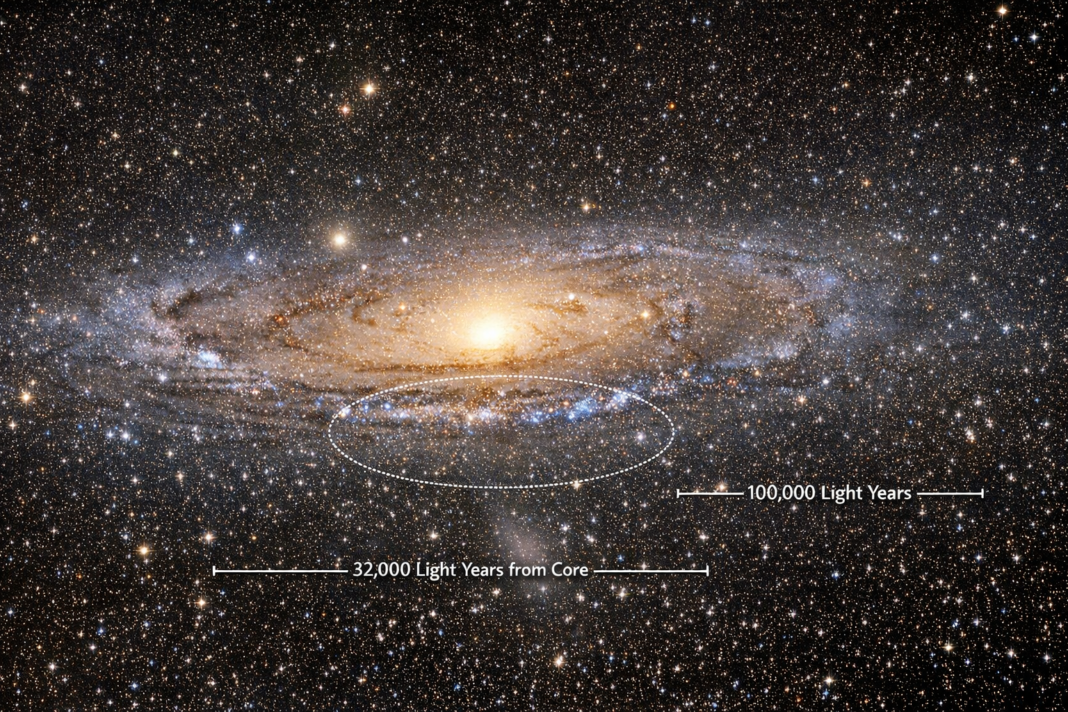

Hubble observations reveal a new analysis of archival Hubble Space Telescope imagery shows the Andromeda galaxy (M31) has steadily reduced its star formation rate over the last 500 million years. The research, published July 27 in The Astrophysical Journal, combined two major Hubble surveys that mapped roughly two‑thirds of Andromeda’s disk and catalogued about 200 million individual stars. Study co‑author Ben Williams of the University of Washington emphasized that resolving individual stars provides the fossil record needed to reconstruct the galaxy’s formation history.
Quantitative analysis indicates Andromeda formed stars at roughly one solar mass per year about 500 million years ago; by 40 million years ago that rate had declined by approximately half, and the present rate is near one‑fifth of a solar mass per year. The team found that most recent star formation has been concentrated in a ring roughly 32,000 light‑years from the galaxy’s center and that diminishing activity within this ring accounts for much of the overall slowdown rather than a sudden, galaxy‑wide exhaustion of gas.
Earlier epochs include a pronounced starburst about two billion years ago that is thought to have generated about 20 percent of Andromeda’s stars, an event likely linked to a merger with the compact elliptical companion M32. Researchers examined regions nearest to M32 and observed a more recent decline in those areas, but they characterize the evidence as inconclusive regarding a direct causal role. The authors note that the forthcoming Nancy Grace Roman Space Telescope, scheduled to launch on a SpaceX Falcon Heavy, will survey the entire galaxy and halo with a field of view far larger than Hubble’s, enabling more comprehensive mapping.
Andromeda remains an important laboratory for understanding large spiral‑galaxy evolution: at about 2.5 million light‑years distant and roughly twice the mass of the Milky Way, it offers close‑range detail on when and where stars form. The galaxy is most visible from Earth in November. While models project a possible interaction with the Milky Way in roughly five billion years, the precise long‑term trajectory remains under study; researchers will continue to analyze Hubble’s archive and prepare Roman observations to refine Andromeda’s star‑formation chronology.






