
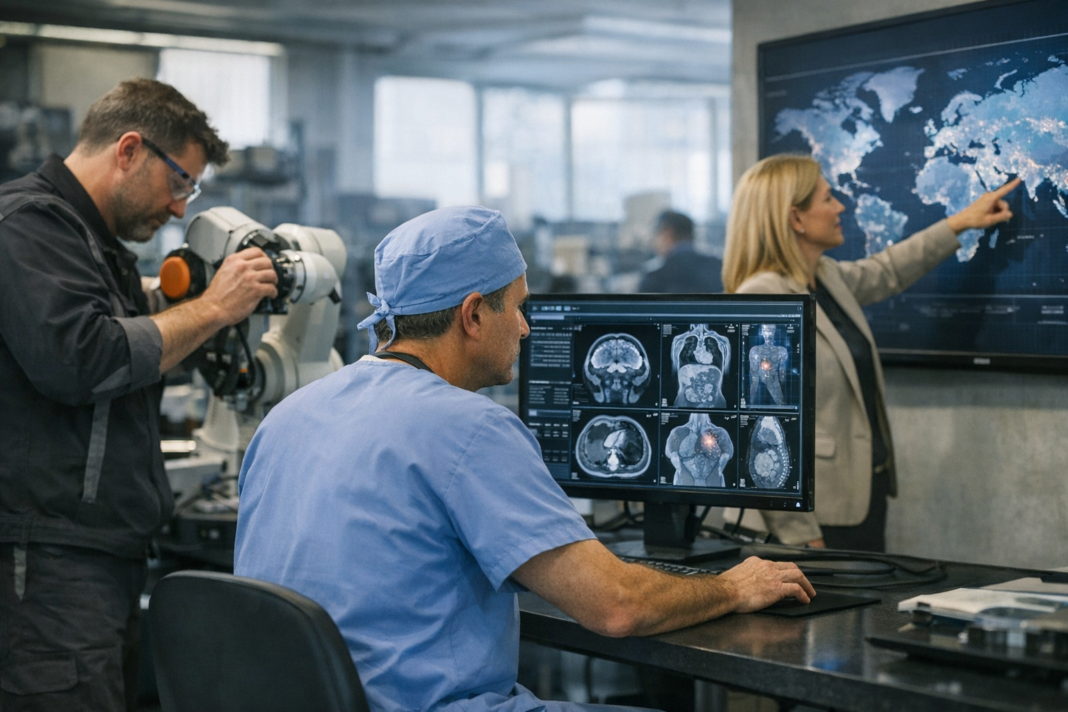

Artificial intelligence is altering core dimensions of contemporary life, with measurable effects on labor markets, medical practice and international security. As technologies such as large-scale machine learning and generative models move from research labs into everyday use, businesses, regulators and public institutions are adapting to concrete challenges and opportunities. The conversation now centers on practical consequences—how jobs are organised, how care is delivered and how states manage risk—rather than abstract promises.
In economic life, automation and cognitive augmentation are changing how work is performed. Sectors that rely on routine data processing have already incorporated algorithmic tools to speed decision-making and reduce repetitive tasks, while other industries deploy AI to optimise supply chains and customer service. These shifts are prompting firms and public authorities to invest in workforce training, labour-market transitions and new forms of social protection. Policy debates focus on balancing productivity gains with measures to support displaced workers and to ensure equitable access to the benefits of innovation.
In medicine and the life sciences, algorithmic systems are increasingly used for image interpretation, clinical decision support and early-stage drug discovery. Clinical sites and research institutions are testing models that assist clinicians and accelerate experimental cycles, while health regulators and organisations consider standards for safety, transparency and data governance. The World Health Organization and national agencies have published guidance and assessments addressing deployment risks and validation needs, reflecting the sector’s emphasis on evidence, oversight and patient protection. See broader coverage at healthcare.
On the geopolitical front, states and alliances are assessing the implications of AI for cybersecurity, information environments and military systems. Security institutions and diplomatic bodies are engaging in technical and normative work to manage dual-use technologies and to discourage destabilising applications. Regulatory initiatives in Europe and engagement by organisations such as the European Commission and NATO illustrate efforts to combine legal frameworks, standards and international dialogue. The resulting landscape will determine how risks are mitigated and how benefits are distributed across societies. For broader context on the technology itself, consult artificial intelligence and geopolitics.






