
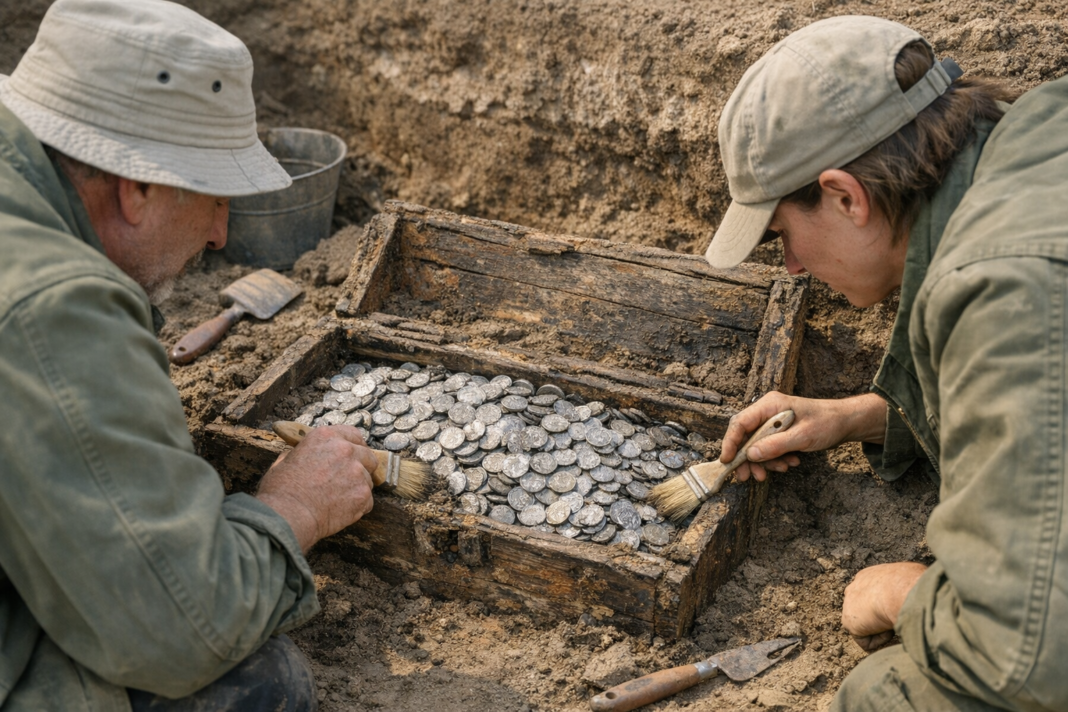

Medieval hoard of 2,600 silver coins has been recovered from a ceramic jug buried in a pit in the historic centre of Kolomna, about 114 kilometres southeast of Moscow, archaeologists report. The discovery, announced by the Institute of Archaeology of the Russian Academy of Sciences, includes more than 350 coin varieties not previously documented and represents one of the largest medieval coin hoards found in the region.
The assemblage is dominated by a type known as the denga, a small silver coin first issued in the late 14th century under the Grand Principality of Moscow. Many pieces in the hoard were struck in Kolomna during the reigns of Vasily I (1389–1425) and Vasily II (1425–1462). Contemporary accounts and numismatic conventions place the denga at half the value of a kopek, with one ruble equal to 100 kopeks, situating the hoard within the monetary system of late medieval Muscovy and offering material evidence for local minting practices.
Among the finds is an especially rare denga depicting a bird in flight, attributed to the closing years of Vasily I‘s rule. Specialists from the institute note that over 350 of the coins are previously unknown varieties minted in Kolomna; these will be subjected to further study to clarify chronology, workshop attributions and circulation patterns. The burial context — coins placed in a ceramic jug and interred in a pit — suggests deliberate concealment by an owner of considerable means. The institute characterises that owner as likely a high-ranking official or prosperous merchant, based on the hoard’s size and composition.
The latest coins in the deposit date to the second half of the 1420s, which provides a potential chronological marker for the burial. Researchers point out that a plague epidemic affected Russian principalities between 1424 and 1427, and this calamity is a plausible explanation for why the hoard remained unrecovered. Beyond its immediate numismatic significance, the find promises new data for scholars reconstructing economic networks and urban importance in 14th–15th century Russia, and it underscores Kolomna’s role as a major regional centre during this period.






