
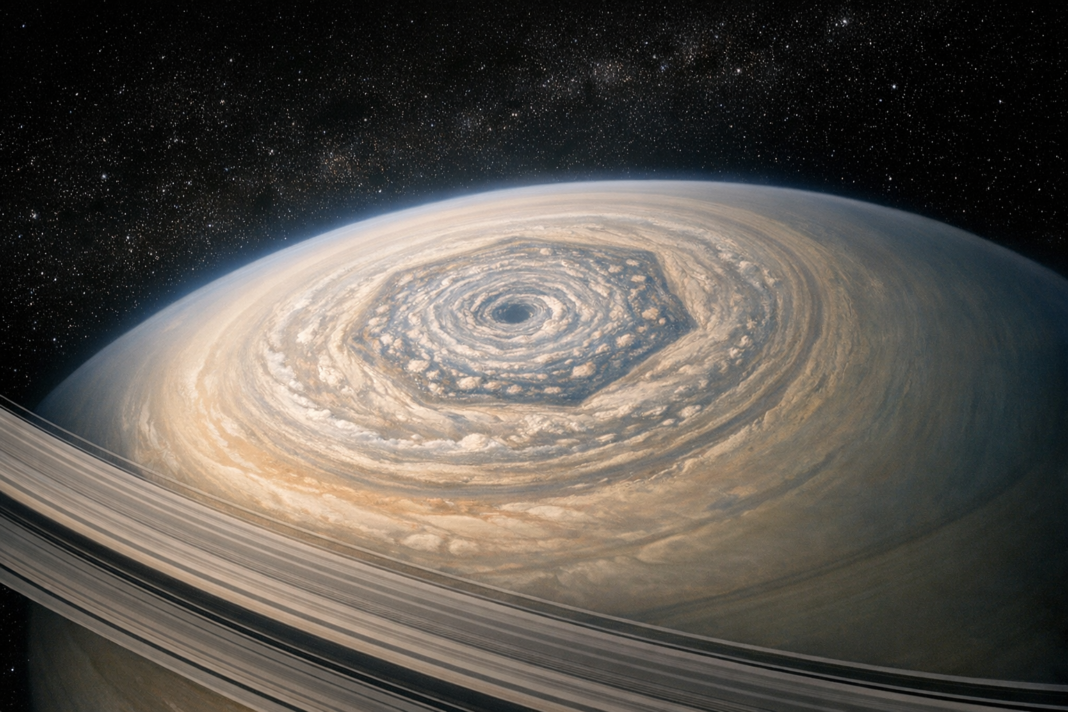

NASA scientists have identified a large ten-sided atmospheric structure encircling the south pole of Saturn. Images and measurements drawn from observations by the Hubble Space Telescope indicate that the geometric pattern — a decagon — began to appear in the past several years and has been strengthening in successive data sets. The feature offers a clear counterpart to the planet’s well-known northern hexagon and represents a rare opportunity to study polygonal jet-stream phenomena on a gas giant.
The northern hexagon has been a persistent and widely studied feature of Saturn’s atmosphere for decades, and the sudden visibility of a south‑polar decagon shifts scientific attention to comparative dynamics between hemispheres. Ground‑based telescopes and past spacecraft missions have established that large‑scale, long‑lived polygonal flows can exist on Saturn; the recent Hubble observations now allow researchers to track a similar structure developing on the opposite pole. The symmetry is striking in geometric terms, but researchers emphasize that the underlying atmospheric processes remain to be determined.
Scientists say the most immediate questions concern origin and longevity. Analysis of the Hubble data suggests the decagon is a manifestation of organized atmospheric waves and jet interactions in the polar vortex, but distinguishing among competing physical mechanisms requires continued monitoring and modelling. Research teams plan to combine the optical imaging with other datasets and numerical simulations to test whether the pattern arises from changes in wind speeds, thermal contrasts, or wave resonance within the polar circulation, and to assess whether it could endure for years or even decades.
Ongoing observations by space‑based observatories and Earth‑based facilities will be crucial to follow the decagon’s evolution and to refine atmospheric models. If sustained, the south‑polar structure will provide a new benchmark for understanding planetary meteorology and will inform broader studies in planetary science. Continued, coordinated monitoring will determine whether this geometric pattern becomes a long‑term feature of Saturn’s climate or a transient expression of polar atmospheric variability.






