
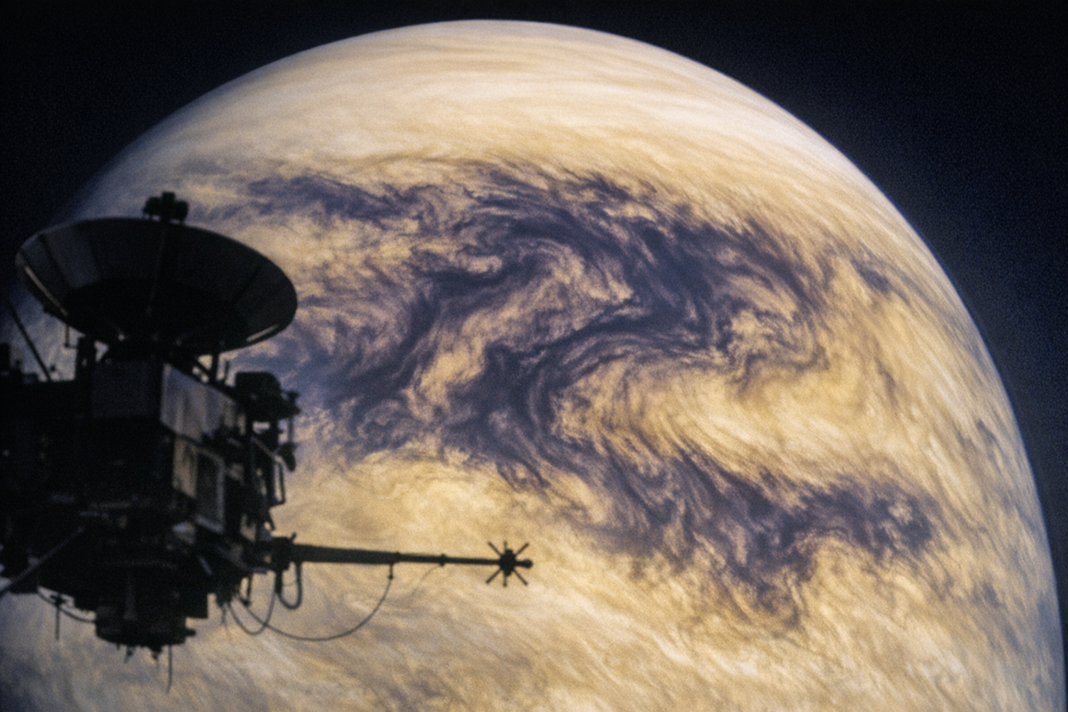

New calculations narrow a long-standing puzzle about the pale yellow clouds that cloak Venus. Researchers have estimated how strongly the unidentified material responsible for the planet’s dark ultraviolet markings must absorb sunlight, a constraint that significantly reduces the range of feasible explanations and refines what future investigations should target.
The dark patterns visible in ultraviolet images of Venus have been noted for roughly a century and remain one of the planet’s most persistent enigmas. While the bulk of Venus’s cloud tops are composed of sulfuric acid droplets, the specific component that produces the pronounced ultraviolet contrast has resisted identification. The recent work does not identify that component but provides a quantitative description of its optical behaviour: any candidate must match the newly determined absorption strength across the wavelengths where the patterns appear.
The practical outcome of these limits is immediate: many previously proposed explanations are now less likely, and instrument teams preparing remote-sensing campaigns can prioritize measurements that will best distinguish between the remaining candidates. Constraining the absorber’s optical properties helps define which spectral bands and detector sensitivities are most useful, and it informs laboratory studies that seek to reproduce cloud chemistry under Venus-like conditions. These steps are critical both for interpreting current telescopic data and for designing payloads on upcoming missions.
Looking ahead, the combined approach of targeted observations, laboratory spectroscopy and in situ sampling offers the clearest route to resolution. Precise measurements of how cloud particles absorb and scatter ultraviolet light will either reveal a familiar chemical mixture—organic or inorganic—or point toward an unexpected process operating in the planet’s upper atmosphere. Establishing the absorber’s identity matters beyond solving an observational curiosity: it bears on models of Venus atmospheric chemistry, cloud formation and radiative balance, improving our understanding of how terrestrial planets evolve under dense, corrosive atmospheres.





