
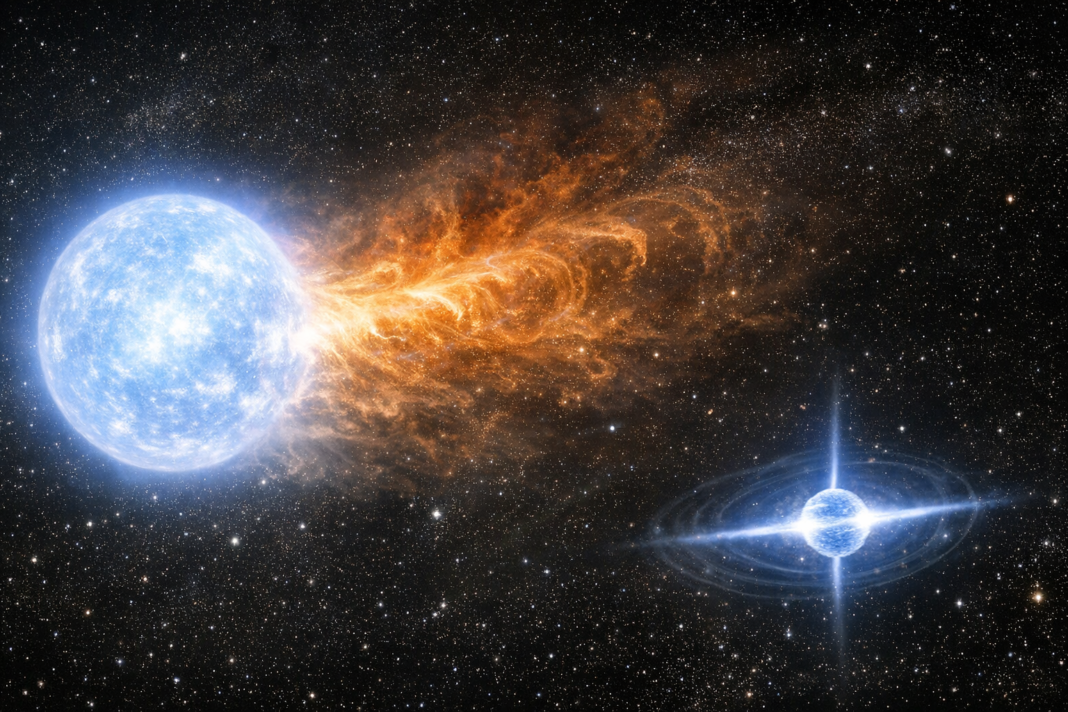

Giant stellar wind plume appears responsible for a pattern of bright X-ray flares from a compact object in the binary system BP Crucis, new observations show. Located about 13,000 light-years away, the system pairs the blue hypergiant Wray 977—roughly 60 times the mass of the Sun—with the dense remnant neutron star known as GX 301-2, a rapidly rotating pulsar that emits regular beams of X-rays toward Earth.
Unlike many pulsars that shine principally from their rotation-powered beams, GX 301-2 produces episodic bright flares in addition to its roughly 11-minute pulses. The system follows a 41.5-day orbit, and astronomers long suspected those flares were linked to streams of material from the companion. The hypergiant expels a concentrated plume of ionized gas at extremely high speed—hundreds of thousands of kilometres per hour—and when the neutron star traverses that plume it accretes material that ignites powerful X-ray emission.
New data from XRISM, a mission operated jointly by NASA and JAXA, captured a 16-hour interval that coincided with one of the prominent flares. The high-resolution spectra revealed rapidly varying emission and absorption features that trace how the dense wind plasma flows and momentarily piles up around the neutron star. The analysis—published in Science Advances—constitutes the first clear detection of a stellar-wind plume interacting directly with a compact stellar remnant, according to the study authors Roi Rahin and Nazma Islam, and provides data that make detailed simulations possible.
The results establish BP Crucis as a natural laboratory for wind-fed accretion onto pulsars and set a baseline for future monitoring with XRISM and other observatories. Project scientists including Brian Williams at NASA Goddard note that repeating these targeted observations during subsequent orbital passages will help quantify how plume structure, orbital geometry and magnetic fields combine to produce the observed X-ray behaviour and refine models of extreme mass transfer in massive binaries.






