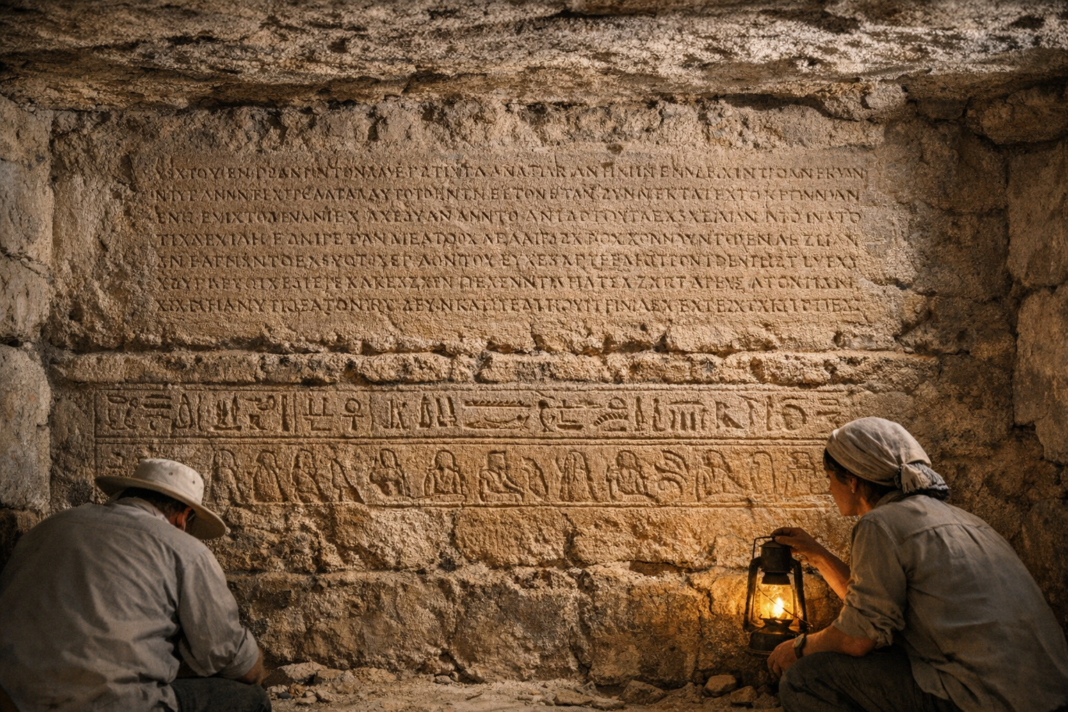

1,700-year-old limestone tomb uncovered in the Dakhla Oasis contains a rare 19-line poem inscribed in ancient Greek alongside traditional Egyptian funerary inscriptions. The structure, with a small pyramid-shaped roof, lies near the ruins of ancient Mothis (modern Mut) and dates to the fourth century, a period when Roman authority extended over Egypt. The find was described in a statement shared by the Egyptian Ministry of Tourism and Antiquities.
The burial chamber appears to have been built for a married couple and includes a carved stone plaque bearing the Greek poem. The deceased man is named Pisechtes, described in the inscription as a kind and wise advisor and possibly a judge; the report did not note any recovered human remains. Alongside the Greek text, hieroglyphic passages invoke protective spells and refer to elements of the Amduat, the funerary narrative of the sun god’s nightly journey. Excavators also found an offering table, a purification basin, pottery and at least one coin depicting Constantine the Great, though no Christian imagery was observed inside the tomb.
Access to the burial is via fourteen steps; the entrance is decorated with a winged sun disk, an image of the god Osiris and two cobras. A later mud-brick shrine erected above the doorway suggests the tomb may have been reused after the original interments. The combination of Greek epigraphy and Egyptian ritual elements points to the coexistence of cultural practices in this region of the oasis system.
The Greek inscription is a lament in which the son, named Sarapion, addresses his father with the phrase translated as “Listen, father!” and asks that funerary libations and offerings be accepted. Angelos Chaniotis, a scholar at the Institute for Advanced Study, described the verse as “a highly literary and original epigram,” noting grammatical affinities with Homeric style and the use of diacritical marks that point to a high level of education on the part of the author.
The discovery contributes material evidence on funerary practice and cultural interaction in Roman-period ancient Egypt and will inform further study of bilingual inscriptions and ritual continuity. The archaeological team has published images and preliminary notes via the ministry; further analysis of the text and context is expected as specialists complete documentation and conserve the finds.