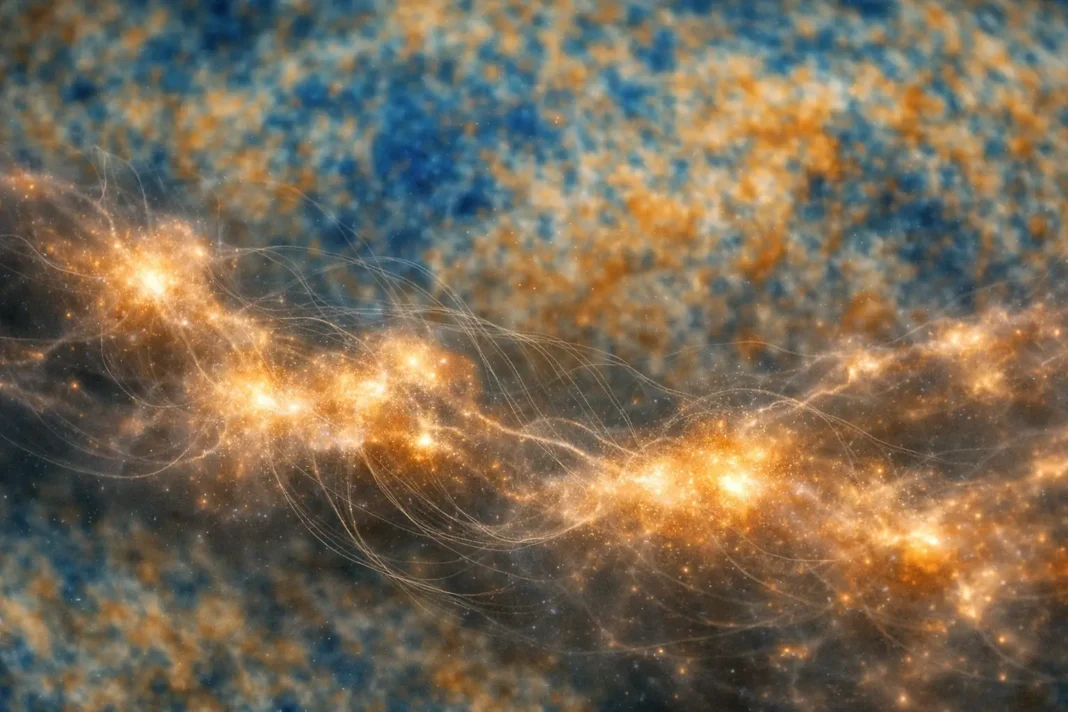

Tiny primordial magnetic fields generated soon after the Big Bang may provide a missing ingredient in the persistent disagreement over the universe’s expansion rate. Researchers using detailed numerical simulations find that even weak magnetic fields present in the early plasma can alter the process by which electrons and protons combined into neutral hydrogen, with measurable consequences for the cosmic microwave background.
The simulations indicate that these fields change the timing and efficiency of recombination, the epoch when the universe became transparent to radiation. That epoch sets the properties of the last-scattering surface imprinted on the background radiation, so small shifts in recombination can modify the pattern of temperature and polarization fluctuations observed today. Because cosmological parameters such as the Hubble constant are inferred from those fluctuations, a revised recombination history can alter the expansion rate deduced from early-universe measurements.
The finding is relevant to the long-standing “Hubble tension,” the mismatch between the expansion rate inferred from early-universe probes like the Planck measurements of the background and the higher values obtained from direct, late-universe methods such as supernovae and Cepheid-variable studies. The new effect does not yet provide a definitive resolution, but it demonstrates that previously neglected physics in the primordial plasma can bias the early-universe inference. Re-examining existing datasets in light of these results could change the early-universe estimate; the work also underscores the need for tighter constraints on primordial magnetic fields.
Next steps include confronting the simulations with observational signatures and refining theoretical models of recombination in the presence of magnetic fields. Planned and future measurements of the cosmic microwave background, together with complementary probes of large-scale structure and primordial chemistry, will be needed to test whether these tiny fields materially shift the inferred expansion rate. If confirmed, the effect would be an important correction to the cosmological model rather than a new exotic component, with implications for how cosmologists combine early- and late-universe observations.