
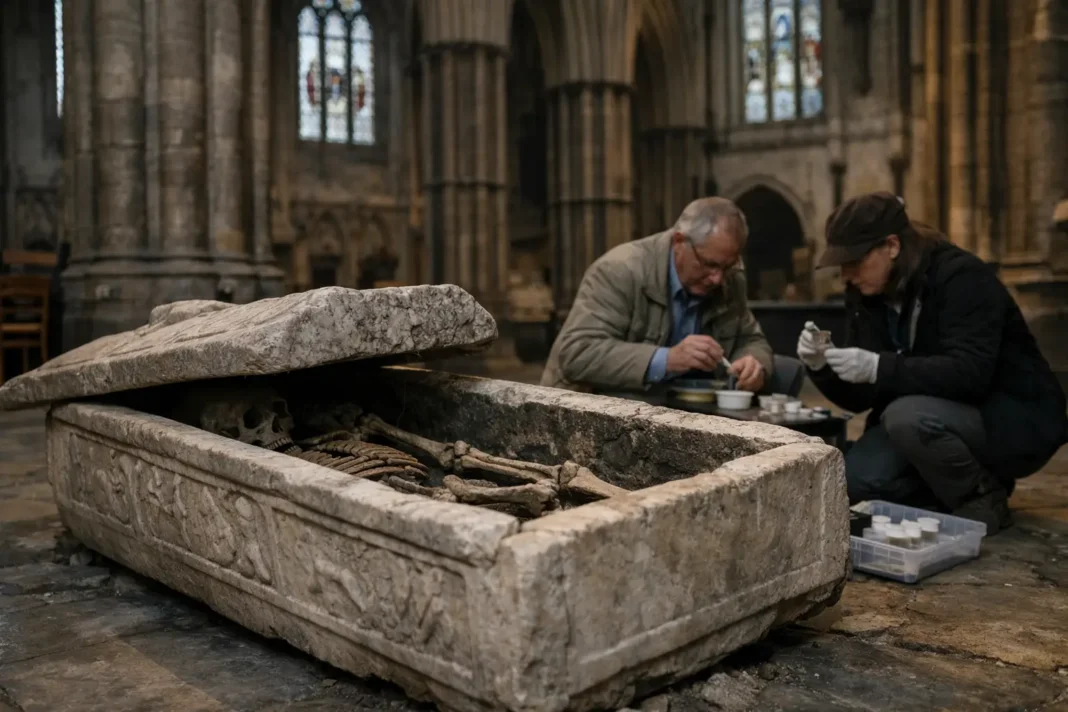

Mystery of a sarcophagus that blends Roman inscription and a medieval cross has been narrowed by new research to a likely 11th-century cleric. The stone coffin was found by masons at Westminster Abbey in 1869; its base bears a fourth-century Latin dedication to a Roman named Valerius Amandinus, while the lid was carved with a large Anglo-Saxon cross. When conservators opened the reused Roman sarcophagus for work in 2016 they uncovered a largely complete skeleton, reigniting questions about who was interred there and why a Roman coffin was recycled.
The skeletal analysis recorded that the individual was male, of average stature and middle age, with evidence of osteoarthritis, two healed rib fractures and signs consistent with gout. Post-mortem disturbance included damage to the skull and mixed limb bones, complicating reconstruction. Radiocarbon dating placed the remains between 987 and 1052, establishing a clear medieval date for the burial. These findings were outlined in a recent study by the abbey’s consulting archaeologist, Warwick Rodwell, and the osteological report prepared by bioarchaeologist James Langthorne.
Rodwell’s assessment uses burial context, dating and the absence of grave goods to propose that the occupant was almost certainly an abbot entombed with ecclesiastical dignity. By comparing the death window with known holders of the abbacy, he reduced the list of plausible candidates to two men who served at Westminster in the late 10th and early 11th centuries: Ælfwig and Wulfnoth, noting that an earlier abbot, Wulfsige, left to take up a bishopric and is therefore a less likely match. The Roman inscription, which records a dedication by sons to Valerius Amandinus, and the coffin’s Oxfordshire limestone point to a complex biography for the monument long before its medieval reuse.
Many questions remain unresolved: the reasons for selecting a fourth-century coffin for an 11th-century burial, the original findspot and whether additional Roman-era funerary material survives nearby. The sarcophagus itself is now on public view in the Queen’s Diamond Jubilee Galleries, where researchers and visitors can examine an object that links late Roman London with the ecclesiastical landscape of the early Middle Ages. The study, published in the Journal of the British Archaeological Association, frames the tomb as an exceptional case of cross-period reuse that prompts further archaeological investigation in the vicinity of the abbey.






