
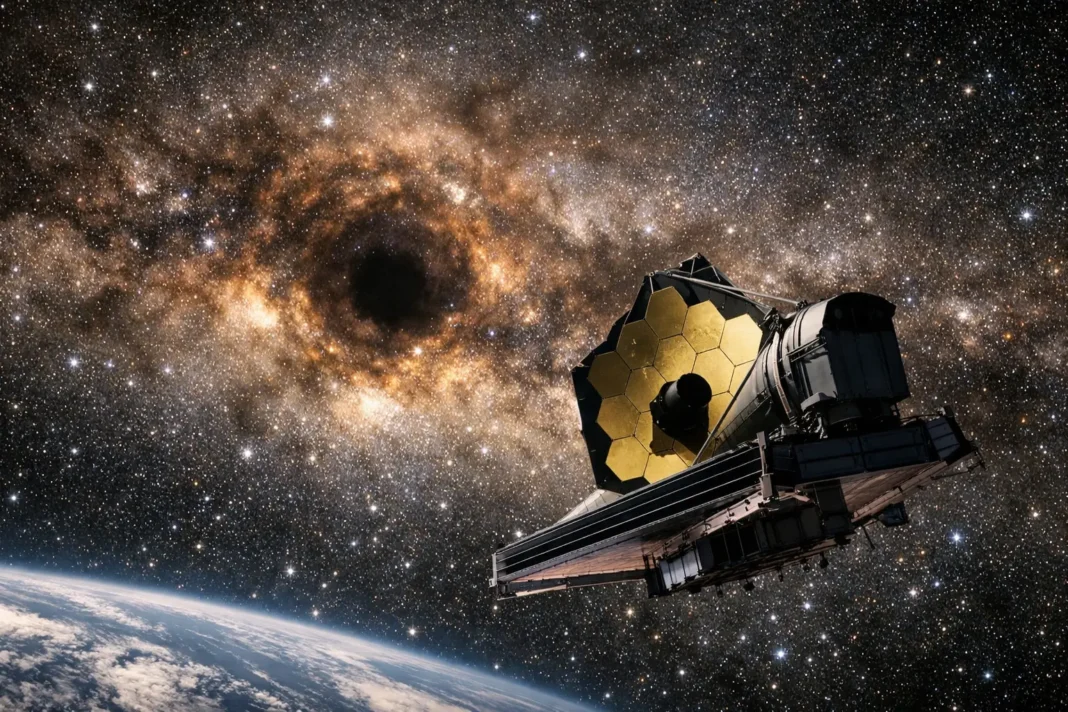

New infrared observations from the James Webb Space Telescope have identified a reservoir of metal-enriched gas close to Sagittarius A*, the supermassive black hole at the heart of the Milky Way. The study finds elements heavier than hydrogen and helium present in emission from several gas clouds, a composition consistent with material expelled by nearby dying stars. The results were published on Oct. 19 in The Astronomical Journal, following earlier related work in The Astrophysical Journal.
Nicole Ford, a doctoral researcher at McGill University, and colleagues interpret the chemical signature as evidence that supernovae enriched the central parsec, dispersing metals into the interstellar medium. The detected gas exhibits a composition similar to that of several stars orbiting close to the centre, suggesting a shared origin or formation epoch. Team members emphasise that mapping the available gas and dust chemistry is a key step toward explaining why Sagittarius A* currently feeds at a much lower rate than many other known galactic nuclei.
The observations were obtained by JWST while operating near the Sun–Earth L2 point, where its infrared instruments can isolate heat and spectral signatures from the crowded galactic centre. By resolving specific emission features, the telescope distinguished heavy-element lines in the gas without relying on starlight alone. Those spectral measurements allow researchers to compare gas abundances with stellar compositions and to trace the likely contribution of local supernovae to the enrichment of the central region.
Beyond local implications, the findings bear on broader questions about how metals are distributed around supermassive black holes in other galaxies and how such processes contributed to the inventory of elements available during planet formation. At the same time, the team notes that metal-rich clouds change how quickly gas cools, complicating efforts to use gas chemistry as a straightforward proxy for past black hole activity. Continued JWST monitoring and complementary observations will be needed to refine models of accretion and chemical evolution in the galactic nucleus.






