
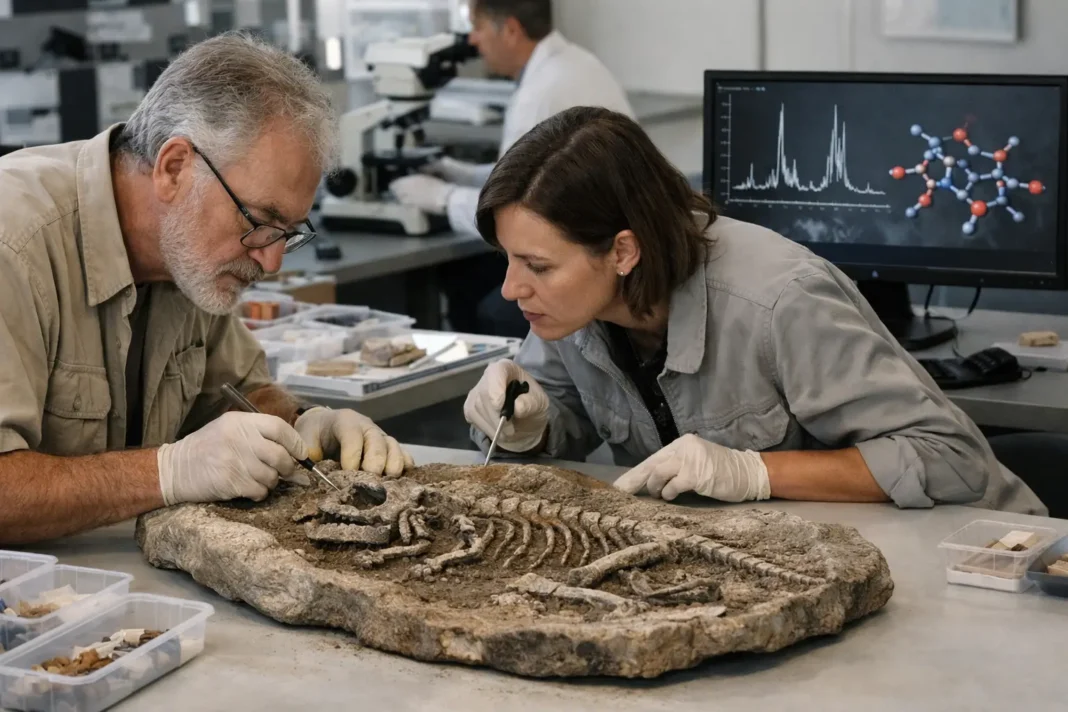

A Brazilian dinosaur fossil may preserve some of the oldest chemical traces linked to blood ever identified in a dinosaur, a new study argues. Researchers examining limb bones from Aratasaurus museunacionali, a small theropod that lived around 115 million years ago, identified microscopic structures resembling red blood cells together with chemical signatures associated with heme, the iron-bearing component of hemoglobin.
The work, published in PNAS, adds a new layer to the study of exceptional fossils. Rather than relying only on bone shape or skeletal anatomy, the team used microscopy, mineralogical analysis and molecular geochemistry directly inside the fossilized bone. The specimen comes from Brazil and belongs to a roughly three-metre-long theropod, part of the broader group of mostly two-legged carnivorous dinosaurs that also includes better-known predators such as Tyrannosaurus rex and Velociraptor.
Kliti Grice, a professor in the School of Earth and Planetary Sciences at Curtin University, and her colleagues did not set out simply to look for fossilized blood. Their broader question was how much original biological information can survive fossilization. Inside vascular canals, the channels that once carried blood vessels through bone, they found numerous tiny structures whose size, position and chemistry led them to propose a blood-related origin.
The researchers link the preservation to the burial environment after the animal’s death. They suggest the carcass was rapidly covered by sediment in low-oxygen conditions and in the presence of microbial mats, thin layers of microorganisms that can alter decomposition. The red-blood-cell-like structures were mineralized with hausmannite, a manganese oxide mineral, a process the team says may have stabilized or replicated delicate biological forms before they disappeared. The fossil also contained amino acids associated with collagen, the structural protein found in bone.
The interpretation remains contested within paleontology. Mary Schweitzer, a molecular paleontologist at North Carolina State University who was not involved in the study, welcomed the molecular approach but was not persuaded that the structures are remnant red blood cells. She noted that red blood cells in birds and reptiles typically retain nuclei, producing a visible bulge, while the reported structures appear more concave and smaller than expected. The study therefore strengthens interest in molecular evidence from deep time, while leaving a central question unresolved: how confidently scientists can identify altered biological traces after more than 100 million years.






