
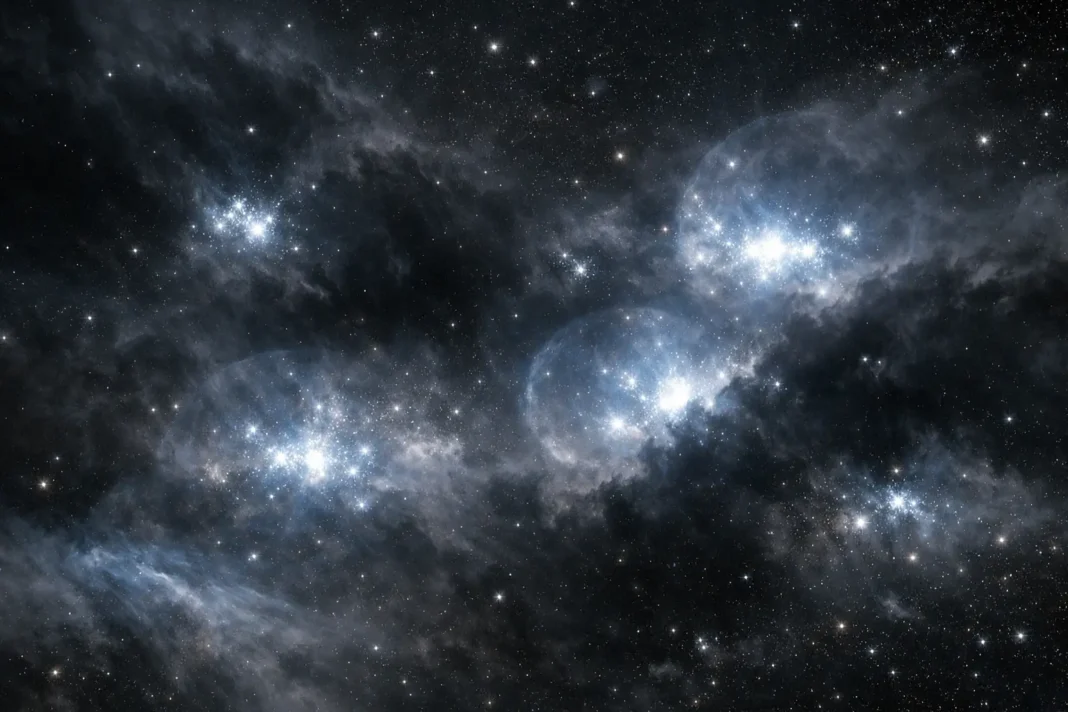

A new study is challenging a central assumption about how the early universe became transparent. Research published on Oct. 15 in Nature Astronomy indicates that supernovas may not have cleared the primordial hydrogen fog during the Epoch of Reionization. Instead, the explosive deaths of massive stars appear to have reduced the escape of ionizing ultraviolet light in the galaxies examined, shifting attention back to the intense radiation and winds from very young stars.
The question lies at the heart of modern cosmology. About 400,000 years after the Big Bang, the universe cooled enough for atoms, mostly hydrogen, to form. That neutral hydrogen absorbed ultraviolet radiation and left space opaque across vast distances. Reionization began when the first generations of stars and galaxies produced enough energetic light to split hydrogen atoms back into protons and electrons, allowing light to travel freely through intergalactic space.
The team, led by Cody Carr of the University of Michigan, used the Hubble Space Telescope to study six compact, star-forming galaxies about 3.5 billion light-years away. These systems serve as nearby analogues for conditions in the young universe. Each is less than about 6,500 light-years across and forms roughly 10 solar masses of stars per year, a rate several times higher than that of the much larger Milky Way.
The galaxies’ spectra allowed the researchers to trace the speed, direction and composition of winds driven by young stars and later by supernovas. The observations point to a two-stage process. During the first three million years of intense star formation, winds from newly formed massive stars cut channels through surrounding gas and dust at nearly 2,000 miles per second, or 3,000 kilometers per second. Through those openings, Lyman continuum photons could escape and ionize hydrogen beyond the galaxies.
After roughly three million years, the picture changed. Short-lived O-type stars ended their lives as supernovas, adding material to the surrounding gas and dust and strengthening large-scale galactic winds. In the studied sample, the oldest galaxies with the fastest supernova-driven winds let the least ionizing radiation escape. The result conflicts with many cosmological simulations in which supernova winds increase the escape of such radiation. Further observations, across more galaxies and additional wavelengths, will be needed to determine how widely this pattern applies to the early universe.






