
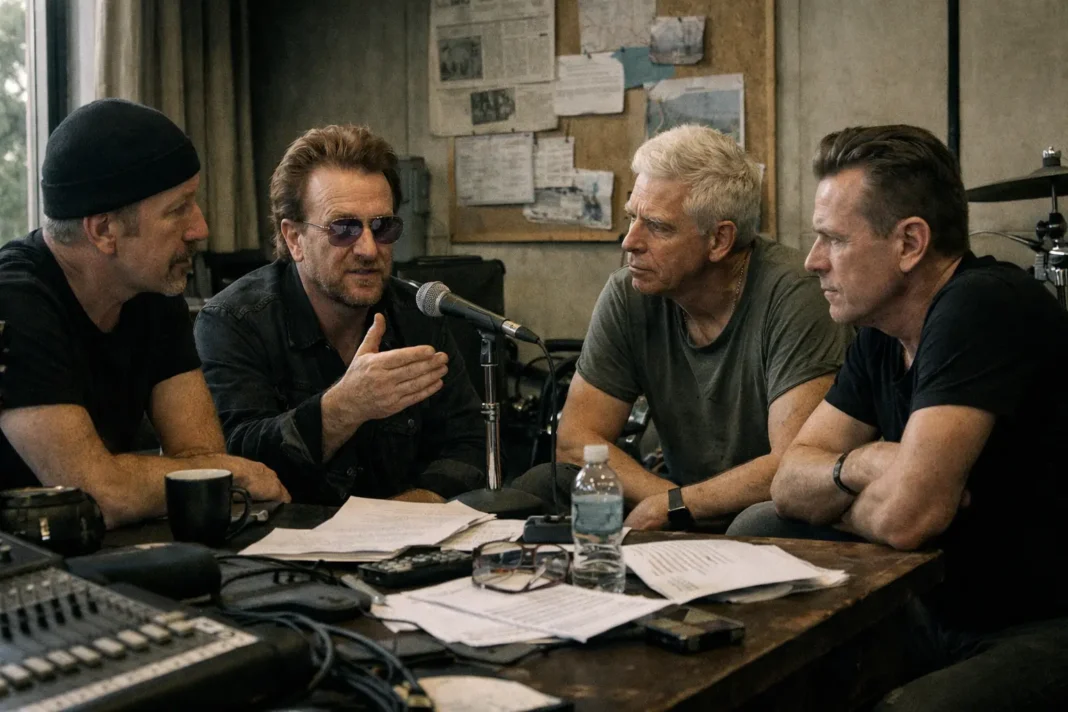

Five decades after forming, U2 remain a rare case in contemporary music: a band still defined by its original collective identity, still operating at global scale, and still willing to frame a record as part of a larger conversation. Their new album, Carnaval de Luz, arrives with questions that go beyond sound and chart performance. For Bono, The Edge, Adam Clayton and Larry Mullen Jr., the milestone is also a test of how a long-running group navigates ego, age, public expectation and a political environment they describe as markedly changed.
The setting for their latest interview was La Petite Maison in Nice, a restaurant known for drawing prominent figures from music and film. Its familiarity to the band is not only social. Bono was there on Bastille Day in 2016, the night of the terrorist attack on the Promenade des Anglais that killed 86 people. He has recalled taking cover inside the restaurant, while its founder, Nicole, remained in place. The memory gives the conversation an additional weight: U2’s long-standing public engagement has often been shaped by moments where private life and public trauma collide.
Carnaval de Luz is being discussed after a period in which the group’s recent albums have drawn more mixed reactions than the landmarks that established their reputation. That makes the project significant not simply as another release, but as a measure of whether U2 can reassert artistic momentum while retaining the communal discipline that has kept the band intact. Their reflections on male egos and internal democracy point to one of the less visible elements of their longevity: the need to keep decision-making collective in a business built to reward individual dominance.
The album conversation also includes an unexpected creative connection with Dolly Parton, underlining U2’s continued willingness to reach beyond the boundaries usually assigned to rock bands of their generation. That breadth has long been central to their public identity, from stadium-scale performance to political advocacy. Yet the emphasis now appears less triumphal than pragmatic. The band’s comments on democracy, Donald Trump and a world they see as increasingly authoritarian place their music within a broader debate about civic trust, without turning the album into a simple political slogan.
What emerges is a portrait of a band trying to reconcile endurance with adaptation. U2’s faith in humanity, a recurring theme across their career, is not presented as naive optimism but as a working principle: something tested in the studio, in public life and within the band itself. At the 50-year mark, their relevance depends less on nostalgia than on whether that principle can still produce music that feels necessary in the present.







