
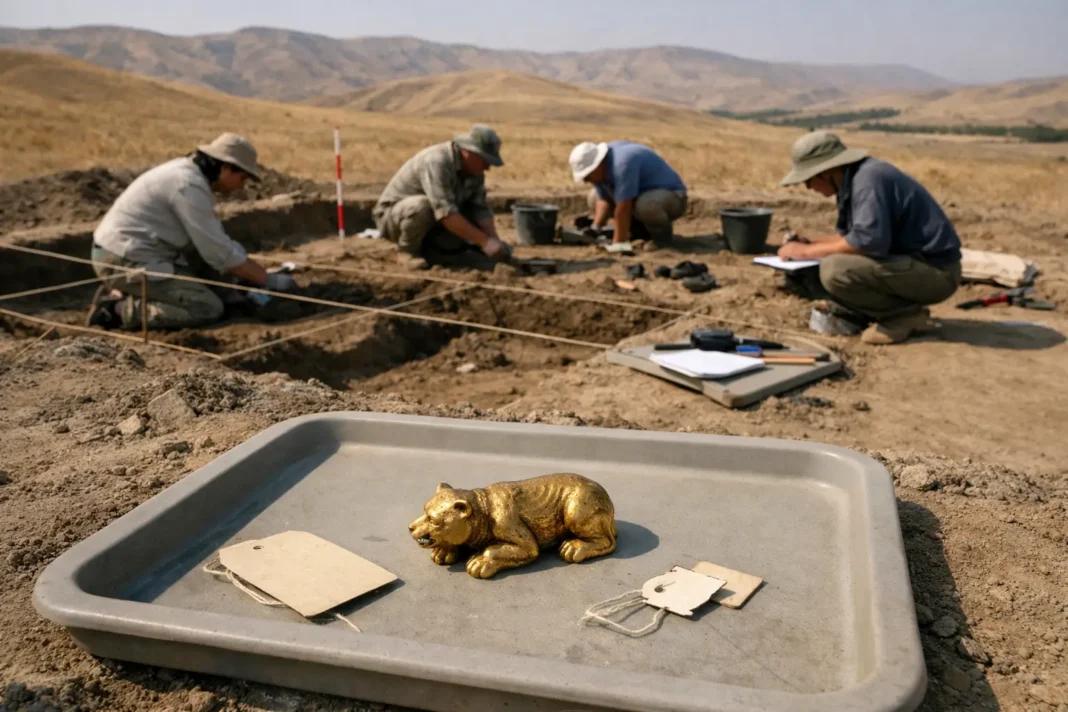

A gold bear figurine discovered in southern Kazakhstan is drawing renewed attention to the burial practices of the Saka, the Iron Age nomads who moved across the Eurasian steppe more than two millennia ago. The artifact was unearthed at the Karagaily burial ground in Almaty, inside a mound that had been disturbed by looters but not fully stripped of its contents. The find was announced by the Almaty city administration, which released details from the excavation.
The small gold ornament shows a bear standing upright and holding a vessel-like object between its front paws. Openings at the base indicate that it was probably attached to a headdress, a form of elite adornment known from other Saka-period graves in the region. Specialists involved in the work describe the figure as unique within Kazakhstan’s archaeological record: while other gold animal motifs have emerged from local burial sites, no comparable bear has previously been documented. The object dates to roughly 2,200 years ago, placing it in the fourth to third centuries B.C.
The excavation was carried out by the Almaty Museums Association, whose director, Lyazzat Sagyndykova, emphasized the cultural significance of the discovery for understanding contacts across Eurasia, from the Black Sea area to the Altai. The Saka are associated with mobile horse-riding communities of the Early Iron Age, and their graves often contain highly worked gold ornaments, weapons and ceremonial items. In Kazakhstan, famous examples include the richly furnished “Golden Man” burial and other headdress elements shaped like animals, reflecting a visual tradition in which animal imagery played a central role.
The gold bear was not the only unusual feature of the mound. Excavators also recovered a notably high quantity of human bones for a single burial structure of this size. The mound measures about 2.4 meters high and 26 meters across, and preliminary assessments suggest it may have contained the remains of four adults and three children. Marat Mugalovich Nurpeisov, a senior researcher with the museum association, noted that comparable mounds in Kazakhstan more commonly held one or two people, making the Karagaily burial especially significant for future study.
Fragments of Saka pottery were also found, many of them displaced after an ancient looting episode that left a pit about 3 meters deep. Research at Karagaily is continuing, with further anthropological analysis planned to clarify the number of individuals buried there and the circumstances of the interment. Once investigations are complete, some of the artifacts are expected to enter the collection of the Almaty Museum, adding a rare object to the public record of archaeology on the Eurasian steppe.





