
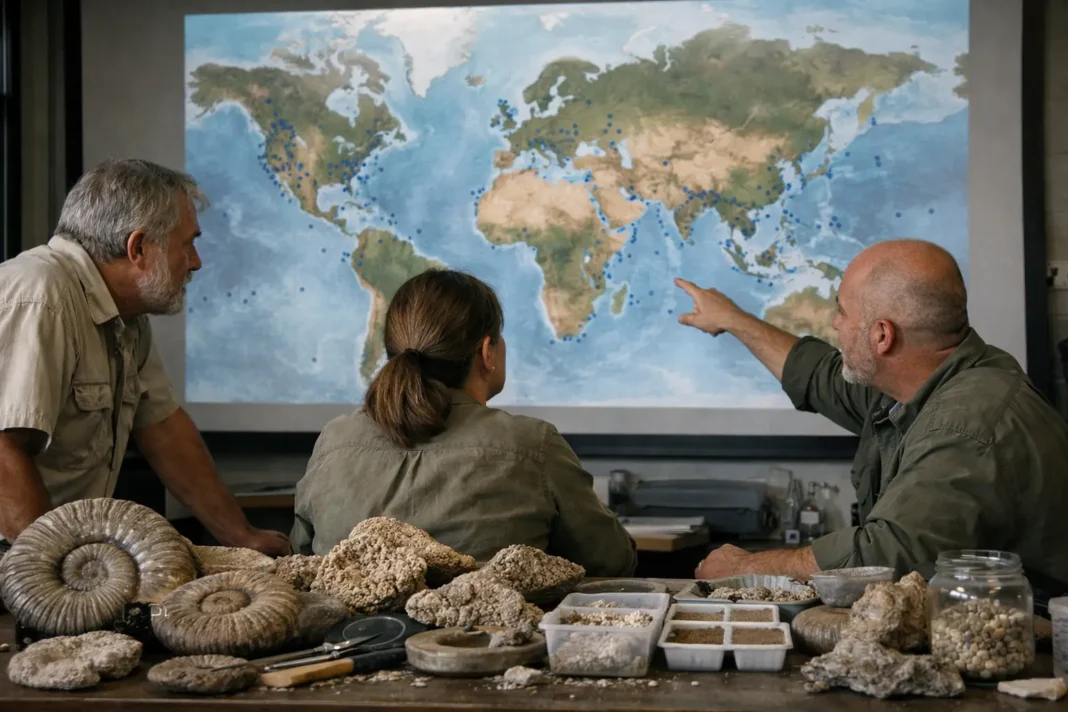

Earth’s marine past remains far less complete than the scale of the fossil record might suggest. A sweeping analysis covering 540 million years of marine fossils has identified major blind spots in scientific knowledge of prehistoric life, showing that many unknown species may still be waiting in regions and rock layers that have received limited attention.
The work highlights a central challenge in paleontology: the fossil record is not only shaped by biology, extinction and preservation, but also by where researchers have looked. Some areas rich in fossils have been studied repeatedly, while other promising regions remain comparatively unexplored. By bringing these gaps together in a global map, researchers have produced a tool designed to help future expeditions focus on places with the strongest potential to expand the known history of marine life.
One of the most striking findings is that the best opportunities are not confined to the most ancient rocks. The analysis indicates that relatively recent geological periods may still hold substantial evidence of species that have not yet been documented. That matters because the later fossil record is often assumed to be better understood than the deep past, when fewer organisms were preserved and geological processes had more time to destroy evidence.
The map’s value lies in its ability to turn absence into useful information. Gaps in collections can reflect erosion, inaccessible terrain or a lack of fieldwork rather than a true absence of life. Identifying fossil-rich but underexplored locations could make excavations more efficient and may help researchers build a more balanced view of how marine ecosystems changed over hundreds of millions of years.
For scientists studying Earth’s prehistoric life, the findings reinforce a cautious lesson: the known fossil record is a guide, not a finished archive. Future discoveries may not depend only on new technology or rare finds, but on directing attention to overlooked places where ancient seas left their traces and where the story of life on the planet is still incomplete.





