
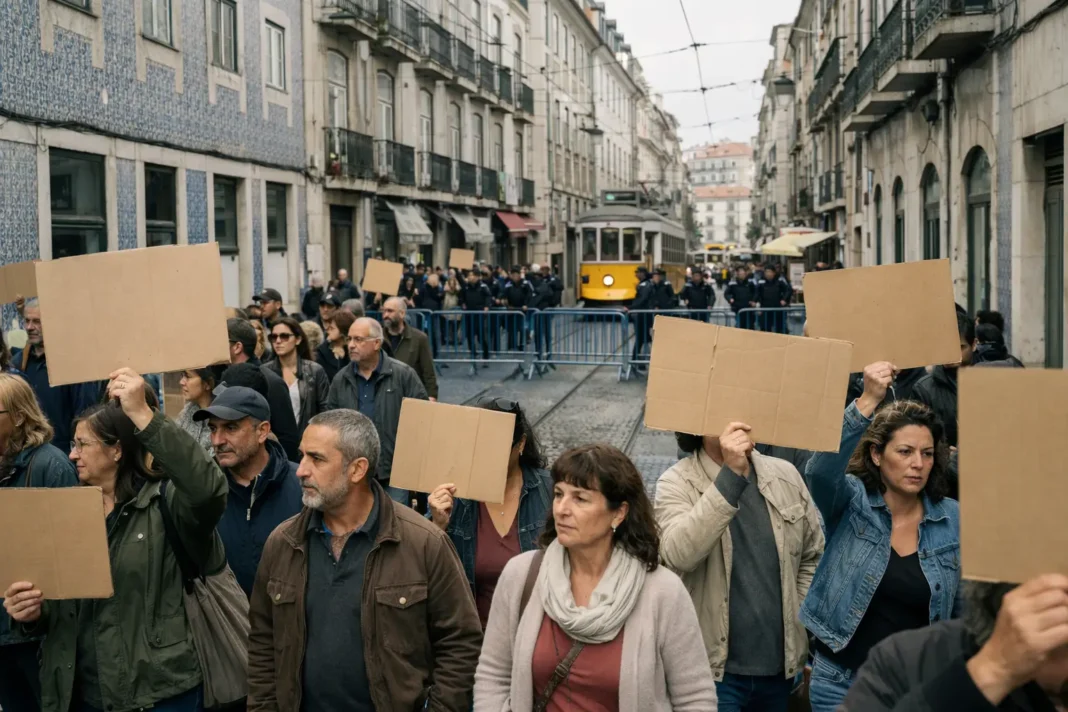

Portugal’s housing protests have become a sustained challenge for the centre-right government of Luís Montenegro, with encampments and daily demonstrations continuing in Lisbon and Porto nearly a month after they began on 14 October. The mobilisations have drawn thousands of people onto the streets and have remained visible despite severe disruption caused this week by Storm Charles.
The storm forced flight cancellations, school closures and the suspension of a full day of events at Web Summit in Lisbon, one of the city’s most prominent international gatherings. Yet the poor weather did not disperse protesters, who continued to occupy public space overnight. Their persistence has turned housing into one of the most pressing political issues facing Portugal, where rising costs have sharpened public concern over security, affordability and access to homes.
The demonstrations form part of a broader European cycle of frustration over housing. Spain, Germany and the United Kingdom have all introduced measures aimed at reinforcing renters’ rights, reflecting pressure from tenants and social movements in major cities. In Portugal, by contrast, the administration led by the Portuguese government has moved in a direction seen by opponents as giving landlords greater power. That contrast has helped fuel anger among protesters who argue that political choices are worsening an already strained rental market.
The scale and duration of the encampments have given the movement a significance beyond a single demonstration. Daily mobilisations in Lisbon and Porto have kept the issue in the public eye, while the overlap with international events has underlined the tension between Portugal’s global visibility and the pressures felt by residents. For the government, the challenge is not only to respond to street protest, but to address the wider perception that housing policy is failing to protect renters at a time when other European countries are moving to strengthen them.






