
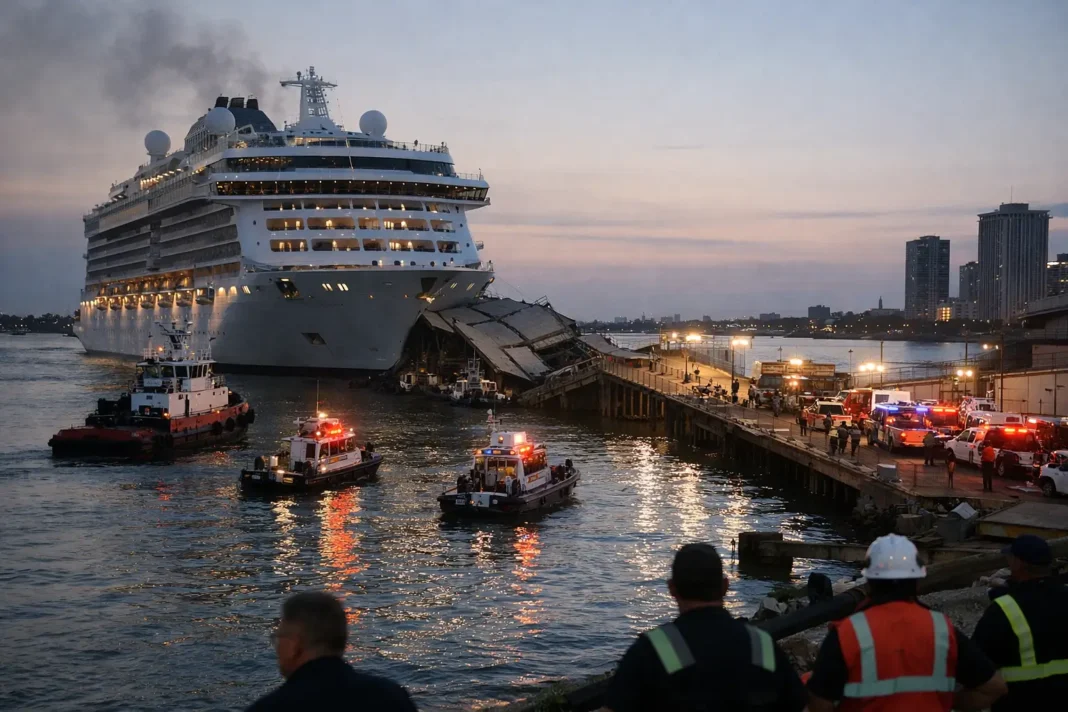

All passengers were rescued after a cruise ship collision in New Orleans, an outcome that prevented a serious maritime incident from becoming a mass-casualty emergency. Thirty-two people were taken to hospital with injuries described as non-critical, and no passenger was left unaccounted for after the response concluded.
The collision occurred on the Mississippi River, one of the busiest commercial waterways in the United States and a central route for tourism, freight and port operations in Louisiana. The presence of cruise traffic near an active urban port adds complexity to emergency planning, particularly where passenger vessels share the water with cargo ships, service craft and other river traffic.
New Orleans and maritime authorities routinely operate in an environment where navigation, weather, river conditions and vessel density can change quickly. While the immediate priority in this case was rescue and medical care, the incident also places renewed attention on cruise safety, evacuation procedures and coordination between vessel crews, emergency responders and river authorities. The U.S. Coast Guard is the federal body responsible for maritime safety and security on navigable waters, while local emergency services support rescue and medical response within the city area.
The absence of missing passengers significantly shaped the scale of the emergency. In passenger-vessel incidents, accounting for everyone on board is one of the most urgent tasks, as search operations can expand rapidly when even a single person remains missing. In this case, the confirmation that all passengers had been rescued allowed responders to concentrate on treatment, transport and the stabilization of the scene.
The incident leaves questions for investigators and operators, including how the collision occurred and what operational lessons may follow. No official findings on the cause have been established. For New Orleans, a city deeply tied to river transport and cruise tourism, the outcome avoided the gravest consequences but underlined the importance of safety systems on a waterway that remains both an economic artery and a public transport corridor.





