
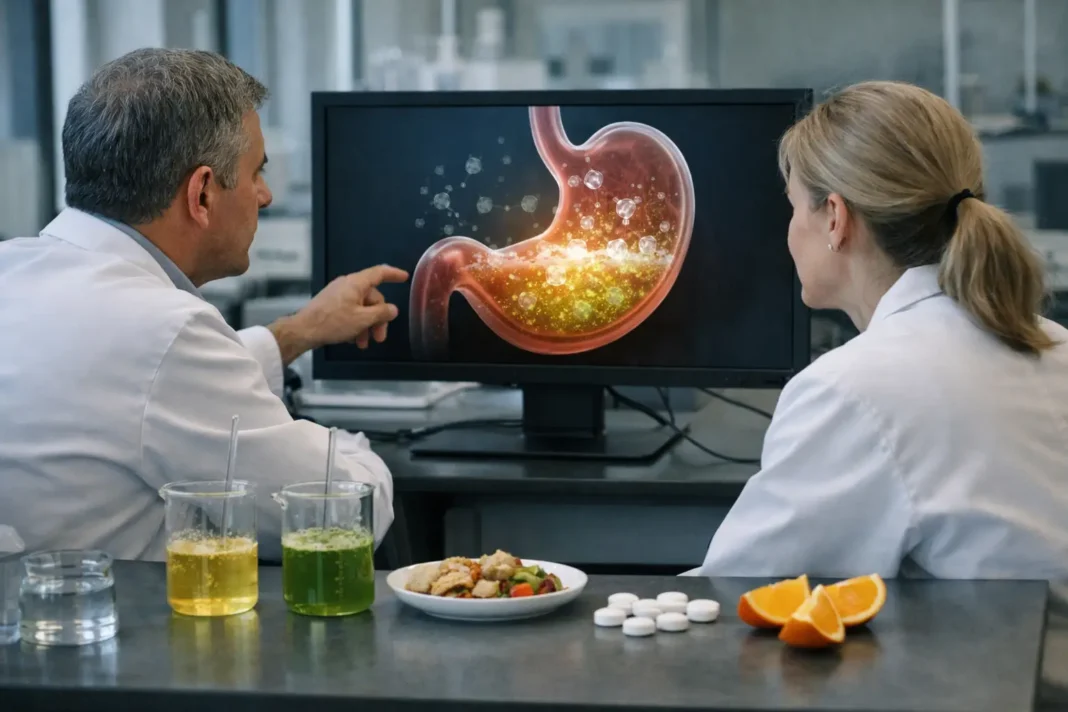

Vitamin C may help curb the formation of potentially harmful chemicals in the stomach after meals containing nitrates and nitrites, according to new scientific work based on a mathematical model. The finding points to a possible dietary strategy for reducing chemical reactions associated with cancer risk, while also underlining how much remains to be evaluated before practical health guidance can be defined.
The study focuses on what happens after foods containing nitrates or nitrites enter the stomach. These compounds are found in a range of foods and are also used in some processed products, particularly where preservation and color stability are important. Under acidic conditions, they can participate in reactions that produce N-nitroso compounds, a chemical family that has drawn attention because some members have been linked to cancer. The new model suggests that taking vitamin C after eating could reduce the likelihood of those reactions occurring.
The relevance of the work lies in its attempt to describe stomach chemistry with greater precision. Rather than testing a broad dietary pattern, the researchers used mathematical modelling to examine how vitamin C might interfere with chemical pathways triggered after a meal. Such models can help scientists identify mechanisms and refine future experiments, but they do not by themselves establish clinical outcomes. The result is therefore best understood as a step toward a clearer understanding of risk reduction, not as proof that a supplement prevents cancer.
Public health agencies already treat diet-related cancer risks as a complex field shaped by food composition, processing, overall eating habits and individual biology. The National Cancer Institute provides information on cancer prevention that emphasizes multiple risk factors rather than isolated nutrients, while the World Health Organization has long highlighted the importance of balanced diets in reducing noncommunicable disease risks. The new findings add a specific biochemical angle to that wider discussion on food safety and nutrition.
For consumers, the immediate takeaway is measured. The model suggests that vitamin C intake after meals containing nitrates and nitrites could limit the formation of certain undesirable compounds in the stomach, but it does not define an optimal dose, timing, or population-level recommendation. Further laboratory, dietary and clinical research would be needed to determine whether the predicted effect translates into a meaningful reduction in disease risk. Until then, the work strengthens scientific interest in how everyday nutrients can influence chemical processes that occur during digestion.





