
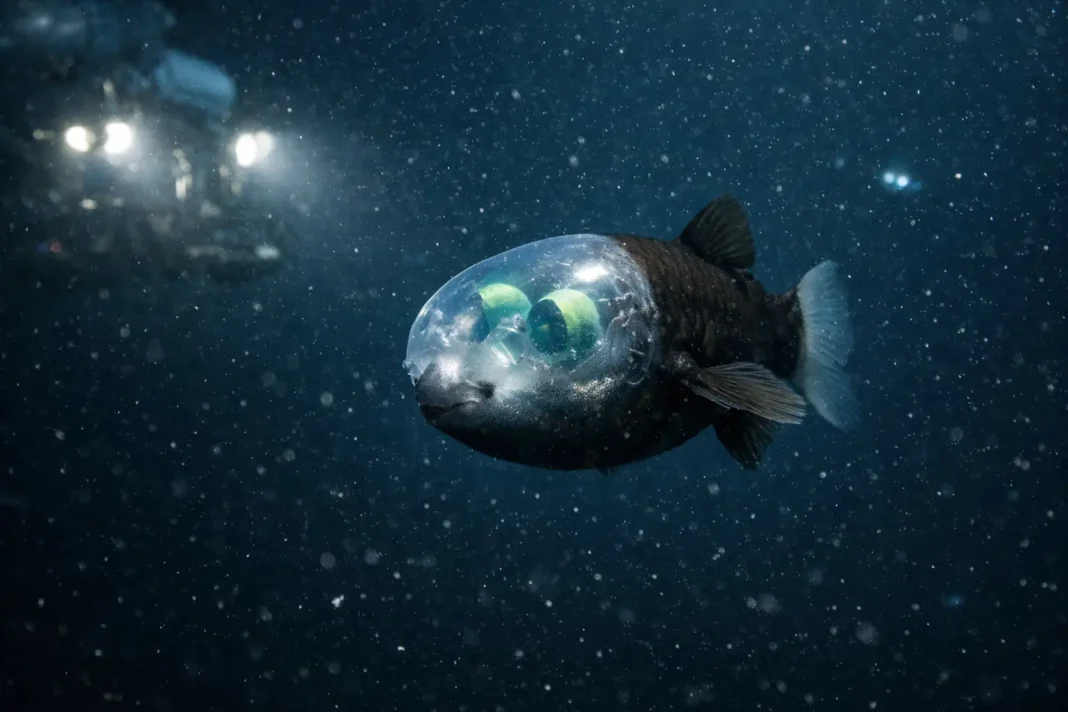

A rare deep-sea fish with a transparent head has been filmed in sharp 4K nearly 2,000 feet below the ocean surface, offering an unusually clear view of one of the ocean’s most distinctive visual adaptations. The animal, known as the barreleye fish, is rarely encountered alive because it inhabits a dark, remote layer of the sea that remains difficult to study directly.
The footage shows the fish’s dome-like head, through which its tubular eyes can be seen inside the fluid-filled shield. Those eyes are normally directed upward, allowing the animal to detect the silhouettes of prey against the faint light filtering down from above. When it moves to feed, the eyes can rotate forward, giving the fish a more direct view of its target. The transparent covering protects the eyes while preserving the field of vision needed in an environment where light is scarce and food is unpredictable.
The observation adds to the limited visual record of a species whose anatomy has long drawn interest from marine biology researchers. At depths close to 2,000 feet, human access depends on specialized deep-sea vehicles and cameras, and even brief encounters can help document behavior that preserved specimens cannot reveal. The latest 4K images are significant because fine details of the head, eye position and body movement are visible in a way that older or lower-resolution footage often could not capture.
The barreleye’s unusual form is not a curiosity detached from its habitat; it reflects the demands of life in the deep ocean. In the dim midwater zone, animals often rely on specialized eyes, transparency, bioluminescence or slow, efficient movement to survive. The fish’s upward-looking vision helps it search the water column above, while the ability to rotate its eyes forward supports feeding at close range. For scientists studying the deep sea, such footage provides a rare opportunity to connect anatomy with behavior in the animal’s natural environment.
Despite improvements in underwater imaging, the deep ocean remains among the least observed parts of the planet. Each clear recording of an elusive species strengthens the scientific record and helps explain how life persists under high pressure, low temperatures and minimal sunlight. The new images of the barreleye fish do more than display an unusual animal: they underline how much of the ocean’s biodiversity is still known through brief, technically demanding encounters far below the surface.






