
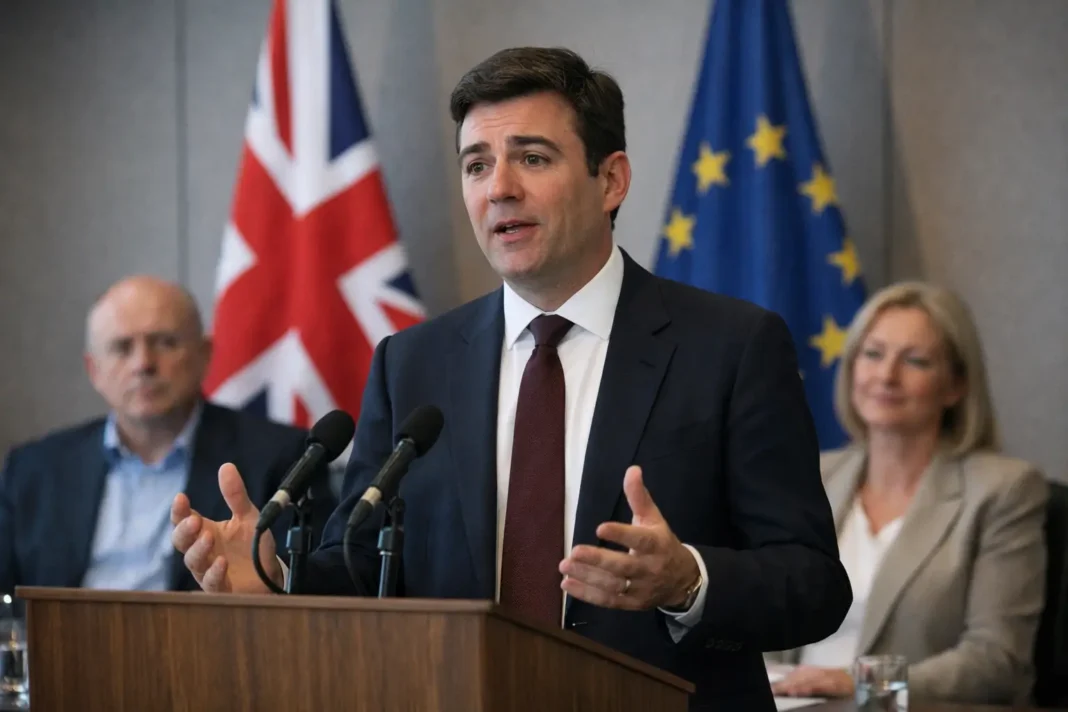

The latest agreement between the UK Government and the European Union has reopened the political conversation about how far Britain should go in rebuilding its post-Brexit relationship with the bloc. Andy Burnham said the deal reached on Friday should be treated not as an endpoint, but as a basis for exploring closer ties with Brussels in areas where shared rules and cooperation can reduce friction.
The agreement covers three politically and economically sensitive fields: British food exports, emissions trading and a youth experience scheme. Each area carries weight beyond its technical detail. Food exporters have faced additional checks and barriers since the UK left the EU’s single market arrangements, while emissions trading is central to climate policy and industrial competitiveness. A youth scheme, meanwhile, touches on the loss of easier movement for younger people after Brexit, even if it falls short of restoring the broader freedoms that existed before departure.
Burnham’s intervention is significant because it reflects a wider shift in the domestic debate. The question is no longer simply whether the United Kingdom should have left the EU, but how closely it should now align with its largest neighbouring market. For regional leaders, businesses and universities, practical cooperation with the European Union can have immediate consequences for investment, labour mobility, research, training opportunities and export costs. The new deal gives ministers a framework for addressing some of those issues without reopening the entire constitutional argument over EU membership.
The inclusion of emissions trading also gives the agreement a strategic dimension. Carbon markets influence the cost of production, energy policy and the treatment of imports from jurisdictions with different climate rules. Greater coordination could help limit competitive distortions, especially for industries exposed to both British and European regulation. For food and agricultural producers, improved access arrangements could reduce delays and increase predictability in trade, although the precise impact will depend on how the agreement is implemented.
For the government, the challenge will be to present closer cooperation as a pragmatic settlement rather than a reversal of Brexit. For EU institutions, any further steps will require safeguards that protect the integrity of the single market. Burnham’s message places pressure on both sides to test whether the new agreement can become a model for a more stable UK-EU relationship, built around specific sectors where mutual benefits are clear and politically manageable.






