
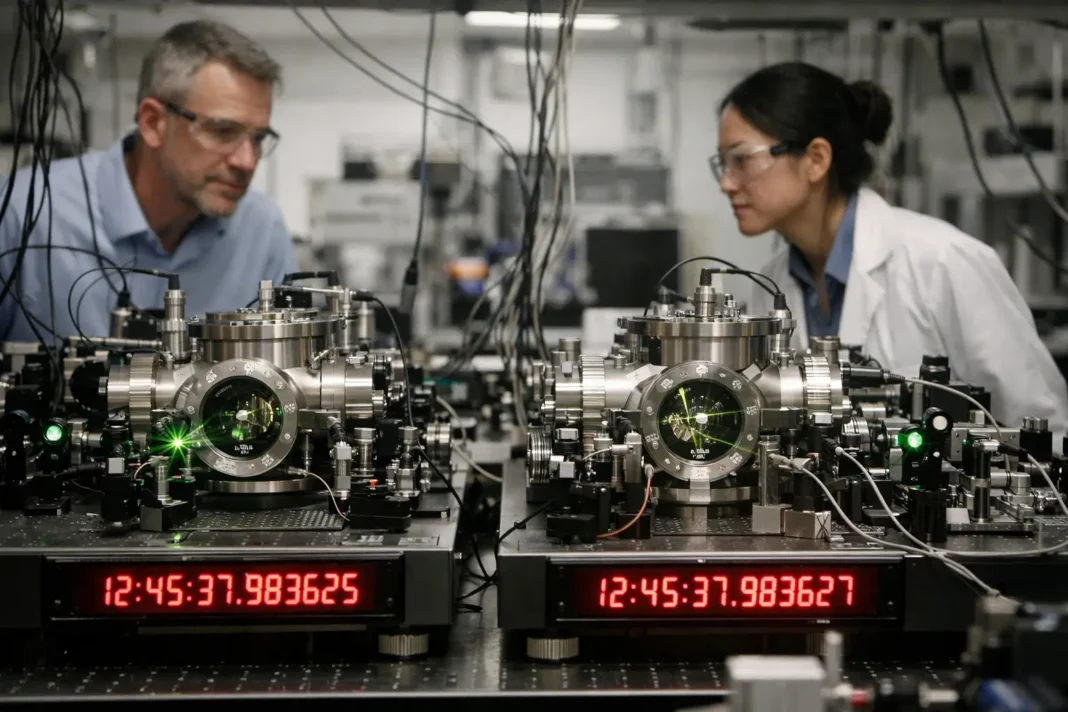

Time may be stranger than everyday experience suggests. Scientists have proposed a new way to test whether a clock can experience more than one flow of time at the same moment, a possibility rooted in the unsettled boundary between quantum physics and our understanding of gravity. The idea does not claim that such an effect has been observed. It sets out a possible experimental route for looking for it with instruments far more precise than ordinary timekeeping devices.
The proposal centers on atomic clocks, which measure time by tracking the stable frequencies associated with atoms. These devices already play a central role in precision science, navigation and tests of fundamental physics because they can detect extremely small differences in elapsed time. Researchers now argue that clocks with dramatically improved sensitivity could be used to search for a quantum effect in which time does not behave as a single, uniform background for a system under observation.
The question matters because modern physics treats time in two very different ways. In quantum theory, particles can exist in combinations of possible states until measured. In relativity, time is shaped by motion and gravitational conditions, causing clocks in different environments to tick at different rates. Bringing those ideas into one experiment raises a difficult possibility: under certain circumstances, a clock might be linked to multiple temporal rates at once. Detecting that would provide a rare laboratory signal from the interface between two well-tested but still incomplete descriptions of nature.
No such multiple-flow behavior has yet been recorded, and the challenge is one of sensitivity. Any signal would be expected to be extremely small, which is why the proposed test depends on next-generation atomic clocks rather than conventional instruments. The value of the approach lies in making an abstract question experimentally accessible. Instead of treating the nature of time only as a theoretical problem, the proposal identifies a measurement strategy that could confirm, constrain or rule out a specific effect.
If future experiments find evidence for clocks experiencing simultaneous flows of time, the result would carry consequences beyond timekeeping. It would influence how scientists frame the relationship between quantum behavior and gravitational effects, two pillars of physics that remain difficult to merge into a single framework. If the search finds nothing, that outcome would still sharpen the limits of current theories. Either result would make precision clocks more than tools for measuring seconds: they would become probes of what time itself may be.






