
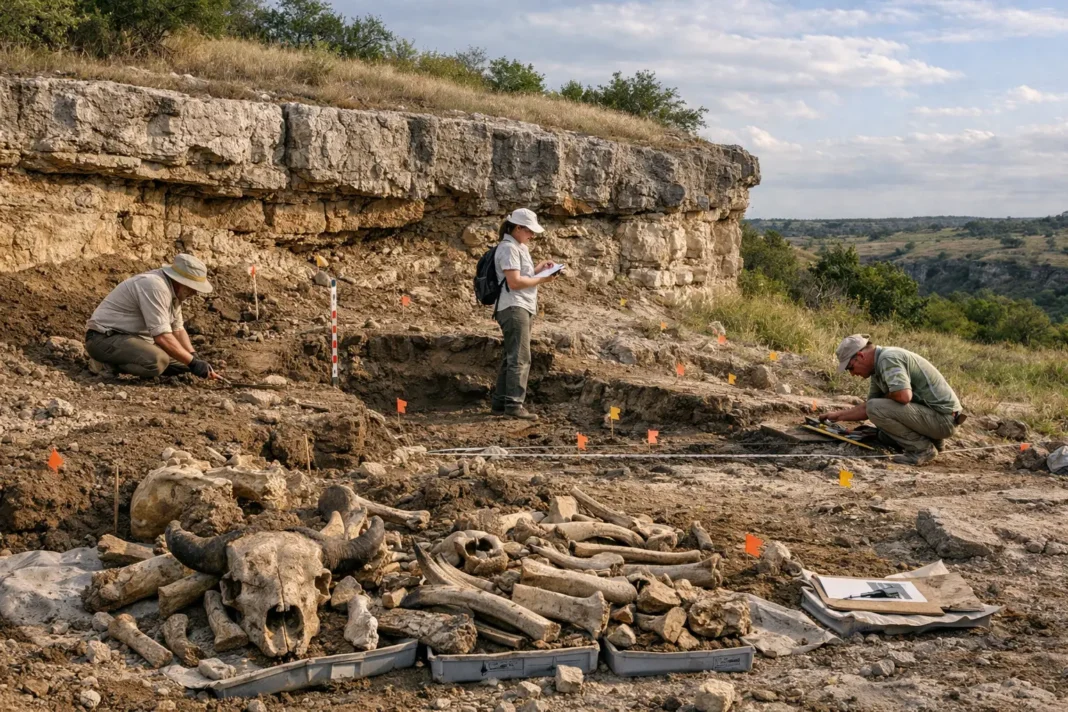

A Texas canyon has yielded rare evidence of an ancient hunting system used by Indigenous communities for roughly 3,000 years, expanding what archaeologists know about large-scale bison hunting in North America. The site, known as Nighthawk, lies in Caprock Canyons State Park in the Texas Panhandle and has been identified as a “bison jump,” a place where hunters drove herds over a cliff to secure large quantities of meat and other resources.
The discovery is significant because bison jumps have long been closely associated with the northern Plains, while evidence from the southern Plains has been scarce. In a study published in American Antiquity, researchers describe hundreds of bison bones found below a roughly 65-foot, or 20-meter, cliff spur. The remains, together with chipped stone tools, arrowheads and bones bearing cut marks, point to repeated hunting and butchery activity at the location.
Gus Costa, an archaeologist at Rice University in Houston and first author of the study, said the repeated use of Nighthawk indicates a lasting connection between people and the hunting facility. The site’s geography appears to have been central to its function: researchers concluded that bison could only have reached the bone bed by falling from above, as the surface is positioned between two cliffs. Rather than a sudden drop encountered during a stampede, the natural spur may have allowed hunters to funnel animals toward the edge in a controlled drive.
Radiocarbon dating indicates at least seven mass kill events between about 1550 B.C. and A.D. 1550. One event, labeled Kill 3 by the research team, accounts for most of the recovered bones and likely occurred around A.D. 300 to 400. Such a hunt would have required coordination among many people, underlining the social and logistical complexity behind prehistoric archaeology sites of this kind. The findings also show that knowledge of the location endured across long intervals, even though the kill events were separated by at least a century and, on average, about 500 years.
The Nighthawk evidence adds nuance to the history of Indigenous peoples and their relationship with bison on the southern Plains. In the northern Plains, mass bison hunts have often been linked to winter provisioning and pemmican production, but warmer conditions in Texas may have limited how long rendered fat could be stored. The study therefore raises broader questions about how large hunts functioned socially, including their possible role in alliance-building and demonstrations of collective capacity, while firmly establishing Nighthawk as a long-lived hunting landscape.






