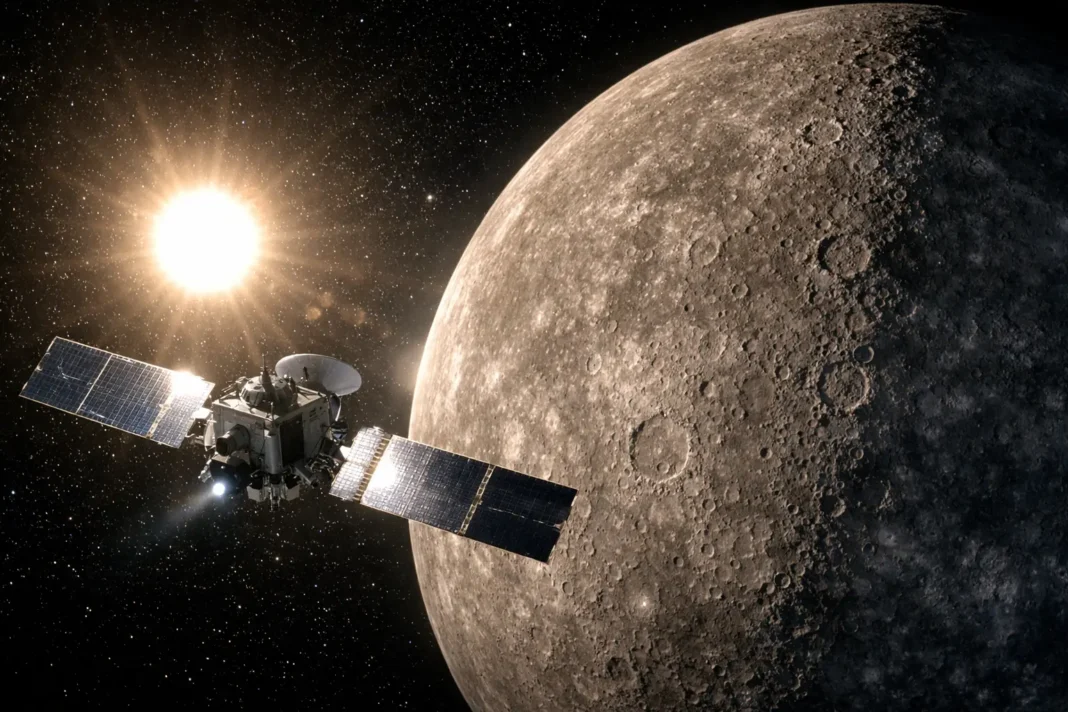

BepiColombo has arrived at Mercury, ending an eight-year journey through the inner solar system and placing a European-Japanese spacecraft in orbit around the closest planet to the Sun. Mission teams confirmed on Saturday, Nov. 21, that the spacecraft is in Mercury orbit and sending data to Earth. The milestone makes BepiColombo only the second mission to achieve orbit around the planet, after NASA’s MESSENGER spacecraft, which operated there from 2011 to 2015.
The arrival was not entirely straightforward. The European Space Agency stated that a software problem prevented the spacecraft from firing its thrusters for the full 37 minutes planned for the orbital insertion manoeuvre. The burn was needed to reduce BepiColombo’s speed as it approached Mercury. ESA is reviewing the effect on the spacecraft’s trajectory, while the mission remains safe and continues transmitting data to ground controllers.
BepiColombo is a joint project of ESA and the Japan Aerospace Exploration Agency. It consists of two orbiters currently travelling together: ESA’s Mercury Planetary Orbiter, known as MPO, and Japan’s Mercury Magnetospheric Orbiter, named Mio. Launched on an Ariane 5 rocket in October 2018, the mission followed a complex route past Earth, the Moon, Venus and Mercury itself, using repeated gravity-assist flybys to manage its speed in the Sun’s strong gravitational environment.
That long route reflects the difficulty of reaching Mercury, which lies about 58 million kilometres from the Sun, roughly one third of the Earth-Sun distance. Spacecraft heading inward are accelerated by solar gravity, so they must shed energy carefully to avoid missing their target or being pulled off course. BepiColombo passed Mercury six times before orbital arrival, including a January 2025 flyby that produced close images of the planet’s north polar region. The mission now enters a preparation phase before its main science campaign at one of the least explored worlds in the solar system.
If the post-arrival checks allow the plan to proceed, MPO and Mio are expected to separate in early December. Mio will move into a highly elliptical polar orbit, while MPO will spend several more months refining its path before reaching a lower, more circular polar orbit in March 2027. Science operations are planned to begin in April. Together, the two spacecraft will study Mercury’s surface, interior, magnetic field and surrounding environment across multiple wavelengths, including X-rays, gamma rays and ultraviolet light. The data are expected to help researchers investigate the planet’s formation, its unusual magnetic field, possible tectonic activity and tests of general relativity through precise tracking of the spacecraft’s orbit.