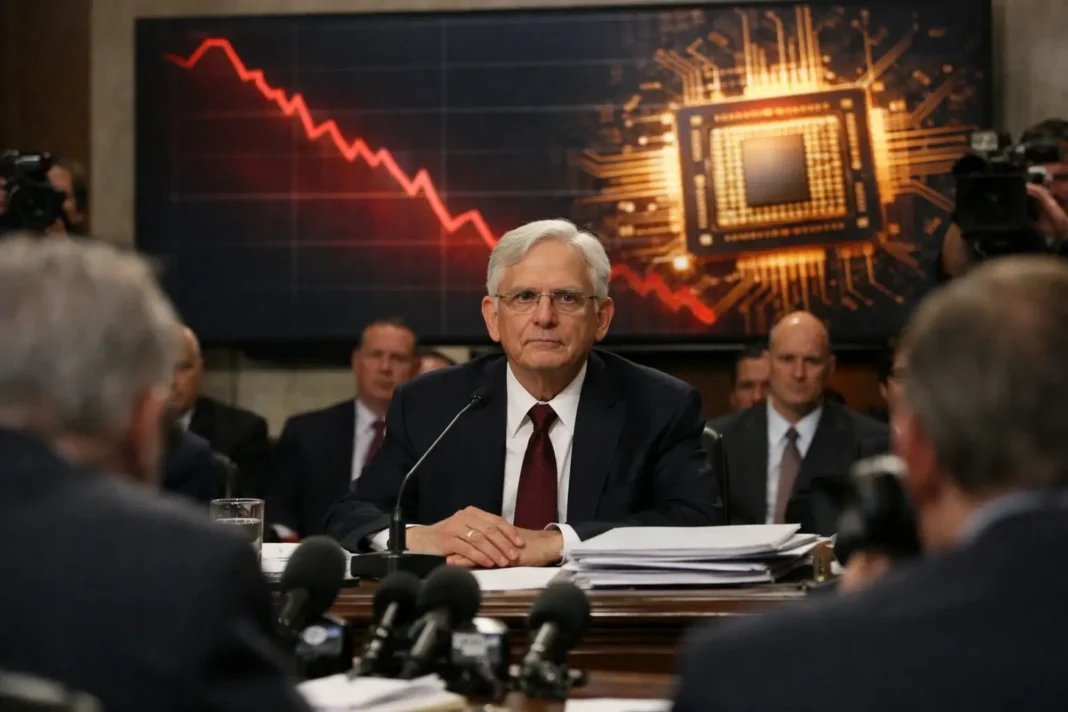

Nvidia’s market pressure intensified after the U.S. attorney general avoided questions about an investigation involving the chipmaker, while lawmakers sought clarity over President Donald Trump’s involvement in Huang’s reinstatement. The company’s share price fell 7%, a sharp move for one of the most closely watched names in the technology sector and a signal that political scrutiny can quickly translate into investor concern.
The case places Nvidia at the intersection of corporate governance, market confidence and public oversight. The company has become a central actor in the global semiconductor industry, with its valuation closely tied to investor expectations around advanced computing and artificial intelligence. Against that backdrop, even limited public information about an investigation can carry significant weight, particularly when elected officials are pressing for answers and the executive branch is being drawn into the discussion.
The refusal by the attorney general to engage directly with questions adds to the political sensitivity of the matter. The U.S. Department of Justice occupies a central role in federal law enforcement, and its public posture in high-profile corporate matters is closely monitored by markets, lawmakers and legal observers. When questions concern the possible role of a sitting president, scrutiny extends beyond a single company and touches broader issues of transparency and institutional accountability in the United States.
Lawmakers’ demand for answers focuses on Donald Trump and his alleged involvement in Huang’s reinstatement, a point that remains politically consequential because it links a corporate matter to presidential influence. No additional details have been established in the available information, and the key facts remain limited: an investigation is drawing questions, the attorney general has not provided direct answers, lawmakers are seeking clarification, and Nvidia’s stock has dropped 7%.
For investors, the immediate consequence is uncertainty. A share-price decline of that size reflects concern not only about the facts already known but also about what remains unresolved. For policymakers, the episode highlights the importance of clear lines between corporate decision-making, federal oversight and political power. Until more verifiable information emerges, the matter remains defined by unanswered questions and a market reaction that shows how quickly governance issues can affect even the largest technology companies.