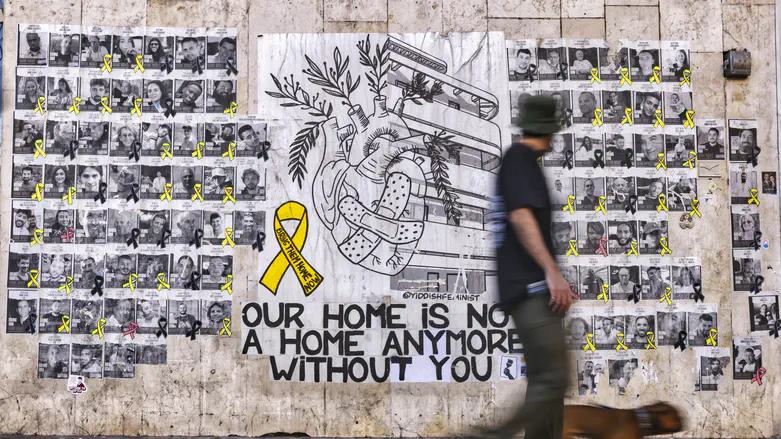
HomeIsraelExperts link hostage families’ suffering to newly defined wartime trauma

Experts link hostage families’ suffering to newly defined wartime trauma


A new peer-reviewed study published in the Psychological Trauma: Theory, Research, Practice, and Policy journal of the American Psychological Association presents groundbreaking findings on the psychological toll faced by families of hostages abducted during the October 7 attacks.

The study, authored by Dr. Einat Yehene and Shir Israeli of the Academic College of Tel Aviv-Yaffo, together with Prof. Hagai Levine of the Hebrew University of Jerusalem and Hadassah Medical Center, introduces the concept of “Dynamic-Static Ambiguous Loss” – a new framework describing how hostage families live in constant emotional flux while trapped in uncertainty.

Titled “The Trauma of Mass Kidnapping and Ambiguous Loss: A Socio-Ecological Framework from the Lived Experience of Israeli Hostage Families,” the research explores how mass kidnappings represent a modern tactic of war and terror with far-reaching consequences extending from individuals to entire societies.

The authors explain that mass hostage-taking produces trauma that is both deeply personal and collective, affecting not only families but also the wider social fabric. The findings offer policymakers and mental health professionals an evidence-based model for addressing trauma that spreads from individuals to the socio-political sphere. According to the study, addressing this trauma requires rebuilding trust, transparent communication, and continued state commitment to securing the hostages’ return.

The research highlights how families of hostages endure a complex reality marked by overlapping emotional, physical, and social struggles. They must navigate private trauma amid national turmoil, often feeling abandoned by the state. Their lives are suspended in an ongoing cycle of hope and despair, with each new report, rumor, or video reigniting uncertainty. Many have turned into tireless advocates for their loved ones, finding purpose but also suffering exhaustion and loss of identity.

The shared ordeal has also fostered powerful solidarity among hostage families, creating a community of mutual support that sustains advocacy efforts and emotional resilience. Yet the toll remains immense, with widespread anxiety, depression, and physical illness disrupting daily life. Families maintain symbolic bonds with their captive loved ones through public messages and rituals, striving to preserve their presence.

Dr. Yehene said the study provides a vital framework for understanding trauma beyond the individual level. “It offers a universal language to describe the profound and destabilizing trauma of mass hostage-taking,” she said. “Understanding this as a collective, multi-layered trauma is essential for developing effective humanitarian and mental health responses.”

Prof. Levine added, “Our findings bring evidence to our hypothesis that massive hostage-taking is a public health emergency. Healing cannot begin until all hostages, both those alive and those deceased, are released.”



Source link

Advertisementspot_imgspot_img

Hot this week

From Studio Peak to Hospital Ward: How James Ford Turned Illness into an Album

Producer James Ford, known for work with Arctic Monkeys and Klaxons, confronted leukaemia and created new music from his hospital bed.

Edinburgh Fringe Embraces Explicit Comedy as Performers Push Boundaries

At the Edinburgh Fringe a wave of explicit comedy—from Julian Clary to street typists—questions conventions and draws engaged, often startled audiences.

Root’s comeback as captain sparks clinical England bowling at Headingley

Joe Root's second stint as Test captain begins as England dismiss Pakistan for 171, led by five-wicket hauls from Robinson and Tongue.

Three Clear Ways AI Is Reshaping Work, Health and Security

AI is transforming labor markets, healthcare delivery and geopolitical dynamics, prompting regulation and new institutional responses worldwide.

Bus strikes in London underline risks of working through extreme heat

Arriva bus drivers stage stoppages as soaring temperatures expose dangers for frontline workers and test workplace protections.

IBM unveils modular ultracold systems to scale fault‑tolerant quantum computing

IBM unveils modular ultracold cryogenic modules and superconducting links to connect quantum chips, aiming for fault‑tolerant machines by 2029.

A 17-year-old carer on missed milestones and hidden labour of youth care

A teenager's account highlights how unpaid caregiving in youth affects schooling, social life and future prospects.

Trump Warns of Severe Economic Penalties for Countries Aiding Iran

Donald Trump warned of 'tremendous economic consequences' for any country aiding Iran after a 60-day ceasefire expired, escalating diplomatic stakes.

Israel launches criminal probe after soldiers fired on car that carried child

Israeli military confirms soldiers fired at a vehicle carrying five-year-old Hind Rajab; a criminal investigation has been opened after her death with six relatives.

Heat Politics: Reform’s Message Forces a Choice Between Immediate Comfort and Long-Term Costs

Reform UK's deputy leader urged acceptance of recent heat, prompting debate on policy priorities amid wildfires, crop damage and emergency strain.

Root’s comeback as captain sparks clinical England bowling at Headingley

Joe Root's second stint as Test captain begins as England dismiss Pakistan for 171, led by five-wicket hauls from Robinson and Tongue.

Edinburgh Fringe Embraces Explicit Comedy as Performers Push Boundaries

At the Edinburgh Fringe a wave of explicit comedy—from Julian Clary to street typists—questions conventions and draws engaged, often startled audiences.

How Honeybees Balance Their Larvae’s Diet: A Hidden Nutritional Strategy

Research shows honeybees detect nutrient imbalances in pollen and process it into well-balanced provisions for their larvae.
Advertisementspot_img

Related Articles